
REVIEW · GOLDEN TRIANGLE TOURS
From Delhi: Private 3-Day Golden Triangle Tour with Hotel Options
Three days can feel like magic in India. This private Golden Triangle tour is built around door-to-door pickup and guided visits, so you can focus on the places instead of the planning headache. You’ll cover Delhi, Agra, and Jaipur with an air-conditioned vehicle, a uniformed driver, and a guide who helps the sights click.
I especially like two parts: the morning-feeling Taj Mahal visit with context from your guide, and the way Old Delhi is handled like a real route, starting with a rickshaw ride and then working through major landmarks step-by-step. You’re not just collecting photos, you’re learning how these places fit together.
One drawback to plan for: the schedule is packed, and the tour price does not include meals or entry tickets, so your total budget will be higher than the base rate.
In This Review
- Key highlights you will actually feel
- Price and Logistics: what the $80 includes, and what costs extra
- Day 1 in Delhi: from Gurudwara Bangla Sahib to Agra hotel check-in
- Day 2: Taj Mahal in early light, Agra Fort, then the Jaipur shift
- Day 3 in Jaipur: Hawa Mahal, Amber Fort views, and Jantar Mantar science
- The service level that makes it feel safe and easy
- What to bring and how to enjoy each day more
- Should you book this 3-day Golden Triangle tour?
- FAQ
- What’s included in the tour price, and what is not included?
- Are entry tickets and meals included?
- Will the itinerary change if I travel on a Friday?
- What if my trip includes a Monday?
- Can I customize the itinerary?
- What kind of vehicle will I ride in?
- Do I need to carry cash for tickets?
Key highlights you will actually feel
- Private guide at every major stop, not just a quick drive-by explanation
- Rickshaw ride in Old Delhi, plus spice-market time at Khari Baoli
- Taj Mahal extras included, like shoe covers and a golf cart to the entrance area
- Hotel upgrade options with breakfast, if you choose 4- or 5-star lodging
- Route changes for closures, like Friday Taj Mahal and Monday Red Fort/Lotus Temple
- High-touch service with a responsive operator and careful, safety-first driving in the way it’s described
Golden Triangle itineraries, three to eight days
Price and Logistics: what the $80 includes, and what costs extra
Let’s talk value first, because Golden Triangle deals vary wildly. The base price you’re looking at is $80 per person, and it covers the core structure: pickup and drop-off, a private air-conditioned vehicle, a personal driver, and a guide at the sites. You also get some smart “friction reducers,” like golf cart access for the Taj Mahal area and shoe covers for the visit.
That said, two big items are not included: meals (listed as $70 per person) and entry tickets (also listed as $70 per person). Add those and the real spend becomes much closer to a full “day-trip + tickets + food” experience than a simple sightseeing bargain. The good news is that you’re not left to figure anything out. Your guide is there, your transfers are handled, and you’re moving between cities with a planned route.
Hotel-wise, you typically get two nights of accommodation if you choose the hotel option, and you can upgrade to 4- or 5-star with breakfast. If you care about comfort after long drive days, that upgrade is often the difference between feeling tired and feeling human. If you’re traveling with less luggage, want minimal stress, and prefer to sleep in one place each night, this setup fits your style.
One small planning note: transfer times are approximate and can shift with traffic. That’s normal in Delhi and on intercity routes, but it’s good to accept it upfront so you don’t feel like the day is “late.”
Day 1 in Delhi: from Gurudwara Bangla Sahib to Agra hotel check-in
Day 1 is your “Old Delhi plus major monuments” foundation. It starts with Gurudwara Bangla Sahib, linked to the eighth Sikh Guru. If you like places that feel calm and communal, this is a strong first stop, especially because it’s known for a healing sarovar. Even if you’re not religious, you’ll probably appreciate the atmosphere and the way the site grounds you before the city ramps up.
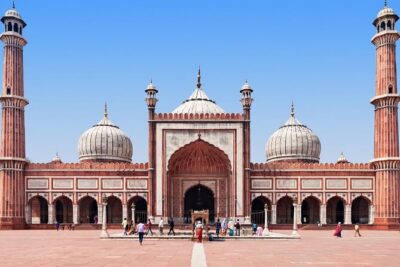
Next up is Jama Masjid, India’s largest mosque. Built in 1656 with 5,000 workers, it’s a Mughal-scale landmark. It also faces the Red Fort area, so your guide can tie together a broader story of Mughal power in this part of town. You’ll want to dress comfortably because you’ll be on your feet for a while.
Then you shift into the neighborhood energy around Chandni Chowk. The tour includes a rickshaw ride, which is the right way to see this area without walking every tight lane. Your guide will explain why the markets matter in daily life, and you’ll get a sense of how the city works at street level.
After that comes Khari Baoli, the famous spice market area. The main “thing” here is sensory: aromas, colors, and the sheer variety. This stop is also where a good guide makes a difference, because you’re not just looking. You’re learning what you’re seeing and how it’s used.
Later you pause at India Gate, the 1921 memorial honoring 13,300 Indian soldiers who died in World War I. It’s quick, but it adds a modern historical frame to a day that otherwise focuses on Mughal-era architecture and religious sites.
Your sightseeing continues with Humayun’s Tomb, a UNESCO World Heritage site and noted as India’s first garden tomb. It was commissioned by Humayun’s wife and it’s a key step for understanding later Mughal architecture. If you like spotting patterns and repeating design ideas, you’ll likely enjoy comparing it to other forts and mausoleums later in the trip.
Then there’s the strikingly different Lotus Temple, a Bahá’í House of Worship opened in December 1986. The lotus-inspired design makes it feel visually modern even though it’s grounded in faith tradition. It’s also listed as a free-admission stop on the itinerary.
After all that, you head to Agra, check into your hotel, and get a little breathing room. The practical upside of this structure is that you don’t waste Day 1 on long, late-night travel without seeing anything. The downside is you’ll feel the pace by evening, so plan to keep your first night low-key.
Day 2: Taj Mahal in early light, Agra Fort, then the Jaipur shift
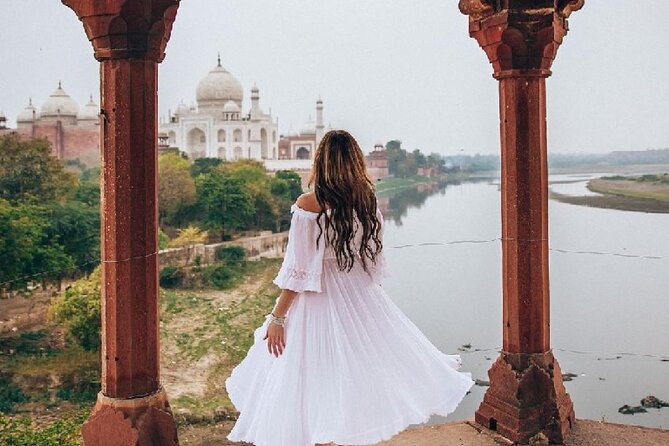
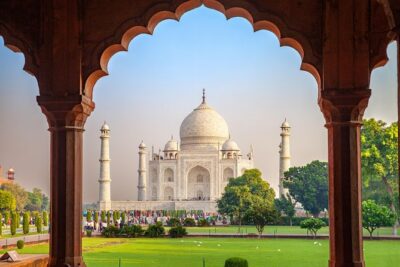
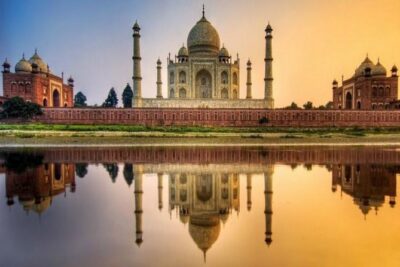
Day 2 is the headline day. You’ll go to the Taj Mahal with a personal tour guide, and the schedule is set up so you see it in early light. That matters because the Taj’s look changes with daylight, and morning light usually helps with atmosphere and photo conditions. More importantly, your guide gives you the context, which turns the “wow” into something you can explain after you leave.
Next is Agra Fort, another UNESCO World Heritage site. Built by Emperor Akbar in 1565 along the Yamuna River, and later expanded by Shah Jahan with white marble additions, it’s a whole complex rather than a single building. If you prefer to understand how power and everyday life overlap in royal spaces, this stop often lands well. It can also be a welcome change after the Taj, because the fort feels more like a lived-in fortress.
After that, you travel to Jaipur, known as the Pink City, and check into your hotel for an overnight stay. Your guide keeps things efficient here. The intercity move takes time, so the best use of the day is exactly what this itinerary does: hit the must-sees early, then transition without wasting daylight on guesswork.
- Old & New Delhi City Tour – Half or Full Day Options Available★ 5.0 · 4,811 reviews
- Taj Mahal Tour from Delhi by Express Train (Viator Award Winner)★ 5.0 · 2,849 reviews
- Same Day Taj Mahal, Fort & Baby Taj Tour from Delhi by Car★ 4.9 · 2,534 reviews
- From Delhi: Taj Mahal and Agra Fort Private Sunrise Tour★ 4.9 · 2,270 reviews
- Sunrise Taj Mahal, Agra Fort & Baby Taj Tour from Delhi by Car★ 5.0 · 2,243 reviews
Day 3 in Jaipur: Hawa Mahal, Amber Fort views, and Jantar Mantar science
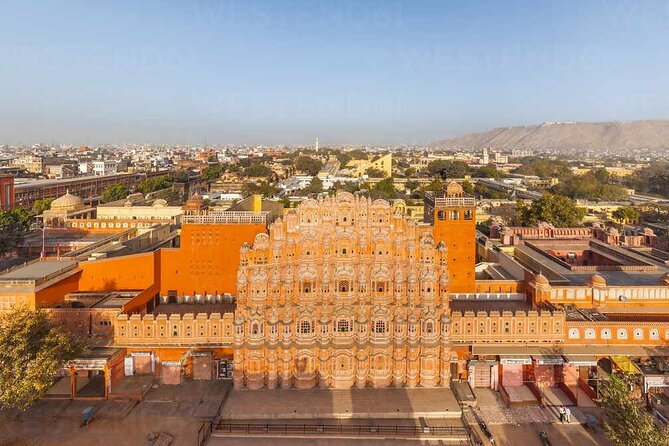
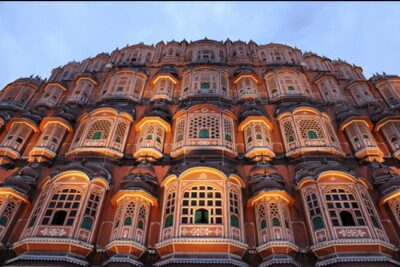
Day 3 is classic Jaipur, and it’s where the tour shows it understands that not all sights are the same. You start with Hawa Mahal – Palace of Wind, famous for its intricate latticework. It’s one of those buildings you can stare at for a while because the facade is basically a pattern machine. You can also enjoy panoramic city views from the top, which is great if you like getting oriented before you go farther out.
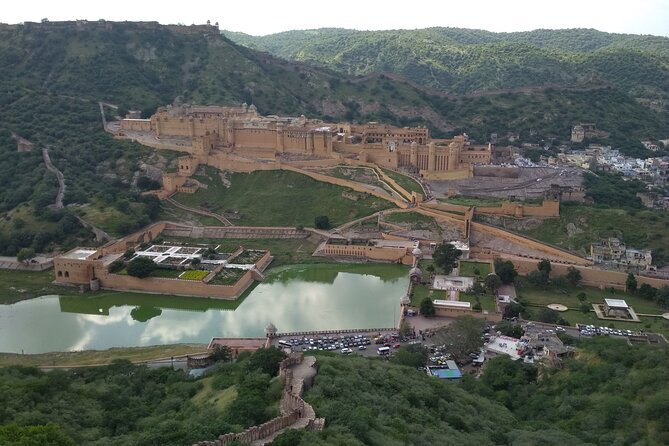
Then comes Amber Fort, one of the big royal set pieces. You’ll explore grand courtyards, temples, and lavish rooms with a guided visit. The tour notes that the fort area offers stunning views of the surrounding hills and Maota Lake below. If you’ve ever been underwhelmed by “forts,” this one can flip that. The reason is that it’s not just stone. It’s layout, decoration, and the way it sits in the landscape.
After Amber, you go to Panna Meena ka Kund, a stepwell that’s described as a peaceful, symmetrical architecture stop with a historic water system. This is one of those locations that’s easier to enjoy when you’re not rushing. It’s also a good photo break that feels calmer than the big palace zones.
Then you drive to Jal Mahal, the “water palace” in the middle of Man Sagar Lake. The itinerary keeps it short, but that can be a plus. It’s more about seeing the structure in context and then keeping your energy for the palace and observatory stops later.
Next is Gaitore Ki Chhatriyan, the cenotaph complex for Jaipur’s royal family. This is listed as tranquil and historically important, with intricate carvings and a calmer atmosphere. For many people, it’s the emotional cooldown point of the day.
After that, you head to the City Palace of Jaipur, described as a Mughal and Rajasthani fusion of architecture. You’ll have time for museums, courtyards, and palaces. This is where the day turns from short stops into longer “walk and look” time, and it’s a good moment to let your guide explain how styles blended.
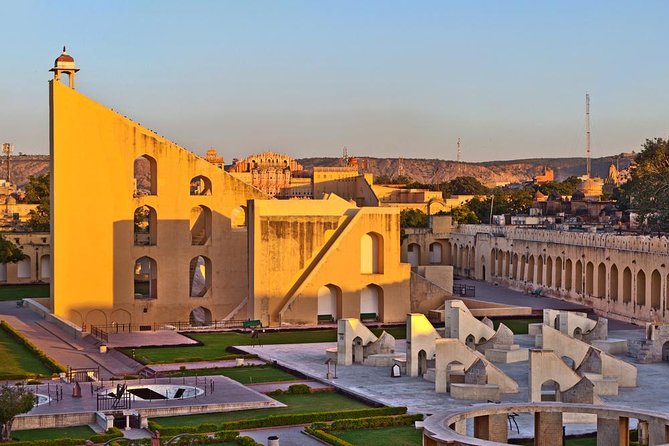
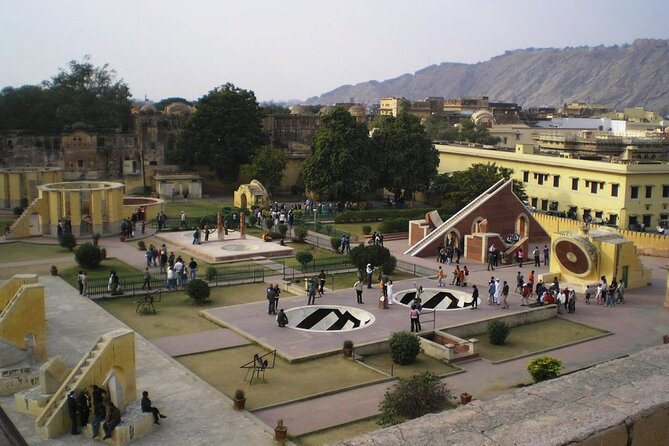
Finally, you end at Jantar Mantar, a UNESCO World Heritage site and an astronomical observatory built by Maharaja Jai Singh II. You’ll see massive instruments used for astronomical observations. Even if math is not your thing, it usually sticks because it’s so physical and so clever.
At the end of a full day, you return to New Delhi with drop-off at Delhi Airport or hotels in nearby areas like Gurugram, Aerocity, Noida, Ghaziabad, or Faridabad.
The service level that makes it feel safe and easy
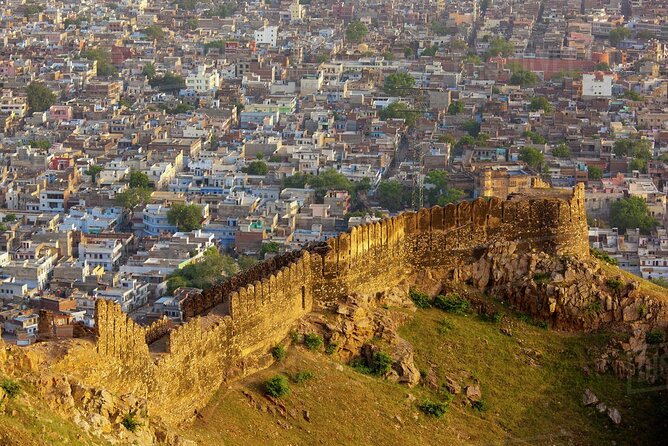
What you’re paying for here is not only transportation and admission management. It’s the “someone has your back” feeling, which matters a lot in a fast itinerary.
The tour is private, meaning only your group participates, so you can move at your group pace without squeezing into other people’s schedules. You also have a personal, uniformed driver and a tour guide at the sites. Based on the service descriptions, guides and coordinators like Akil were mentioned for responsiveness, and Kamal was highlighted for strong explanations in Jaipur. A driver named Naval was also described as driving safely.
Even if you never meet those exact individuals, the pattern is important: you get guided context at every major stop, not just at the big “poster” attractions. In practice, that means less confusion about what you’re seeing, fewer wasted moments asking for directions, and a smoother flow through crowded areas.
And because the tour includes planning for closure days, you’re less likely to show up at a monument only to find it shut. The important swap rules are spelled out: Taj Mahal is closed on Fridays, and Red Fort and Lotus Temple are closed on Mondays. If your dates hit those days, the itinerary adjusts, so you don’t lose the entire experience.
What to bring and how to enjoy each day more
Here’s how to make this itinerary feel less rushed and more satisfying.
First, plan for cash in INR for tickets. Some monuments do not accept credit card payments, and the guide can help find an ATM if needed. Even if card payment seems to work in theory, it’s not a risk you need to take when you have a tight sightseeing plan.
Second, wear comfortable shoes. You’ll be walking through multiple major sites, and even though you get vehicle transport between stops, your legs do most of the work. The itinerary also includes shoe covers for the Taj, which is helpful, but you still want grippy footwear for stairs and uneven surfaces.
Third, accept that the route is action-packed. That’s not automatically bad. It’s just reality. Your best strategy is to treat each day as a sequence of “main scenes” rather than trying to slow down for everything. If you want extra time in one place, the tour is listed as customizable, including modifications even after booking.
Lastly, if you’re picky about comfort, choose the hotel upgrade option when you can. After long days and early starts, breakfast at the hotel can also keep mornings from turning into a scramble.
One more date-specific note: there’s a mandatory gala dinner fee on New Year’s Eve and Christmas, so if your travel window includes those dates, budget for it.
Should you book this 3-day Golden Triangle tour?
I’d book it if you have three days, want Delhi, Agra, and Jaipur highlights, and you prefer a guided route that removes the logistics stress. The private setup, the guide at each stop, and the added “tactical extras” for the Taj Mahal make it a strong value for people who want to see a lot without micromanaging details.
I’d think twice if you have a very slow travel style, hate long days, or you already planned to do everything independently with your own ticketing and timing. Also, factor in the extra costs clearly. The base price plus entry tickets and meals is where the real total lands, so budget accordingly.
If your goal is to get your bearings fast, hit the big icons, and come away with stories you can repeat, this is one of the more practical ways to do the Golden Triangle in a short time.
FAQ
What’s included in the tour price, and what is not included?
The tour includes hotel or airport pickup and drop-off, a private air-conditioned vehicle, a personal driver, a rickshaw ride through Old Delhi, shoe covers for the Taj Mahal, a tour guide at all sites, and 2-night hotel accommodation if you choose the hotel option (plus breakfast if you choose the breakfast option). Meals and entry tickets are not included.
Are entry tickets and meals included?
No. Meals are listed as $70.00 per person, and entry tickets are listed as $70.00 per person, both not included in the base tour price.
Will the itinerary change if I travel on a Friday?
Yes. The Taj Mahal is closed on Fridays, and if your itinerary includes a Friday, the schedule is adjusted to Delhi – Jaipur – Agra – Delhi.
What if my trip includes a Monday?
The Red Fort and Lotus Temple are closed on Mondays. If your trip includes a Monday, the itinerary replaces those stops with a visit to Gurudwara Bangla Sahib.
Can I customize the itinerary?
Yes. The tour is described as customizable. You can request changes to the itinerary even after booking, and you can add, remove, or modify monuments or attractions.
What kind of vehicle will I ride in?
For 1-2 people it’s a three-seater sedan (Toyota Etios or similar). For 3-5 people it’s a six-seater wagon (Toyota Innova or similar). For 6-10 people it’s a ten-seater van (Tempo Traveler).
Do I need to carry cash for tickets?
It’s advised. Some monuments do not accept credit card payments, so you should carry cash in INR for entrance tickets. The guide can assist in locating an ATM if needed.
The Golden Triangle, Longer and Shorter




Recently reviewed across New Delhi
- Golden Triangle – Delhi Agra and Jaipur
★ 5.0 · 10 reviews - Taj Mahal & Agra Tour by Indian Bullet Train All Inclusive
★ 4.5 · 10 reviews - Private Tour in Mehrauli Archaeological Park & Qutub Minar
★ 5.0 · 10 reviews - Old & New Delhi Tour
★ 5.0 · 10 reviews - From Delhi : Taj Mahal & Agra Fort Tour by Luxury Express Train
★ 5.0 · 10 reviews - Delhi Shopping Tour: Top Bazaars, Crafts & Souvenir Finds
★ 5.0 · 10 reviews
Golden Triangle Tours, compared.
 ★ 5.03-Days Private Golden Triangle Tour: Delhi, Agra & Jaipur by CarFrom $1271,098 reviews
 ★ 5.03-Day Delhi, Agra and Jaipur Private Tour – India Golden TriangleFrom $110812 reviews
 ★ 5.0Four-Day Private Luxury Golden Triangle Tour to Agra and Jaipur From New DelhiFrom $160807 reviews
 ★ 5.05 Nights 6 Days Private Golden Triangle Tour – Delhi Agra JaipurFrom $240574 reviews
 ★ 5.04 Days Golden Triangle TourFrom $146499 reviews
 ★ 5.0Private Car and Drive for Golden Triangle (4N/5D)From $167451 reviews
 ★ 5.0Private Golden Triangle Tour Delhi Agra Jaipur ( Top Rated )From $148436 reviews
 ★ 5.03-Day Private Luxury Golden Triangle Tour to Agra and Jaipur From New DelhiFrom $164424 reviews
Browse the lists this tour appears in