
REVIEW · AGRA DAY TRIPS FROM DELHI
Golden Triangle Tour Package Delhi Agra Jaipur
Golden Triangle trips can feel like a speed run. This one stays focused with private guiding and door-to-door pickup across Delhi, Agra, and Jaipur in about three days. You get an air-conditioned ride between stops, so you can spend your energy on the sights instead of negotiating transport.
What I especially like here is the way the day is built around big, iconic landmarks, like Qutub Minar and the Taj Mahal, without turning the experience into a checklist blur. I also like that the tour is described as smooth and organized, with standout guide support that people associate with names like Jitu (and sometimes Jitendra) plus competent drivers such as Pawan.
One consideration: many major monuments list entry as not included unless you pick an option that bundles entrance fees, so you should plan for ticket costs and be ready for short on-site time at each stop.
In This Review
- Key Points I’d Prioritize
- Why This Golden Triangle Tour Works in About 3 Days
- Day 1 in Delhi: Qutub Minar, Humayun’s Tomb, Lotus Temple, India Gate
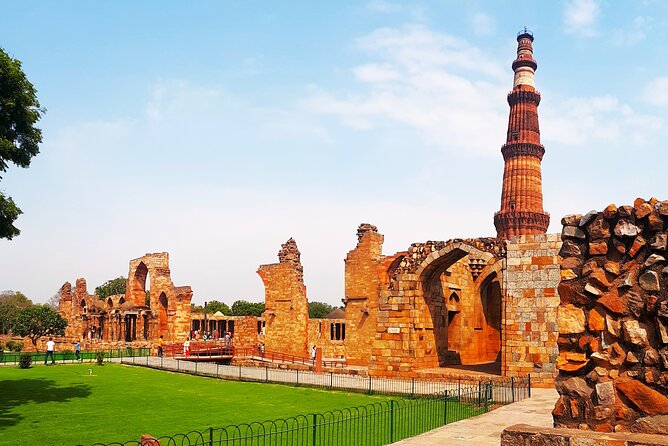
- Qutub Minar: A giant minaret with numbers you can actually picture
- Humayun’s Tomb: The Mughal garden-tomb idea taking shape
- Lotus Temple: Marble lotus, calm break from sightseeing intensity
- India Gate: A memorial you should read before you photograph
- Rashtrapati Bhavan: The President’s residence from the outside
- Day 2: Agra’s Taj Mahal and Agra Fort, plus Fatehpur Sikri on the way
- Taj Mahal: The marquee, handled in a guided, photo-friendly way
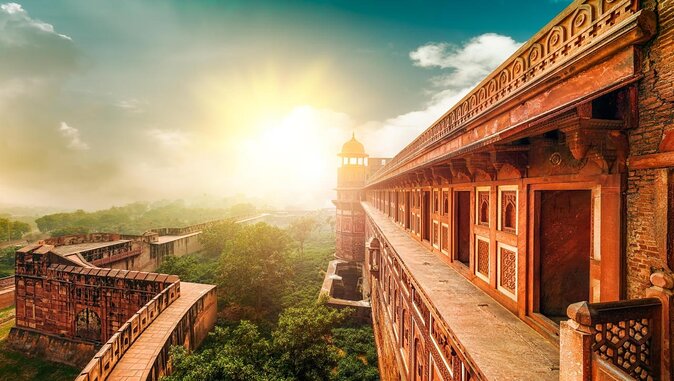
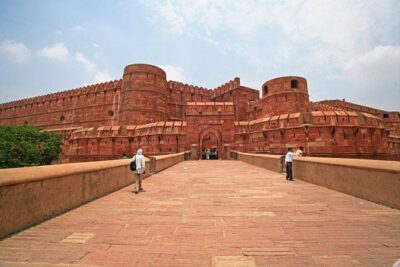
- Agra Fort: Red stone power, Mughal-era life, and city scale
- Fatehpur Sikri: A dramatic red sandstone detour
- Day 3 in Jaipur: Hawa Mahal, Amber Fort, Jal Mahal, City Palace, Jantar Mantar
- Hawa Mahal: The Palace of Breeze, made of red stone
- Amber Fort (Amer Palace): A big hilltop complex with Rajput rooms
- Jal Mahal: A palace sitting in the lake
- City Palace: Royal residence and museum feeling in one
- Jantar Mantar: 19 astronomical instruments and a UNESCO site
- The Guide, Pickup, and Drivers: What You Actually Get Besides Transportation
- Tickets, Entrance Fees, and the Real Money Math
- Price and Value: Is $72 per Person a Good Deal?
- Who Should Book This Tour, and Who Might Want Something Else
- Should You Book This Golden Triangle Tour?
- FAQ
- How long is the Golden Triangle Tour Package Delhi Agra Jaipur?
- Is hotel pickup and drop-off included?
- Do I need to pay for monument entrance tickets?
- Is breakfast included?
- Is lunch included?
- What is the cancellation policy?
Key Points I’d Prioritize
- Private, guided format keeps the pacing easier and the explanations clearer.
- Door-to-door pickup and drop-off reduces the biggest stress of Golden Triangle travel.
- Air-conditioned vehicle matters, especially on hot days.
- Real landmark mix: Mughal-era masterpieces, plus Jaipur’s forts, palaces, and observatory.
- Some stops are free, but others are not, so you’ll want to check your chosen add-ons.
Other one-day Agra runs out of Delhi
Why This Golden Triangle Tour Works in About 3 Days
The Golden Triangle is famous because it packs in three heavy hitters: Delhi, Agra, and Jaipur. The problem is that getting between them can turn your trip into logistics. This tour helps you solve that with door-to-door hotel pickup and drop-off, plus a car that keeps you comfortable through transfers.
You also get a professional local guide for Delhi, Agra, and Jaipur, not just a generic driver. That makes a difference at the sites where small details help you understand what you’re seeing. Even when the time at each stop is short, a good guide helps you know where to look and what matters.
Price is listed at $72 per person, but the real value is what’s included by default versus what’s bundled by option. The tour includes breakfast (2) and an air-conditioned vehicle, and it can include hotels, dinner, and monument entrance fees depending on what you select. If you choose upgrades for hotels and admissions, it can feel like you’re paying for fewer decisions and less back-and-forth.
Day 1 in Delhi: Qutub Minar, Humayun’s Tomb, Lotus Temple, India Gate
Delhi on day one is a smart introduction. You cover a strong spread of styles, from early Islamic architecture to Mughal garden-tomb design, then you end with major memorial and government landmarks. The pacing is tight but workable, with time blocks like 1 hour 30 minutes at Qutub Minar and Humayun’s Tomb, plus shorter stops later in the day.
Qutub Minar: A giant minaret with numbers you can actually picture
Qutub Minar is listed as the world’s tallest brick minaret. The key details you’ll hear on-site are the scale: 73 meters high and 14.3 meters in diameter at the base. It was started in 1192, and that timeline matters because it sets the site as one of Delhi’s earliest landmark monuments.
Expect this stop to be most enjoyable if you take your time looking at the form and the vertical rhythm. The admission ticket is noted as not included, so you may pay extra unless your option bundles entrance fees.
Golden Triangle itineraries, three to eight days
- 3-Days Private Golden Triangle Tour: Delhi, Agra & Jaipur by Car★ 5.0 · 1,098 reviews
- 3-Day Delhi, Agra and Jaipur Private Tour – India Golden Triangle★ 5.0 · 812 reviews
- Four-Day Private Luxury Golden Triangle Tour to Agra and Jaipur From New Delhi★ 5.0 · 807 reviews
- 4 Days Golden Triangle Tour★ 5.0 · 499 reviews
- Private Car and Drive for Golden Triangle (4N/5D)★ 5.0 · 451 reviews
Humayun’s Tomb: The Mughal garden-tomb idea taking shape
Humayun’s Tomb is another 1 hour 30 minute stop and one of the best ways to understand Mughal design thinking. The tomb was commissioned by Humayun’s first wife and chief consort, and it’s described as the first garden-tomb on the Indian subcontinent. Built in 1560, it’s a great place to notice symmetry, the garden layout, and how the tomb sits like a centerpiece.
Again, admission is listed as not included, so plan for that unless you booked an add-on.
Lotus Temple: Marble lotus, calm break from sightseeing intensity
The Lotus Temple is often a welcome change from stone-and-symmetry monuments. It’s described as marble, shaped like a lotus leaf, with a large hall inside where people can sit. This stop is given as 45 minutes, and admission is marked free.
If your schedule feels rushed, this is the kind of pause that helps you recharge before moving back into city icons.
India Gate: A memorial you should read before you photograph
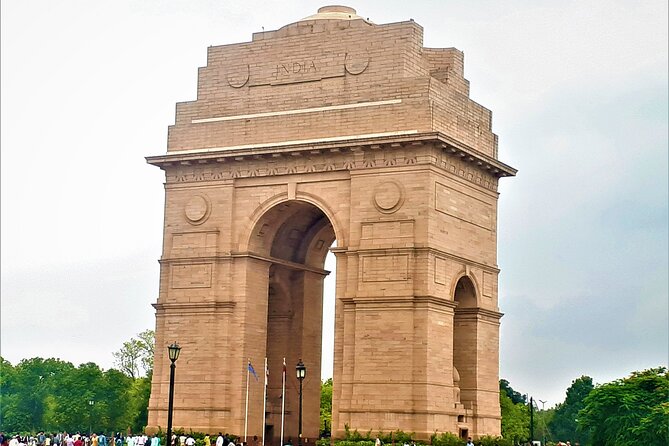
India Gate is short, around 45 minutes, and admission is marked free. It commemorates 70,000 Indian soldiers who lost their lives fighting for the British Army during World War I, which gives the arch a weight beyond the postcard look.
Tip: if your guide points out the names and memorial details, take a moment. Understanding the meaning changes how you experience the space.
Rashtrapati Bhavan: The President’s residence from the outside
Rashtrapati Bhavan is a quick stop, about 15 minutes, and free. It’s described as the official residence of the President of India, located at the western end of Rajpath. This isn’t usually the highlight if you want maximum time inside, but it rounds out day one with a sense of Delhi’s formal geography.
Day 2: Agra’s Taj Mahal and Agra Fort, plus Fatehpur Sikri on the way
Day two shifts you from Delhi’s monuments to Agra’s Mughal legacy. The agenda includes the Taj Mahal (2 hours), Agra Fort (about 1 hour), and Fatehpur Sikri (around 2 hours) before heading toward Jaipur.
This is where comfort and timing matter most. The tour handles the travel between cities by air-conditioned vehicle, which helps you avoid spending your day on buses or scrambling for rides.
Taj Mahal: The marquee, handled in a guided, photo-friendly way
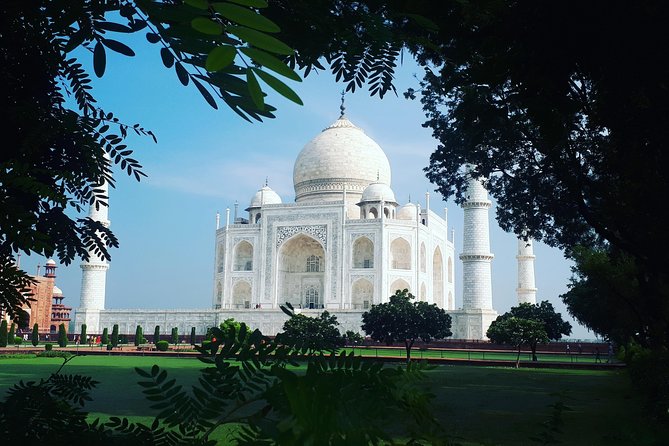
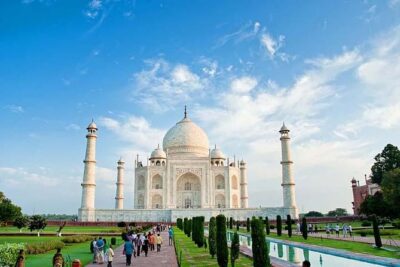
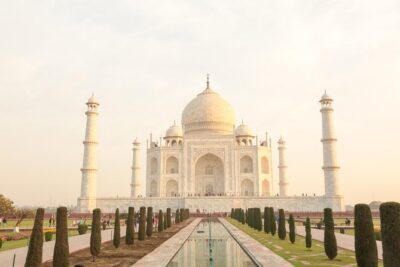
The Taj Mahal is listed for 2 hours, with admission not included. Agra’s link to the Mughal Empire is highlighted, and knowing that helps you understand why the Taj Mahal sits in such a tourism-centered city.
If you care about photos, pay attention to where your guide suggests you stand. People associated with this tour format have mentioned guides calling out the best picture spots at the Taj Mahal and Agra Fort. That kind of practical guidance can save you time and frustration, especially when crowds make angles tricky.
Agra Fort: Red stone power, Mughal-era life, and city scale
Agra Fort is about 1 hour and admission not included. It’s described as a red stone monument where the Mughal family lived, and it was central when Agra served as a capital city.
The best use of your hour here is to look at the fort as a whole system, not just isolated views. A guide can point out how the fort functions as architecture for living and power, which makes it feel less like a stop you rush through.
Fatehpur Sikri: A dramatic red sandstone detour
Fatehpur Sikri is planned as an on-the-way stop to Jaipur, about 2 hours, and admission is marked free. It’s described as red sandstone buildings, and it’s positioned as the scenic, culture-rich bridge between Agra and Jaipur.
This is a good stop if you like variety. The Taj Mahal is famous for its white marble beauty, while Fatehpur Sikri leans into bold stone and historical setting. The contrast helps the day feel less repetitive.
Day 3 in Jaipur: Hawa Mahal, Amber Fort, Jal Mahal, City Palace, Jantar Mantar
Jaipur day is where the tour leans fully into royal architecture and design. You get multiple stops, so even short time blocks feel like a real “see a lot” day: Hawa Mahal (about 30 minutes), Amber Fort (about 2 hours), Jal Mahal (about 30 minutes), City Palace (about 2 hours), and Jantar Mantar (about 1 hour).
Jaipur is also the day where you’ll benefit most from a guide who can connect what you’re seeing to why it looks the way it does.
Hawa Mahal: The Palace of Breeze, made of red stone
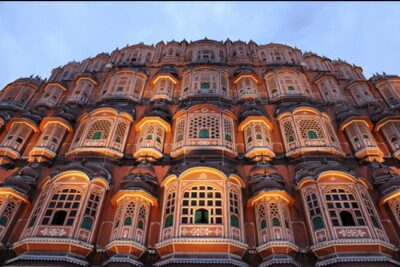
Hawa Mahal is described as the main attraction in Jaipur. It’s a grand red stone structure inspired by Khetri Mahal, and it’s a perfect quick stop because it’s about shape and visual impact more than deep museum time. The tour gives it about 30 minutes, and admission is listed as not included.
If you’re planning photos, go early in your stop window. The façade is the star, and the light can change how much detail you can capture.
Amber Fort (Amer Palace): A big hilltop complex with Rajput rooms
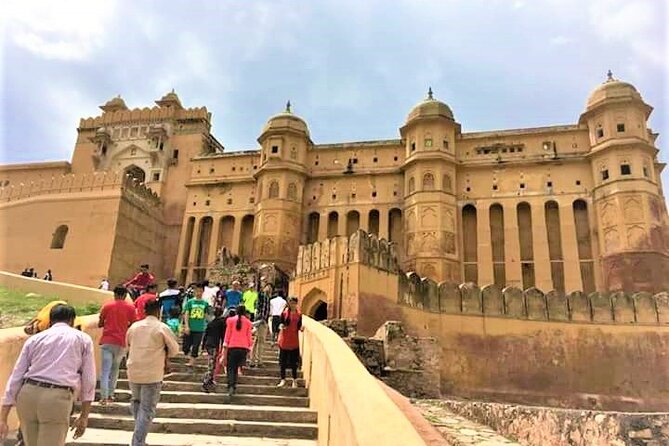
Amber Fort is the longest Jaipur stop, about 2 hours, with admission not included. The tour describes it as a large Rajput building high on a hill, with many internal buildings and rooms, including references to 12 queen rooms.
This is the stop where you should slow down a little. If you rush, it becomes “walls and hallways.” If you listen, it becomes a sense of how royal living spaces were arranged and how the fort dominates the landscape.
Jal Mahal: A palace sitting in the lake
Jal Mahal is placed for about 30 minutes and admission is noted as free. It’s described as a palace in the middle of Man Sagar Lake, used by the royal family in summer when Jaipur gets very hot.
This stop works best as a visual breather. You get the dramatic view without needing deep ticket time.
City Palace: Royal residence and museum feeling in one
City Palace is about 2 hours and admission not included. It’s described as both a museum of royal items and a royal residence, with construction completed in 1732. There’s also mention of a blue palace built according to Hindu Vastushastra principles.
This is the kind of stop that rewards a guide’s explanation. You’ll see how the palace functions as a lived-in statement of power, art, and design.
Jantar Mantar: 19 astronomical instruments and a UNESCO site
Jantar Mantar gets about 1 hour. It’s described as a collection of 19 astronomical instruments built by Rajput king Sawai JaiSingh and it’s listed as a UNESCO World Heritage Site. Admission is not included.
If you like science and you enjoy seeing history through a practical lens, this will be a highlight. It can also be the most surprising stop because it’s not just built for looks. It’s built to measure.
The Guide, Pickup, and Drivers: What You Actually Get Besides Transportation
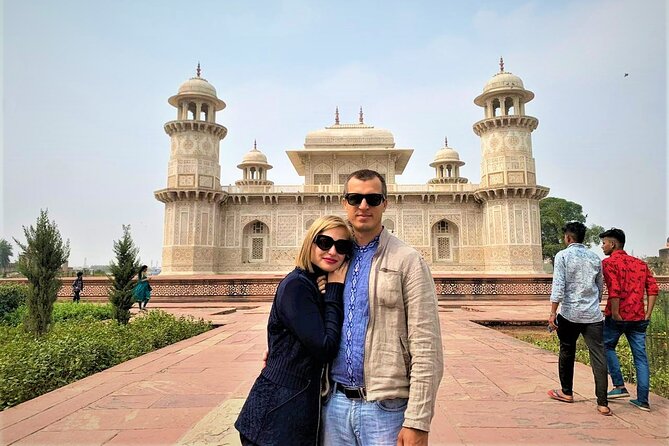
This tour is built around three comfort anchors: local guiding, door-to-door pickup, and an air-conditioned vehicle.
A key detail from people’s experience is the role of Jitu and Jitendra as guides, with emphasis on smooth, friendly support. One theme is that guides help you find good photo angles and keep the visit efficient, and some guidance has even been offered in Spanish for the Taj Mahal and Agra portion. That matters because it reduces the mental load of asking questions you do not know how to ask.
Another theme is driver quality. The name Pawan shows up in the feedback as particularly good, which suggests you’re less likely to deal with sudden route confusion or uncomfortable driving. In a place where traffic can shift fast, that’s not a small thing.
Door-to-door pickup and drop-off also changes the feel of a short trip. Instead of losing time to meeting points and hunting for taxis, you start each day by rolling straight into the day’s first stop.
Tickets, Entrance Fees, and the Real Money Math
Here’s the catch with any Golden Triangle shortcut: monument entry fees can swing your total cost.
In the itinerary, you’ll see many big stops marked as admission not included, including Qutub Minar, Humayun’s Tomb, Taj Mahal, Agra Fort, Hawa Mahal, Amber Fort, City Palace, and Jantar Mantar. Some stops are marked free, including Lotus Temple, India Gate, Rashtrapati Bhavan, Fatehpur Sikri, and Jal Mahal.
The included section says all monuments entrance are included only if you book the option that includes entrance fees. So the most practical move is to confirm what your ticket bundle includes before you go, especially for Taj Mahal and the forts.
Lunch is not included. Breakfast (2) is included, but you’ll want to plan for lunch on the ground. If you’re the type who hates “surprise hunger,” carry a snack and water between stops.
Price and Value: Is $72 per Person a Good Deal?
At $72 per person, this tour’s value depends on what you select. The base price sounds attractive, but the real question is what you’re already paying for separately back home.
What you get at the core level is a professional guide across the route, an air-conditioned vehicle, and breakfast for two days. That’s a strong baseline because it covers the two biggest trip costs people often underestimate: time and stress, plus organized local expertise.
Where the value can jump is with the upgrades. If you add hotels, the tour includes 2 nights accommodation. If you add dinner, dinner can be included too. If you add admission, you may save time by not negotiating entry at each site. Even if you pay extra for upgrades, the trade can be worth it if you want a low-decisions trip.
A final value note: the tour is described as private for your group. That means your schedule is less likely to be dictated by strangers and last-minute changes.
Who Should Book This Tour, and Who Might Want Something Else
This tour is best for you if:
- you want a structured Golden Triangle without planning every connection yourself
- you prefer a private group experience rather than hopping between random guides
- you like major sights, like the Taj Mahal and Amber Fort, and you want them done efficiently
- you can handle short stop windows at each location
You might want a different format if:
- you hate rushing and want lingering museum time
- you’re trying to minimize all monument tickets and you do not want any paid admissions at major stops
- you want free time built in each day for independent wandering
The tour says most travelers can participate, and that usually means the overall flow is flexible enough for a wide range of ages. Still, it is a three-day sprint, so comfortable footwear is a must.
Should You Book This Golden Triangle Tour?
I’d book this tour if you want the Golden Triangle done in a way that feels organized and guided, not stressful. The biggest reasons are the door-to-door pickup, the air-conditioned transfers, and the chance to have guides like Jitu handle the key stops with practical commentary and helpful photo positioning.
I’d double-check your add-ons before paying final attention to entrance fees. With many attractions listed as admission not included, your total cost can change quickly depending on the option you choose. If you hate ticket math, look for a bundle option that includes monument entrance fees.
If you get the right option set and you go in ready for a fast-paced sightseeing schedule, this tour is a solid way to cover Delhi, Agra, and Jaipur without burning your trip on logistics.
FAQ
How long is the Golden Triangle Tour Package Delhi Agra Jaipur?
The duration is approximately 3 days, with stops scheduled across Delhi, Agra, and Jaipur.
Is hotel pickup and drop-off included?
Yes. Door-to-door hotel pickup and drop-off are included.
Do I need to pay for monument entrance tickets?
Many stops list admission as not included, while some are marked free. The tour can include all monument entrance fees if you choose the option that includes entrances.
Is breakfast included?
Yes. Breakfast is included for 2 days.
Is lunch included?
No. Lunch is not included.
What is the cancellation policy?
Free cancellation is available up to 24 hours in advance for a full refund. If you cancel less than 24 hours before the start time, the amount paid is not refunded.
The Pink City, More Reviewed Days





The Golden Triangle, Longer and Shorter

Delhi to Agra and Back in a Day



Recently reviewed across New Delhi
- Golden Triangle – Delhi Agra and Jaipur
★ 5.0 · 10 reviews - Taj Mahal & Agra Tour by Indian Bullet Train All Inclusive
★ 4.5 · 10 reviews - Private Tour in Mehrauli Archaeological Park & Qutub Minar
★ 5.0 · 10 reviews - Old & New Delhi Tour
★ 5.0 · 10 reviews - From Delhi : Taj Mahal & Agra Fort Tour by Luxury Express Train
★ 5.0 · 10 reviews - Delhi Shopping Tour: Top Bazaars, Crafts & Souvenir Finds
★ 5.0 · 10 reviews
Agra Day Trips from Delhi, compared.
 ★ 5.02 Days Overnight Taj Mahal & Agra Tour From DelhiFrom $67743 reviews
 ★ 5.0Delhi to Agra Taj Mahal Private Day Trip by Superfast TrainFrom $170708 reviews
 ★ 5.0Private Taj Mahal & Agra Day Tour by Superfast Train From DelhiFrom $51580 reviews
 ★ 5.05 Nights 6 Days Private Golden Triangle Tour – Delhi Agra JaipurFrom $240574 reviews
 ★ 5.0Private Golden Triangle Tour Delhi Agra Jaipur ( Top Rated )From $148436 reviews
 ★ 5.0Taj Mahal Tour From Delhi to Agra Sightseeing by Private AC CarFrom $15403 reviews
 ★ 4.5Private Taj Mahal at Sunrise and Agra Day Tour from DelhiFrom $92373 reviews
 ★ 5.0Taj Mahal at Sunrise and Agra Day Tour from DelhiFrom $92335 reviews
Browse the lists this tour appears in