
REVIEW · PONDICHERRY AND AUROVILLE TOURS
Pondicherry Heritage Walking Tour of French Quarters
Pondicherry’s French Quarter hits fast. In about 2 hours, you walk past colonial landmarks and learn why this neighborhood mixes French, Greco-Roman, Rococo, and Indian influences so naturally. I love how the route gives you a tight walking loop through White Town street scenes and big monuments you can actually see up close. I also like that the tour ends near the waterfront sights, so it feels like you’re building momentum for the rest of your day. One thing to consider, though, is that English can vary by guide, so if you’re strict about easy-to-follow narration, pick your expectations accordingly.
If you’re new to Puducherry, this is an efficient way to get your bearings. You’ll cover the French War Memorial, Eglise de Notre Dame des Anges, an old lighthouse landmark, and a giant Gandhi statue, plus a couple of lesser-known stops tied to military and local legends. There’s no heavy museum time, which is exactly why it works as an intro tour. And for many people, that’s the sweet spot: a guide, a walk, and context for what you’re looking at.
In This Review
- Key highlights you will not rush past
- Entering White Town the right way (with a 15-person group)
- Walking Rue Dumas and the French street layout you can actually picture
- The one drawback to watch
- Foyer du Soldat: a legion hall that makes history feel local
- Raj Niwas: from French Baroque to British destruction to Rococo rebuild
- Why this stop matters for first-time visitors
- Aayi Mandapam (Park Monument): Napoleon III, Greco-Roman style, and a courtesan’s legacy
- Quick visual tip
- French War Memorial and Louis Guerre’s lighting story
- What to consider
- Eglise de Notre Dame des Anges: twin towers and Greco-Roman church design
- Old Lighthouse: the same engineer, the same 1835 era, and upgraded light technology
- The 13-foot Gandhi statue finish: scale you feel from across the area
- Price and what you actually get for $26
- How the guide can make or break the experience
- Who should book this walk (and who should skip it)
- Family-friendly note
- Should you book the Pondicherry Heritage Walking Tour of French Quarters?
- FAQ
- How long is the Pondicherry Heritage Walking Tour of the French Quarters?
- What is the price of the tour?
- What is included in the tour price?
- Are admission tickets included for each stop?
- Where does the tour start and end?
- How many people are in the group?
- Is free cancellation available?
Key highlights you will not rush past
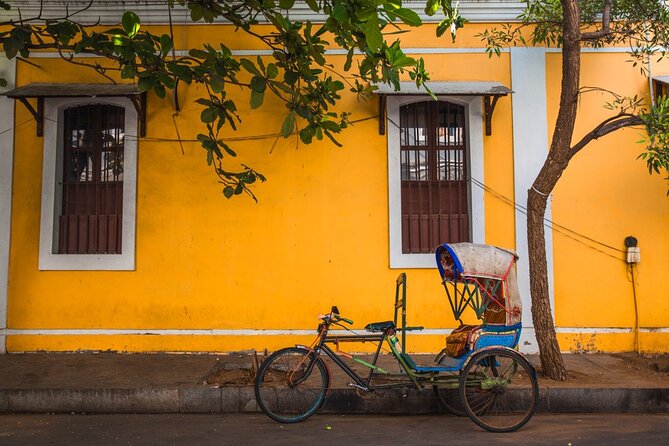
- French Quarter architecture on foot: streets named Rue Dumas, Rue Romain Rolland, Rue Suffren, and Rue La Bourdonnais help you visualize the colonial layout
- Napoleon III-era details: Aayi Mandapam and other Greco-Roman touches are easier to spot once someone points out the design story
- Louis Guerre’s imprint: the same French engineer shows up across the war memorial, church, and the old lighthouse
- War and civic spaces: Foyer du Soldat connects the neighborhood to French Legion history and veteran gatherings
- A big cultural end point: the 13-foot Gandhi statue offers a dramatic finish you can build on afterward
Auroville and the seafront promenade, more trips
Entering White Town the right way (with a 15-person group)
This tour is designed for walking pace, not museum pace. You meet at the Chief Secretariat Government Of Puducherry on Goubert Avenue in White Town, and you finish at the Mahatma Gandhi Statue nearby on Beach Road. The group max is 15 travelers, which matters more than you might think, since it keeps the walk conversational and makes it easier to hear the guide while you’re moving.
You also get a mobile ticket, so you’re not fussing with paper. And because it’s near public transportation, you can usually fit this into a longer day without feeling stuck. In short, it’s a practical format: walk, pause, look, learn, repeat.
Walking Rue Dumas and the French street layout you can actually picture
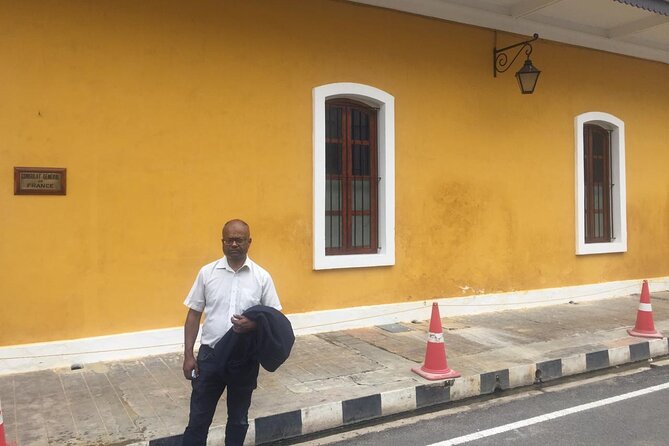
Your first stretch goes through White Town, the French Quarter proper, with stops tied to the street grid. You’ll move along roads like Rue Dumas, Rue Romain Rolland, Rue Suffren, and Rue La Bourdonnais. Even if you never studied colonial maps, you start to see how the neighborhood was planned and how the streets connect major points.
What I like here is the visual learning. You’re not just hearing that the architecture blends styles. You’re standing in front of it, noticing how the neighborhood reads differently street by street. The colonial buildings, combined with casual street life and the nearby beach vibe, give you that instant “this place is layered” feeling.
The one drawback to watch
If you’re someone who prefers deep, slow storytelling, a 2-hour loop can feel a bit quick. You’ll see a lot, but you won’t get extended time inside buildings. That’s not bad, just know what you’re signing up for: a fast orientation more than a full-on deep dive.
- Full Day Guided Tour of Pondicherry with lunch and hotel pickup★ 5.0 · 10 reviews
Foyer du Soldat: a legion hall that makes history feel local
Next you head toward Foyer du Soldat, a French legion hall that functions as a gathering place for former soldiers of the French army who served in different wars. It also hosts cultural events, and veterans often meet there.
This stop works because it turns “history” into a living social space. Instead of imagining a distant past, you’re seeing how the building still holds community meaning. Even if you spend only part of your time looking around, the key idea sticks: this neighborhood’s French connections are not only architectural, they’re also social.
Raj Niwas: from French Baroque to British destruction to Rococo rebuild
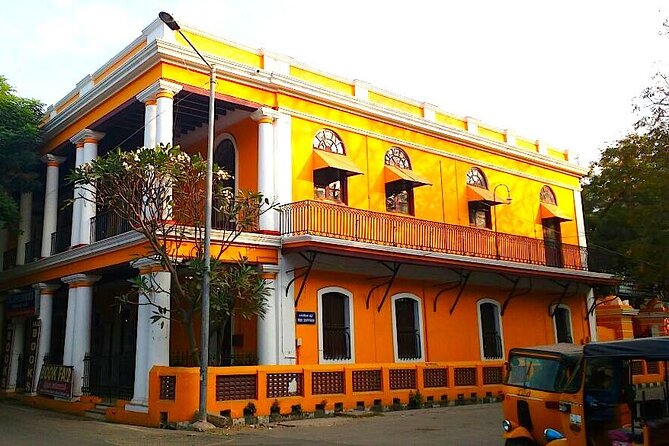
Then comes Raj Niwas, the residence of the Lieutenant Governor of Puducherry. The building story is dramatic. It was originally constructed in a French Baroque style, destroyed by the British in 1761, and later rebuilt in the Rococo style.
The important practical note: this is listed as an admission ticket not included stop, so plan to view from the outside unless your ticket situation covers entry on your specific booking. Even with that limitation, the architectural timeline gives you something valuable. You start seeing the French influence as a process, not a single era frozen in time.
Why this stop matters for first-time visitors
If you’re trying to understand the French Quarter blend, this is the kind of landmark that explains the “why” behind the mix. Styles didn’t just arrive and stay. They were reshaped by conflict and rebuilding.
Aayi Mandapam (Park Monument): Napoleon III, Greco-Roman style, and a courtesan’s legacy
Park Monument, also known as Aayi Mandapam, is built during the reign of Napoleon III in the 19th century, in the Greco-Roman architectural style. The monument commemorates a courtesan named Aayi and a selfless act.
You’ll likely have a moment where you look at the structure and think: why is this person being remembered with monumental architecture? That question is exactly why the stop is worth it. It nudges you to pay attention to who gets honored in public space, and how colonial-era monuments in India often reflect a mix of official and local storytelling.
Quick visual tip
When you pause here, take 20 to 30 seconds to scan the overall design style before you zoom in on one detail. Greco-Roman elements can blend in when you’re moving fast, but the big shapes are the easiest entry point.
French War Memorial and Louis Guerre’s lighting story
The French War Memorial is another standout, built in 1835 and designed by French engineer Louis Guerre. Here’s the detail that makes it interesting rather than just another plaque: it originally used six oil lamps and two reflectors. Those lighting systems were converted to electric lamps in 1913, and later upgraded in 1931.
This is the kind of information that changes how you look. A memorial becomes not only a tribute to the past, but a record of technology and upgrades across time. It also ties into the theme of the tour: you’re learning how French engineers and design choices affected real structures in Puducherry.
What to consider
Because the tour is short, you don’t get long quiet time at each point. If you love photos of lights, memorials, or architecture, go prepared to shoot quickly and then listen. The story matters, but you also want the images.
Eglise de Notre Dame des Anges: twin towers and Greco-Roman church design
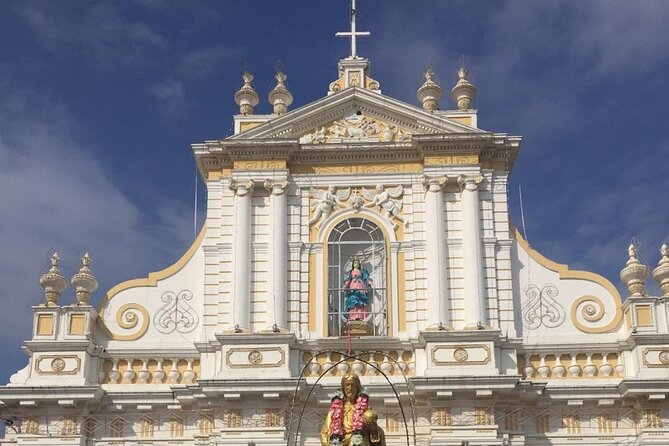
Next is Eglise de Notre Dame des Anges, a historic Catholic church built facing the Bay of Bengal. It’s in the Greco-Roman style, built in 1855 under Napoleon III, designed by architect Louis Guerre. The church is known for its twin towers with stained glass windows.
This stop is where the tour shifts from “architectural recognition” into “visual impact.” Twin towers plus stained glass means you can’t miss the church once you’re close. And facing the Bay of Bengal gives it that extra sense of place, like the building was meant to be seen from multiple directions.
If you enjoy religious architecture, even briefly, this is your best “pause and look up” moment on the walk.
Old Lighthouse: the same engineer, the same 1835 era, and upgraded light technology
Right after the church, you visit the Old Lighthouse, built in 1835 and also designed by Louis Guerre. Like the war memorial, its original lighting system used six oil lamps and two reflectors. It was converted to electric lamps in 1913, and upgraded again in 1931.
This stop adds a nice layer. You start noticing that Louis Guerre’s work isn’t one isolated feature. It’s a pattern across Puducherry’s French-era structures. Even if you only get a short look, the parallel details make it feel like you’re following a thread through the city.
The 13-foot Gandhi statue finish: scale you feel from across the area
The tour ends at the Statue of Gandhi, which is 13 feet tall. It was built by sculptor Roy Choudhary from the Madras School of Art and Crafts. The statue is surrounded by eight beautifully carved elements.
Finishing here works because the scale grabs you immediately. And the location makes it easy to transition into whatever you’re doing next along Beach Road and the White Town area. You don’t end feeling like the tour stopped mid-sentence. You end with a big landmark that’s easy to point at, remember, and photograph.
Price and what you actually get for $26
At $26 per person for about 2 hours, this tour is priced like an efficient orientation walk, not a major attraction with lots of paid entry. You get a guide, and the small group size (maximum 15) helps you feel like you’re not standing in a crowd.
Most stops are free in terms of admission, and you’ll spend your time outdoors or at landmarks where the storytelling is the main value. One stop, Raj Niwas, is marked as admission ticket not included, so if entry matters to you, plan for that.
Also, there’s no mention of snacks being provided. That’s totally normal for a 2-hour walk, but it does mean you’ll want to pair it with coffee or a snack plan before or after, especially if you’re walking in heat.
How the guide can make or break the experience
The guide is the engine of this tour. In the positive experiences, guides like Vanaraj are described as helpful and knowledgeable, and another guide, Prasanth, is praised for being attentive to expectations and tailoring the pace when traveling with a child. That kind of flexibility is a big deal on a walking tour.
On the other hand, one drawback that shows up is that English proficiency can be substandard. If your comfort depends on easy explanations, it’s worth considering that possibility. Your best move is to set expectations for a walk that relies on visual cues as much as language.
Who should book this walk (and who should skip it)
This is ideal if you want:
- a first-time introduction to White Town and French Quarter landmarks
- an easy, low-stress way to connect architecture to stories
- a compact route you can fit into a busy day
It’s less ideal if:
- you need lots of indoor time or long stops at each building
- you are strongly dependent on highly fluent English narration
Family-friendly note
One guide is specifically mentioned as adapting for a child. If your group includes kids, this kind of practical pacing can help a lot.
Should you book the Pondicherry Heritage Walking Tour of French Quarters?
I’d book it if you’re visiting Puducherry for the first time and want a clear sense of the French Quarter in a short window. For the money, you’re getting a guided route that hits multiple landmark types: street layout, church architecture, engineering details, memorials, and a big public statue finish. The structure is simple, and that’s why it’s good value.
Skip it or choose another option if English clarity is essential for you, or if you dislike walking tours that prioritize quick stops over deep stays. But if you can enjoy learning while you walk, this one is an efficient way to see the French Quarter with your eyes open.
FAQ
How long is the Pondicherry Heritage Walking Tour of the French Quarters?
The tour runs for about 2 hours.
What is the price of the tour?
The price is $26.00 per person.
What is included in the tour price?
A guide is included.
Are admission tickets included for each stop?
Admission tickets are free for most stops listed, but Raj Niwas is noted as admission ticket not included.
Where does the tour start and end?
The tour starts at the Chief Secretariat Government Of Puducherry on Goubert Avenue, White Town. It ends at the Mahatma Gandhi Statue on Beach Road, White Town.
How many people are in the group?
The tour has a maximum of 15 travelers.
Is free cancellation available?
Yes, you can cancel for a full refund if you cancel up to 24 hours in advance of the experience start time.
Pondicherry and Auroville, More Trips




Recently reviewed across Pondicherry
- Full Day Guided Tour of Pondicherry with lunch and hotel pickup
★ 5.0 · 10 reviews - Pondicherry Heritage Walking Tour of French Quarters
★ 5.0 · 25 reviews - Traditional Kolam Class in Pondicherry
★ 5.0 · 28 reviews - Guided City Tour in Pondicherry with complimentary refreshments
★ 4.5 · 33 reviews - The Unique Pondicherry City Bike Tour
★ 4.5 · 58 reviews
Pondicherry and Auroville Tours, compared.
 ★ 5.0Indian Cooking Class in PondicherryFrom $2867 reviews
 ★ 4.5The Unique Pondicherry City Bike TourFrom $2058 reviews
 ★ 5.0One day private tour of Pondicherry from Chennai in car with a guideFrom $15553 reviews
 ★ 5.0Pondicherry day trip from Chennai by Wonder toursFrom $16951 reviews
 ★ 4.5Guided City Tour in Pondicherry with complimentary refreshmentsFrom $12233 reviews
 ★ 5.0Traditional Kolam Class in PondicherryFrom $928 reviews
 ★ 5.0Auroville: Nature Trail Forest Cycling AdventureFrom $1418 reviews
 ★ 4.5Private day tour to Mahabalipuram, Pondicherry from ChennaiFrom $9813 reviews
Browse the lists this tour appears in