
REVIEW · CHENNAI AND MAHABALIPURAM TOURS
Mahabalipuram: Private Guided tour from Chennai with lunch
Stone lions, giant reliefs, and a calm A/C ride.
This private tour packs Mahabalipuram’s UNESCO rock-cut wonders into one smooth day, with standouts like the Shore Temple and the massive bas-relief of Arjuna’s Penance. I especially like how the guide turns the carvings into stories you can picture fast, and how the private car keeps the long road from feeling like a chore. One thing to consider is that the day can include a short stop at a local craft or sculpture place, so if you want zero shop time, plan your expectations.
If you’re doing Chennai and you want your “wow” moment to happen quickly, this 7-hour format is built for that. It includes hotel pickup and drop-off, entrance fees, and lunch, so you’re not doing math mid-day or hunting for tickets. You will still walk between sites, and at least one stop can involve stairs, but you can usually choose to avoid climbing when needed.
In This Review
- Key points before you go
- Mahabalipuram in a Half-Day, Why This UNESCO Site Matters
- Price and Logistics: What $120 Buys in a Private Day Trip
- From Chennai to Mahabalipuram: The Road Part You Actually Enjoy
- Pancha Rathas: Five Chariots Carved from One Stone
- Arjuna’s Penance: The 100-Foot Bas-Relief Scene You Should Slow Down
- Krishna’s Butterball and the Art of Stone That Teases Physics
- Ganesha Ratha, Mahishasura Mardini Cave, and Varaha Cave
- Ganesha Ratha
- Mahishasura Mardini Cave
- Varaha Cave
- Shore Temple: Granite, Sea-Farers, and the Marco Polo Connection
- ISKCON Mahabalipuram: A Different Kind of Cultural Stop
- Lunch That Doesn’t Derail Your Day
- The Service Factor: Ministry-Approved Operator and Real Human Guides
- Timing, Walking, and Stairs: The Practical Side of a 7-Hour Day
- Who This Private Mahabalipuram Tour Is Best For
- Should You Book This Private Guided Tour from Chennai?
- FAQ
- How long is the Mahabalipuram private guided tour from Chennai?
- What is included in the price?
- Are drinks included?
- Is the group private?
- What language is the live guide?
- Where do you get picked up from in Chennai?
- What sights are part of the tour?
- Is there free cancellation?
- What does pay later mean for this tour?
Key points before you go
- World Heritage highlights in one route, from Pancha Rathas to Shore Temple
- Arjuna’s Penance is an enormous bas-relief scene you’ll want to see slowly
- Monolith sculptures everywhere, including Krishna’s Butterball and several carved rathas and caves
- Private guidance in English that helps you read what you’re looking at
- Lunch is included, at a vegetarian restaurant, so you keep your day on track
- Optional craft stop possible, one review mentions an obligatory visit to a sculpture workshop
Mahabalipuram in a Half-Day, Why This UNESCO Site Matters
Mahabalipuram is one of those rare places where the rocks feel like they are doing the storytelling. The whole setting is built around Pallava-era creativity, and much of what you see is carved directly into granite, not assembled in later stages. That means the art is tied to the site in a very physical way: you’re not just viewing objects, you’re walking through a sculpted landscape.
This private day is also smart for time. You start from Chennai and focus your time on the best-known concentration of temples, rathas, caves, and reliefs, rather than scattering across distant beaches and random stops. The result is a day that feels full, but still ordered, like someone has already done the hard work of choosing what matters most.
And yes, Mahabalipuram is famous for Marco Polo’s connection. Shore Temple is linked to the old legend of the seven pagodas, which gives you a handy way to connect these stone structures to something written down centuries ago.
Price and Logistics: What $120 Buys in a Private Day Trip
At $120 per person for a 7-hour private tour, the price makes sense if you value convenience and a guided read on complex monuments. You’re not just paying for transport. The package includes hotel pickup and drop-off, a private car, a guide, entrance charges, and lunch. Drinks are not included, so you may want water on hand, especially in warmer weather.
Where this becomes good value is pacing. In Mahabalipuram, the difference between a hurried visit and a satisfying one is usually your ability to stop, look, and ask. A private guide helps you understand why each carving looks the way it does, and where to stand so you can see the full scene.
The main drawback, from a practical point of view, is that private tours can sometimes add time for stops you did not plan. One review mentions an obligatory stop at a sculpture place connected to student work. You can’t assume this will happen every day, but it’s enough of a pattern to treat it as a possibility.
From Chennai to Mahabalipuram: The Road Part You Actually Enjoy
The drive from Chennai to Mahabalipuram is not the highlight, but it matters. This tour includes pickup from your hotel lobby and a dedicated driver in a private car. One review specifically notes a fully A/C vehicle, which is a big deal if you’re visiting during hot hours.
What I like about bundling the ride into the tour is that the guide often begins shaping your visit before you even reach the monuments. You get a framework for what you’ll see, so the first structures do not land as random carvings. They start to feel like a connected world.
If you are planning photos, start thinking early. You’ll be moving through different light conditions, and the best angles for stone carvings can change with the sun. A guide can also point out where to stand for better shots without turning your day into a constant shuffle.
Pancha Rathas: Five Chariots Carved from One Stone
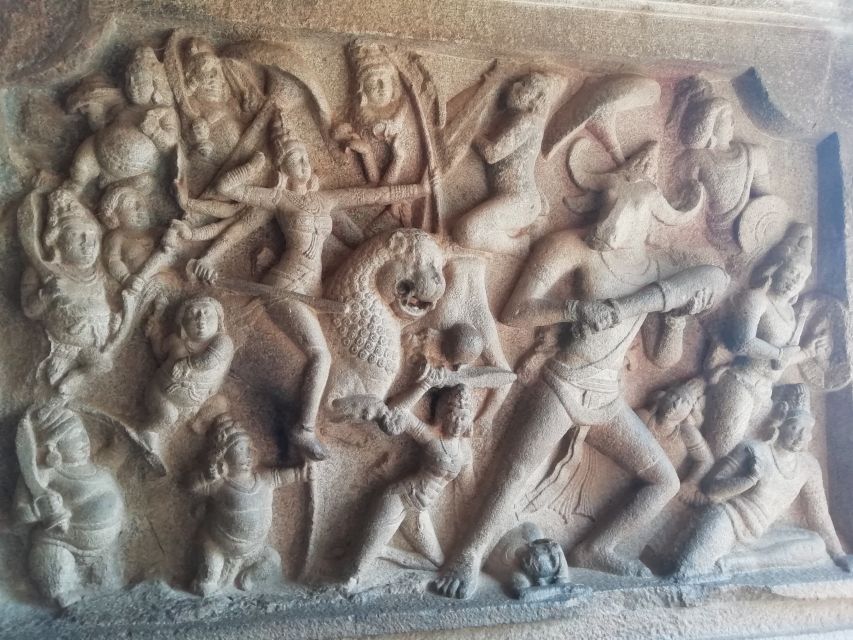
Pancha Rathas, often called the five chariots, are the first major stop for a reason. These are monolithic rock-cut structures, meaning the stone block is carved into separate rathas rather than being built up piece by piece. In plain terms, the scale and craftsmanship are easier to appreciate right away here.
Each ratha is tied to figures from the Mahabharata epic. You’ll see shrines associated with Draupadi, Arjuna, Bhima, Yudhister, and Nakul-Sahadeva. One extra detail worth noticing is the elephant sculpture near the ratha of Nakul-Sahadeva, which gives you a visual anchor when you’re trying to map the characters across the site.
A practical note: these structures are not one single building. They are spread out, and you’ll walk between them. If stairs are part of your concern, keep it in mind for the overall day. The Pancha Rathas section usually involves uneven ground and short climbs rather than anything massive, but your comfort will depend on your pace.
What makes this stop valuable is that you get your “reading skills” activated for the rest of Mahabalipuram. Once you understand what a ratha is, you’ll look at caves and reliefs with better instincts, like where the focus is meant to be and how the symbols repeat.
Arjuna’s Penance: The 100-Foot Bas-Relief Scene You Should Slow Down
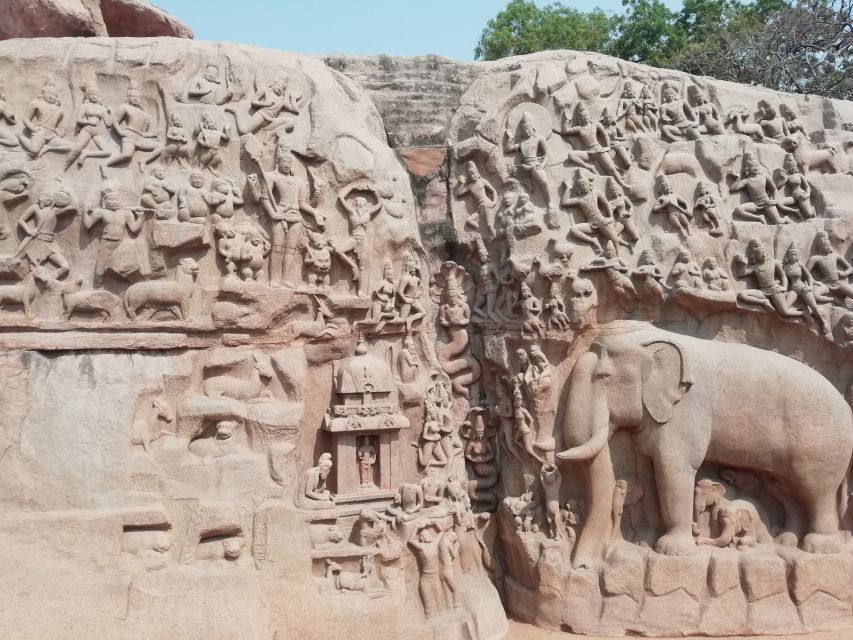
If you only had time for one site, this is the one that often fixes your whole day. Arjuna’s Penance is a massive bas-relief, roughly 100 feet by 45 feet, carved as a full storytelling panel. It’s not just characters lined up on stone. It’s a whole world, arranged around a central theme and filled with small details.
The panel includes the river Ganga at the center, with divine beings, hunters, animals, birds, and trees linked to the Himalayan regions. And the carvings include scene-like moments that reward close looking. A famous one is the cat standing on one leg in imitation of a holy man, with plump mice gathered around it.
Why I think this stop is worth paying for with a guide: bas-reliefs can look “busy” if you don’t have a roadmap. With a good guide, you learn what to notice first, how to scan the panel without missing the main action, and why certain elements are placed where they are.
Also, for anyone thinking about mobility or pacing, this is a good place to pause. You can take in the artwork from a comfortable viewing stance and let your eyes do the work, rather than constantly moving to new corners.
Krishna’s Butterball and the Art of Stone That Teases Physics
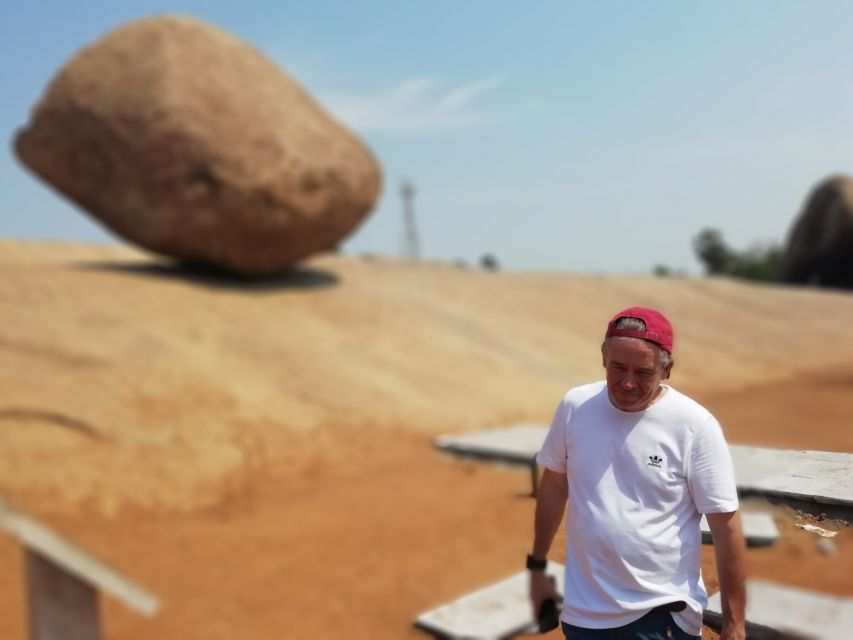
Next comes Krishna’s Butterball, a boulder perched on a slope in a way that looks like it should roll. It’s about 5 meters in diameter, and the visual trick is exactly why it works on first-time visitors. Your brain wants to solve it like a physics problem, and the stone just keeps its secret.
This is not the same kind of “story wall” as Arjuna’s Penance, but it’s an important breather. After a long look at relief carving, your eyes need a different type of input. Butterball gives you that, plus a memorable image to carry later when your brain starts mixing dates and names.
One tip: don’t treat it like a quick glance. Take 30 seconds to stand back and then step slightly to see the full perch effect. The illusion gets clearer as you reposition, and you’ll remember it more clearly if you actually look.
Ganesha Ratha, Mahishasura Mardini Cave, and Varaha Cave
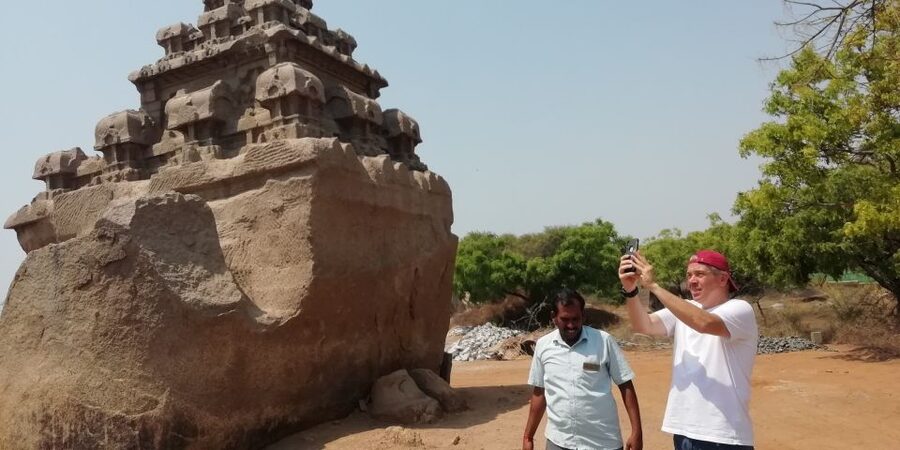
Mahabalipuram is full of places where different faiths and storylines share the same carved environment. These stops show that variety without changing the core look and feel of the site.
Ganesha Ratha
Ganesha Ratha is carved out of a single stone and was built in the 7th century by King Mahendravarman I. Originally dedicated to Lord Shiva, it later has Lord Ganesh associated with it. What makes it practical for first-time visitors is that it gives you a clear deity link, plus you can look for inscriptions. There are 18 inscriptions in ancient scripts, which helps you understand why scholars care about Mahabalipuram as much as tourists.
Mahishasura Mardini Cave
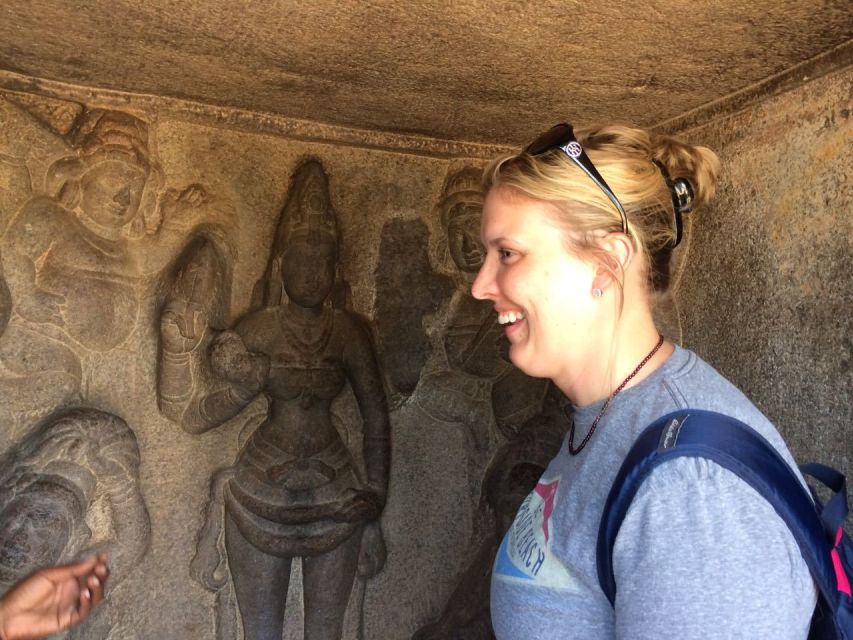
This cave contains two major bas-reliefs. One shows Lord Vishnu reclining on the coils of a serpent. The other shows Goddess Durga fighting the demon on a lion. These images can feel dramatic even if you do not know the whole epic. The arrangement helps you follow the story because the figures are placed as if the action is happening right now.
Varaha Cave
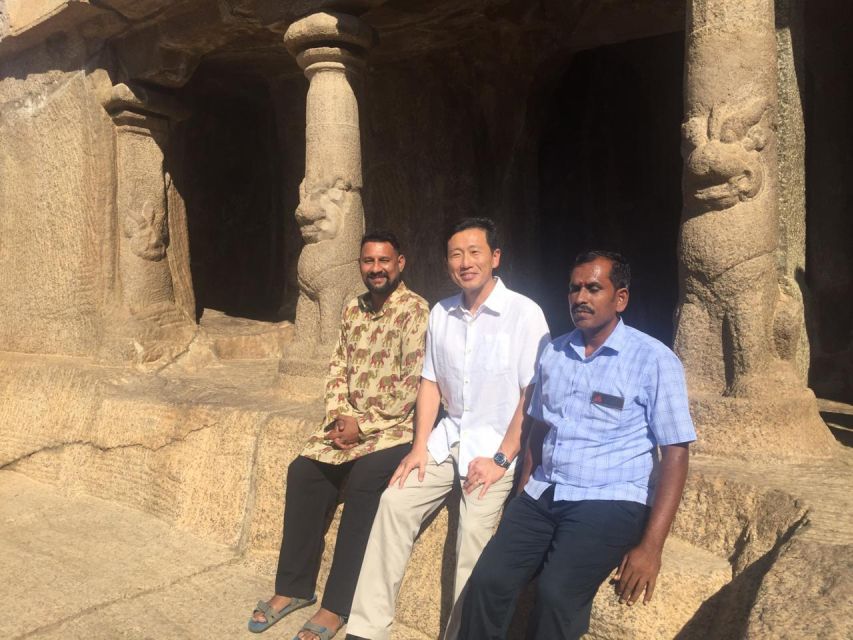
The Varaha cave is carved from a huge granite piece and dates back to the 7th century. It took decades to complete, and that long build time is part of what makes the carving feel intentional rather than rushed. You’ll notice squatting lions on pillars, and you’ll also see guardian figures that protect the sanctum.
What ties these three together is the feeling that you’re watching different versions of devotion expressed through stone. And because this tour is guided in English, you’re not left guessing about what the figures represent. You get enough context to make your staring feel productive.
Shore Temple: Granite, Sea-Farers, and the Marco Polo Connection
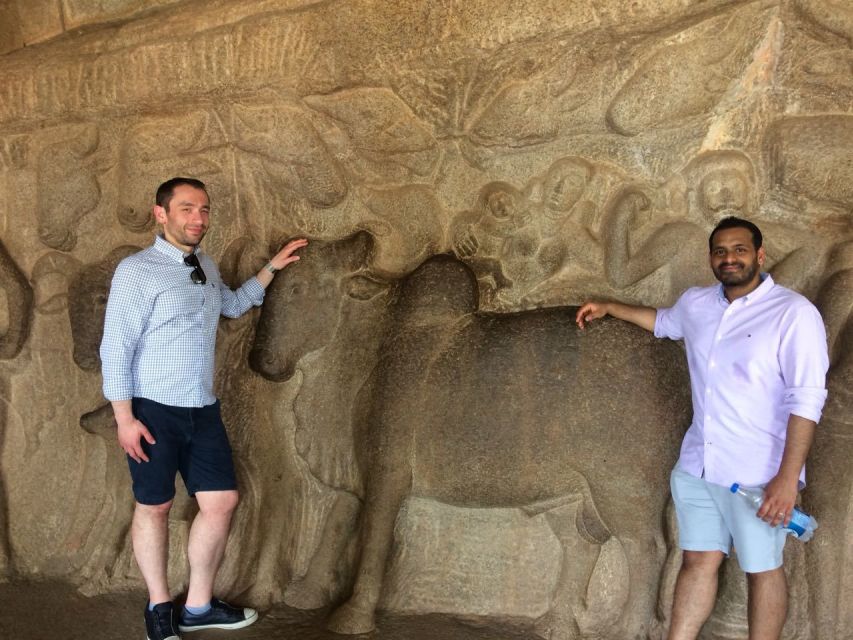
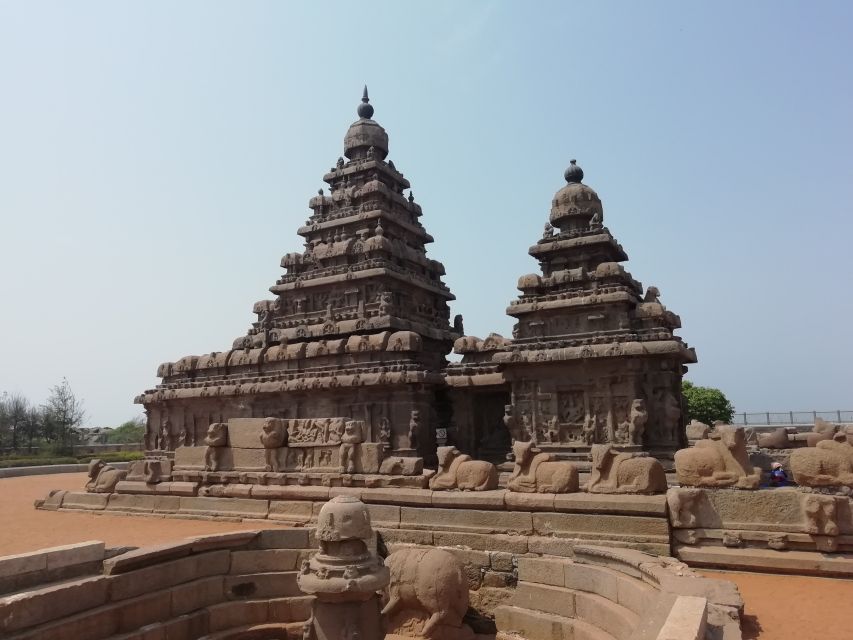
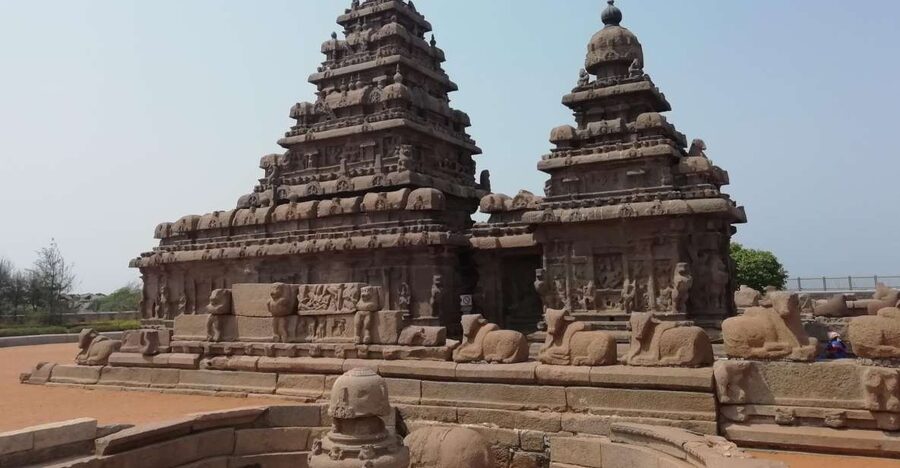
The final big monument in the Mahabalipuram set is the Shore Temple, an 8th-century structural temple made of granite. It was a beacon for sea farers, which immediately changes how you should imagine the site. Don’t picture it as a museum piece. Picture it as something meant to be seen from the water.
There’s also a legend that Shore Temple belonged to a complex of seven temples along the sea. This is where the Marco Polo story comes in. He mentioned Mahabalipuram as the city of the seven pagodas in his memoirs, linking this place to a wider world beyond Tamil Nadu.
From a photo perspective, Shore Temple is often easier because it’s more “architectural” than relief-focused sites. You can frame the structure, and the sea air gives you a different texture to the scene. If the sun angle is kind, you can also get better contrast in the granite surface than you get in shaded caves.
ISKCON Mahabalipuram: A Different Kind of Cultural Stop
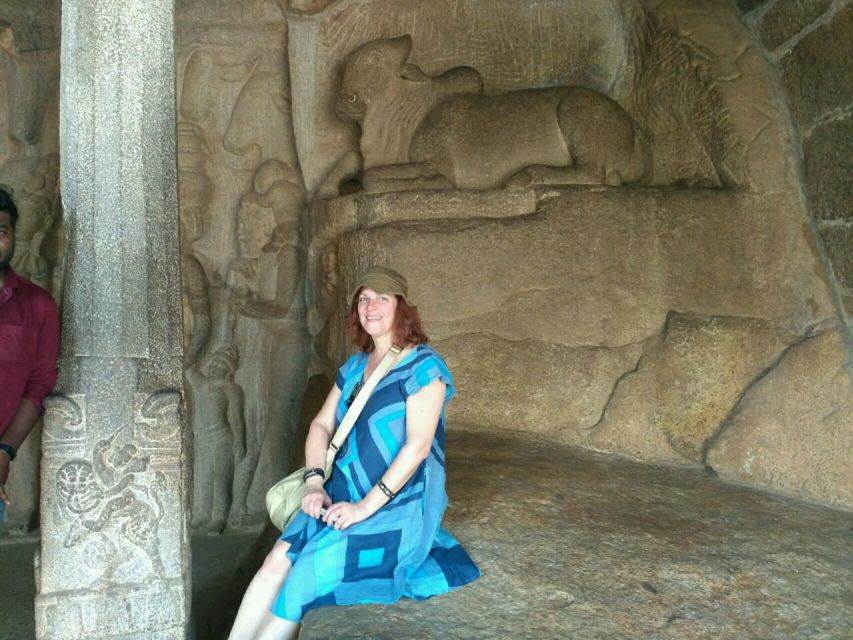
The tour also includes cultural immersion at the colorful ISKCON temple. This is a useful counterweight to hours of stone carving. You shift from Pallava-era iconography to living temple culture, where sound, color, and daily ritual make the day feel more complete.
I like this kind of add-on because it prevents the day from becoming only “monuments and trivia.” You get a place where people are worshiping and gathering now, not just preserved art from centuries ago. It’s also a good moment to reset your energy before heading back toward Chennai.
You may not come away with new architectural “facts” here, but you will come away with the sense that Mahabalipuram is not just a stop on a history list. It’s a functioning cultural center.
Lunch That Doesn’t Derail Your Day
Lunch is included, and it’s vegetarian at a local restaurant. Several guides and guests highlight that the food is tasty and satisfying, and that the guide may even help you make sense of what you’re eating.
This matters because Mahabalipuram days can run hot and long. When lunch is part of the planned timing, you avoid the classic problem of arriving at the wrong restaurant or waiting while your group loses momentum.
If you have dietary preferences, you should communicate them upfront. The tour data just says lunch is included and drinks are not, so specific menu details are not guaranteed. But you can at least expect a proper sit-down vegetarian meal built into the 7-hour window.
The Service Factor: Ministry-Approved Operator and Real Human Guides
A standout of this tour is the service quality tied to a tourism ministry approved operator. That translates into fewer headaches and a smoother flow between sites.
Just as important is the guide experience. Reviews mention guides such as Ramesh, Ganesh, Kennan, Kannan, Narayanan, and Dhanalakshmi, with consistent praise for clarity and care. One guide even worked as a “cultural translator,” adding context beyond Mahabalipuram and helping someone not miss a key Chennai site like St. Thomas basilica in limited time.
This is the part many people underestimate. With rock-cut sites, you can either watch stone sit there, or you can learn how to interpret it. When your guide helps you read what you’re seeing, you leave with more than photos.
There is one operational reality to keep in mind. This kind of private day can still include a short craft stop. One review calls it obligatory, and another person notes that it can be less impressive than the monuments themselves. If you are sensitive to time spent on shopping or demonstrations, ask your guide what that stop is for, and gauge how much time you should expect.
Timing, Walking, and Stairs: The Practical Side of a 7-Hour Day
Seven hours sounds long until you do it. In reality, it can feel fast once you factor in the drive, entry timing, and the need to pause at each monument to actually see details.
Walking is part of the deal. The good news is that not every site requires a huge climb. One review points out that only one site has a significant stairs section, and you can enjoy the area without tackling those stairs. Still, if you have mobility limits, I’d plan to move at a slower pace and bring the right shoes.
Also remember: most of these monuments are carved into stone, so the ground can be uneven. Wear stable footwear, and treat this as a walking day, not a drive-and-view day.
Who This Private Mahabalipuram Tour Is Best For
This is a strong fit if you:
- Want a private guide in English to interpret the rock-cut carvings
- Prefer hotel pickup, included entrance fees, and lunch to avoid planning on the fly
- Like history that you can see with your own eyes, not just read later
- Are short on time in Chennai and want the best Mahabalipuram concentration in one outing
It might be less ideal if you:
- Want zero time spent on any craft stop or shop visit
- Have limited mobility and do not want any chance of stairs, even if options exist to avoid them
- Prefer a very slow, linger-all-day pace rather than a structured 7-hour sweep
Should You Book This Private Guided Tour from Chennai?
I’d book it if your goal is a high-impact Mahabalipuram day with less stress. The mix of Pancha Rathas, Arjuna’s Penance, Krishna’s Butterball, Ganesha Ratha, cave temples, and the big finale at Shore Temple is exactly how you want to spend limited time. Add in a guided read, included lunch, and a ministry approved operator, and it’s the kind of day that feels thought-through.
Before you go, set one expectation: this is a guided circuit, so you’ll be moving and you may encounter a craft stop. If you can tolerate that, you’ll likely love the payoff. If you cannot, message the operator or ask your guide how the day is paced, then decide based on that.
FAQ
How long is the Mahabalipuram private guided tour from Chennai?
The tour duration is 7 hours.
What is included in the price?
The package includes hotel pickup and drop-off, a guide, entrance charges, lunch, and a private car.
Are drinks included?
No. Drinks are not included.
Is the group private?
Yes, it is a private group.
What language is the live guide?
The live tour guide is English.
Where do you get picked up from in Chennai?
Pickup is included from the lobby of your hotel.
What sights are part of the tour?
You will visit Pancha Rathas, Arjuna’s Penance, Krishna’s Butterball, Ganesha Ratha, Mahishasura Mardini Cave, Varaha Cave, Shore Temple, and you also get cultural immersion at the ISKCON temple.
Is there free cancellation?
Yes, free cancellation is available up to 24 hours in advance for a full refund.
What does pay later mean for this tour?
You can reserve now and pay later, which lets you book without paying anything today.
Chennai and Mahabalipuram Tours, compared.
 ★ 5.0Mahabalipuram tour by Tourism Ministry approved companyFrom $115405 reviews
 ★ 5.0Gods of Mylapore walking tour- tourism ministry approved companyFrom $40267 reviews
 ★ 5.0Mahabalipuram & Kanchipuram by tourism ministry approved companyFrom $135264 reviews
 ★ 5.0Chennai tour in car with guide-winner of traveller’s choice awardFrom $80258 reviews
 ★ 5.0Georgetown heritage walking tour in Chennai about the founding of ChennaiFrom $50144 reviews
 ★ 5.0Mahabalipuram Private tour from Chennai by car with guide and lunch by WonderFrom $89137 reviews
 ★ 5.0Mahabalipuram walking tour by tourism ministry approved companyFrom $50102 reviews
 ★ 3.8Chennai Walking Tour ( 2 hours guided tour)From $1485 reviews
Browse the lists this tour appears in