
REVIEW · CHENNAI AND MAHABALIPURAM TOURS
Mahabalipuram walking tour by tourism ministry approved company
Mahabalipuram makes history feel close. This Ministry-approved guided walk in Chennai region links the Pallava story to real stone monuments, from the Five Rathas to the Shore Temple. You’re not just ticking off sites, you’re learning how and why these 7th-century carvings matter.
I like two things right away: the small group size (max 15) keeps the pace sane, and the guide turns the monuments into a clear story you can follow. The big drawback to plan for is time, you only have about 3 hours, so you’ll want comfort on your feet and a quick eye for details.
In This Review
- Key Things That Make This Walk Work
- Where Mahabalipuram Fits in a Chennai Trip
- Meeting Point and End Point: Know Your Start, Avoid Temple Chaos
- The Pace: 3 Hours, 10 Stops, and the Art of Not Rushing
- Stop 1, Pancha Rathas: The Stone Chariots That Set the Tone
- Stop 2, Pancha Pandava Cave: Yali Figures and Six-Pillar Support
- Stop 3, Arjuna’s Penance: One of India’s Most Dramatic Bas-Reliefs
- Stop 4, Krishna’s Butter Ball: A Curious Boulder With a Big Story
- Stop 5, Varaha Cave Temple: 7th-Century Granite Carving Done Slowly
- Stop 6, Trimurti Cave: Brahma, Vishnu, Shiva in Rock-Cut Form
- Stop 7, Ganesh Ratha Temple: One Stone, Big Presence
- Stop 8, Old Light House: From 7th-Century Port Life
- Stop 9, Mahishasura Mardini Cave: Durga Versus the Demon
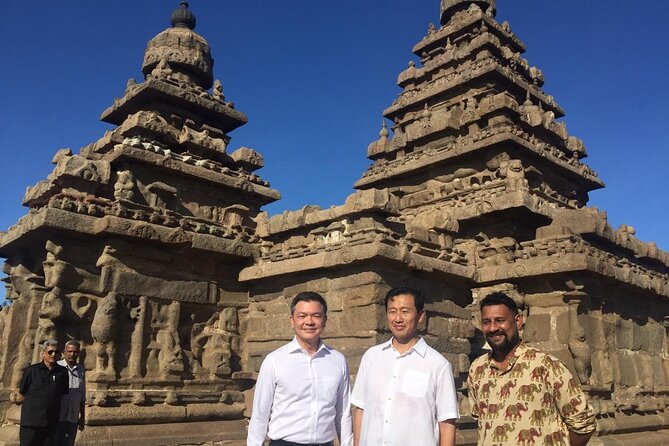
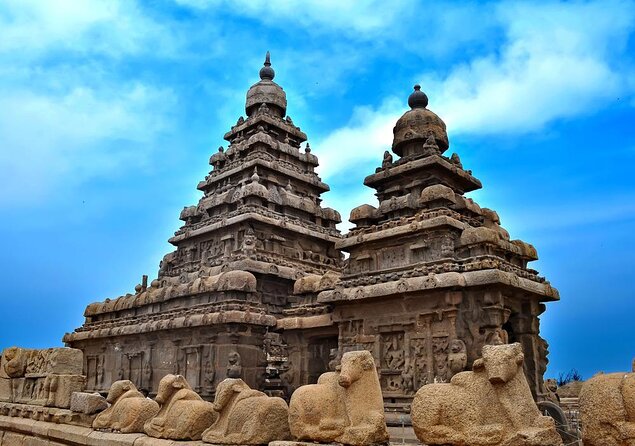
- Stop 10, Shore Temple: Ending With a View Over the Bay
- Transport Options: Walk It or Use an Autorickshaw
- Why the Guide Matters More Than You Think
- Price and Value: $50 for Tickets, Time, and Clear Direction
- Who This Tour Suits Best
- Should You Book This Mahabalipuram Walk?
Key Things That Make This Walk Work
UNESCO World Heritage highlights in one tight route that fits a half-day schedule
Admission tickets are included at each stop, so you do not waste time budgeting on the ground
Small groups with personal guidance so questions stay easy, even at stone carvings
Flexible transport options (walk or autorickshaw) if you want to pace yourself
A guide story style that brings Pallava art and building techniques to life, often with standout guidance from Ramesh
More Chennai days and shore temple runs
Where Mahabalipuram Fits in a Chennai Trip
Mahabalipuram is the kind of place that rewards a guide. The monuments are spread in a way that can feel confusing if you arrive with only guidebook maps. With a local guide, the route makes more sense fast: you see the progression of Pallava religious art, you understand repeated design themes, and you notice the techniques that make the stone look impossibly precise.
This tour is priced at $50 per person for an approximately 3-hour experience. For that money, you get more than a stroll. You get a set route, a group cap of 15, and admission included at the listed stops. If you’re the type who wants to see a lot without getting lost or waiting around, this is strong value.
Meeting Point and End Point: Know Your Start, Avoid Temple Chaos
The walk starts at the Mahabalipuram Shore Temple, Beach Rd. It ends at Five Rathas (Pancha Rathas) on W Raja St. That matters because Mahabalipuram’s temple area can be crowded and traffic around the monuments can be slow.
A practical tip: if you arrange your own drop-off, ask the driver to stop a bit away from the busiest temple entry points. Several people found that approach saves time and reduces stress when getting everyone moving. By the end of the walk, you’ll already be near your finishing cluster at the Five Rathas, which is handy if you want to continue exploring on your own.
The Pace: 3 Hours, 10 Stops, and the Art of Not Rushing
This is a highlight route. Each stop is short, roughly 15 to 20 minutes, with time to walk between areas and hear the key points. That means you’ll get the essentials at each monument, but you won’t have hours to linger.
So, decide what kind of traveler you are:
- If you want structure, story, and fast clarity, you’ll like this format.
- If you prefer slow museum-level looking, you may wish you had more time at the biggest carvings.
Because the tour runs on good weather, plan your day with a little buffer. If rain shows up, you could be offered a different date or a full refund.
- Georgetown heritage walking tour in Chennai about the founding of Chennai★ 5.0 · 144 reviews
- Mahabalipuram Private tour from Chennai by car with guide and lunch by Wonder★ 5.0 · 137 reviews
- Mahabalipuram walking tour by tourism ministry approved company★ 5.0 · 102 reviews
- Chennai Walking Tour ( 2 hours guided tour)★ 3.8 · 85 reviews
- Sowcarpet Street Food Walking Tour in Chennai with guide★ 5.0 · 83 reviews
Stop 1, Pancha Rathas: The Stone Chariots That Set the Tone
You begin at the World Heritage site with the Pancha Rathas, also called the Five Rathas. These are rock-cut monolith structures, carved in shapes that resemble chariots. They’re dedicated to different figures, and the design gives you an early lesson in how Pallava artists used scale and form to signal power and devotion.
What I like about starting here is how it primes your eye. After you see these stone chariots, the later carvings feel less random. You start noticing the same visual logic: clean edges, repeating motifs, and purposeful composition.
A small consideration: because these are carved structures, the best experience comes when you’re ready to look up as well as straight ahead. If you struggle with glare or strong sun, bring something that helps with eye comfort.
Stop 2, Pancha Pandava Cave: Yali Figures and Six-Pillar Support
Next up is the Pancha Pandava Cave, described as the largest cave-temple at Mahabalipuram. The cave is supported on six pillars and two pilasters, and that architectural detail is part of why it’s worth a guided visit.
You’ll also see Yali sculptures on the pillars. Yali figures are mythical creatures that show up across South Indian art, and in person they feel more expressive than in photos. With a guide, you get the connection between these creatures, the decorative framework of the cave, and the larger Pallava style.
Time here is about 15 minutes, so it’s a quick hit. Use that time to look closely at how the carvings sit on structural elements like pillars, because it’s a reminder that the art is built into the building, not added later.
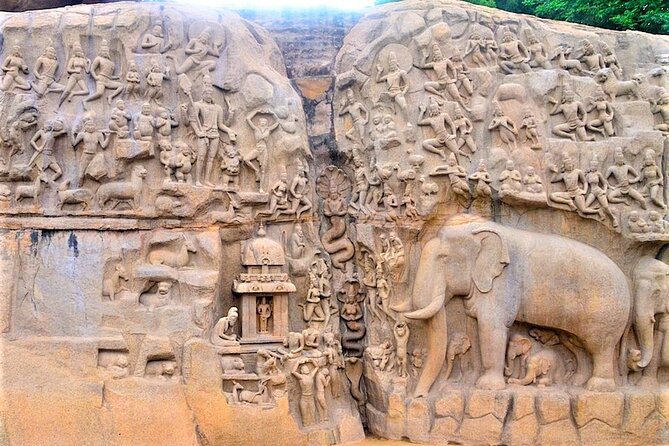
Stop 3, Arjuna’s Penance: One of India’s Most Dramatic Bas-Reliefs
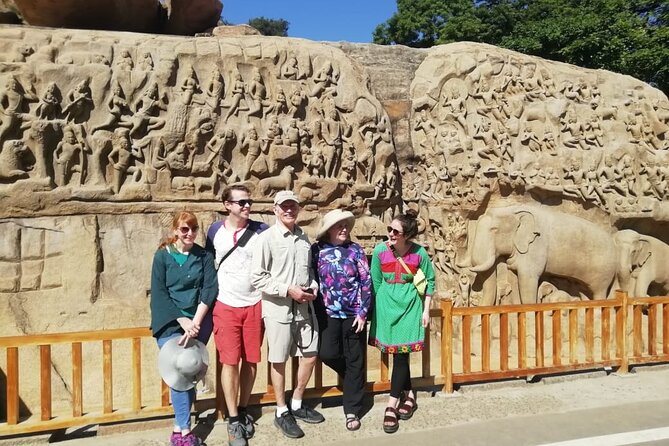
Then you reach Arjuna’s Penance, a bas-relief monument considered among India’s most magnificent ancient artworks. The scale is the headline: it’s described as 100 feet long and 45 feet tall.
Bas-reliefs can be tricky on your own because you need a guide to explain the storyline across the scenes. Here, the monument depicts vivid episodes from the Mahabharata. With interpretation, the scenes stop being “a lot of figures” and start reading like chapters.
A practical note: at a big relief, your best view depends on where you stand. Plan on adjusting your position a little to catch different sections. This is one of the best places to ask a question, even if it feels basic, because the guide can point out recurring characters and how the carving organizes the narrative.
Stop 4, Krishna’s Butter Ball: A Curious Boulder With a Big Story
Krishna’s Butter Ball is a granite boulder poised on a stony slope, famous for looking like it should slide but reportedly does not move. It’s a short stop at about 15 minutes, yet it’s a fun change of pace.
This monument is useful because it reminds you Mahabalipuram isn’t only temples and caves. It also plays with perception and stone geometry. If you like local explanations for famous shapes and “how did they do that” moments, this one is worth your attention.
Keep expectations realistic: this isn’t a long sit-and-stare sculpture garden. It’s a quick, memorable pause in the middle of the more serious temple stops.
Stop 5, Varaha Cave Temple: 7th-Century Granite Carving Done Slowly
The Varaha Cave Temple is carved out of a huge piece of granite and dates back to the 7th century. The tour notes it took several decades to complete, which changes how you see it. When a project like that takes decades, every detail feels intentional, not rushed.
You’ll see features like squatting lions adorning pillars. Lion forms are common in temple architecture, often tied to protection symbolism and strong visual framing at entrances or supports.
The time window is about 20 minutes, so you’ll focus on the key architectural and sculptural details rather than a full study. Still, the “decades” context from the tour makes the stop land better than a quick photo moment.
Stop 6, Trimurti Cave: Brahma, Vishnu, Shiva in Rock-Cut Form
Trimurti Cave is described as a fine example of Pallava rock-cut architecture. The cave is dedicated to the holy trinity of Hindu gods: Brahma, Vishnu, and Shiva. The guide’s job here is especially useful because trinity symbolism can feel abstract until you connect it to specific carvings.
The tour also highlights carvings of elephants. Elephants appear throughout South Indian art as symbols with cultural and religious meaning, and they can help you spot the style markers of the period.
This stop lasts about 20 minutes. If you’re an architecture-focused traveler, this is the place to look for the consistency of the carving style across spaces and surfaces, because it’s where you can feel the system behind the artwork.
Stop 7, Ganesh Ratha Temple: One Stone, Big Presence
At Ganesh Ratha Temple, you see an imposing chariot carved out of a single stone. It was originally dedicated to Lord Shiva and later associated with Lord Ganesh. The tour notes it was built in the 7th century by King Mahendravarman I.
This is one of those sites where a guide’s explanation helps you read the shift over time. Even if you only catch the main idea in a short visit, it’s still valuable: you see how temples and dedications can evolve, while the stone structure remains a fixed witness.
You’ll spend about 15 minutes here. For best results, take a second to notice the overall shape first, then return to details. With rathas, the silhouette matters.
Stop 8, Old Light House: From 7th-Century Port Life
Now for something different: the Old Light House. It’s noted as built in 640, described as India’s oldest lighthouse and one of the oldest in the world. That timing ties directly to why Mahabalipuram mattered as a port since the 7th century.
When a tour includes this stop, it expands the story from temple art to maritime life. Mahabalipuram wasn’t just a religious center. It was a working location where sailors needed help navigating the Bay of Bengal.
This portion is about 20 minutes, and it’s a good reminder that UNESCO sites often carry layers, not just one theme.
Stop 9, Mahishasura Mardini Cave: Durga Versus the Demon
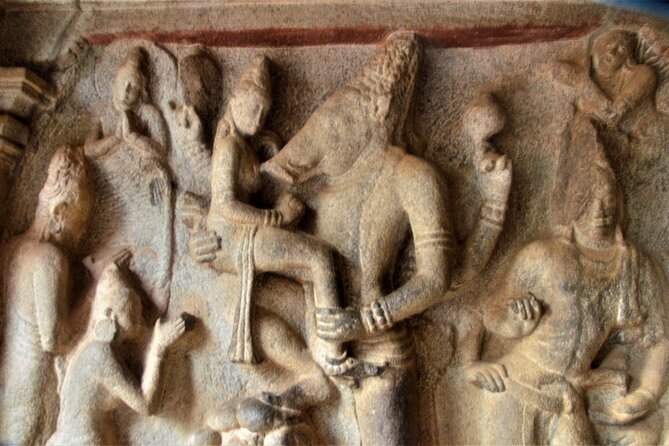
The Mahishasura Mardini Cave has two imposing bas-reliefs on the walls. One shows Lord Vishnu sleeping on the coils of a serpent. The other depicts Goddess Durga fighting the demon Mahishasura on a lion.
This is a strong storytelling stop because both scenes are visually dramatic. With a guide, you’re not stuck trying to interpret iconography from scratch. The guide can help you understand what’s being shown and why those images belong together.
Time here is about 15 minutes, so focus on composition: who is where, what action is frozen in stone, and how the figures are framed by surrounding carvings.
Stop 10, Shore Temple: Ending With a View Over the Bay
The last stop is the Shore Temple, which overlooks the Bay of Bengal. It’s described as an important center during the reign of the Pallavas, when Mahabalipuram served as their main port.
Ending at the Shore Temple is smart because it gives you an emotional reset. After caves and reliefs, you step back and connect the stones to the setting they were built for. The seaside location also helps you understand why maritime importance and temple power likely reinforced each other.
This stop lasts about 20 minutes, giving you enough time for a final guided wrap-up and time to reset your camera position if you want one last set of photos.
Transport Options: Walk It or Use an Autorickshaw
The tour gives you choice: you can do it on foot or by autorickshaw. People also mention tuk tuk as a practical option, especially if you’re trying to reduce strain.
For seniors or anyone with mobility concerns, this flexibility can be a make-or-break detail. You still see the monuments, you just manage your body and energy.
If you choose to walk most of it, bring water and wear comfortable shoes with decent grip. Stone can be uneven, and you’ll be moving between outdoor areas that can feel hotter than you expect.
Why the Guide Matters More Than You Think
This is where the tour earns its high marks. The guidance style described is energetic, and the explanations are clear enough to turn carved stone into a coherent story. One name that repeatedly shows up in positive feedback is Ramesh, praised for being knowledgeable about Pallava sculptures and the remarkable construction techniques used.
The biggest value here is context. Without interpretation, you might admire the craftsmanship and move on. With a guide, you can connect the architecture to the era, the art to the stories, and the stones to the people who commissioned them.
Also, guides appear flexible in real-world situations. Some people report their guide extended the tour when there was extra time, which tells you the experience is not rigid for the sake of being rigid. That flexibility can matter on days when you want a bit more breathing room at a major relief.
Price and Value: $50 for Tickets, Time, and Clear Direction
At $50 per person for about 3 hours, you’re paying for three things: entry-admission inclusion, guided interpretation, and a route that keeps you from wasting time figuring out what to see first.
A simple way to judge value:
- If you would otherwise pay for multiple admissions on your own, the included tickets reduce friction.
- If you tend to ask questions and want explanation, the guide is the main value driver.
- If you’re traveling with others and want a smoother plan, the small group cap of 15 helps.
The only real cost risk is your own pace. If you want lots of lingering time, you may end up wanting an extra hour on your own after the walk.
Who This Tour Suits Best
This walk is ideal for:
- History and architecture buffs who like stonework, design, and symbolism
- Travelers who want a structured “greatest hits” route without dealing with confusion
- Anyone who values small groups and straightforward explanations
It’s also a good fit if you’re on a Chennai trip and want a half-day cultural stop that feels meaningful, not rushed.
Should You Book This Mahabalipuram Walk?
If you want a focused way to see the Pallava masterpieces in a short time, I think it’s a smart booking. You get included admissions at multiple major monuments, a small group size, and a guide who is praised for turning stone carvings into understandable stories.
Book it if:
- You like guided context, not just photos
- You want a route that covers a lot in about 3 hours
- You appreciate the option to walk or use autorickshaw
Skip it or plan extra time if:
- You prefer slow, long visits at a few monuments
- You’re traveling without the flexibility to handle uneven stone and outdoor walking
If weather is good and you’re ready for a brisk, story-led route, this is an excellent way to spend your day in Mahabalipuram.
Chennai and the Shore Temples



Recently reviewed across Chennai
- Colonial Charm & Cultural Treasures Chennai Sightseeing Tour
★ 4.0 · 10 reviews - Chennai & Mahabalipuram day trip with private car, Lunch & Guide
★ 5.0 · 10 reviews - Mahabalipuram walking tour by certified travel company
★ 5.0 · 10 reviews - Explore Chennai City Tour with Guide, Lunch, and Local Highlights
★ 5.0 · 10 reviews - British Architecture Walk in Chennai by Wonder tours
★ 5.0 · 10 reviews - St Thomas Trail in Chennai by Wonder tours
★ 4.5 · 11 reviews
Chennai and Mahabalipuram Tours, compared.
 ★ 5.0Mahabalipuram tour by Tourism Ministry approved companyFrom $115405 reviews
 ★ 5.0Gods of Mylapore walking tour- tourism ministry approved companyFrom $40267 reviews
 ★ 5.0Mahabalipuram & Kanchipuram by tourism ministry approved companyFrom $135264 reviews
 ★ 5.0Chennai tour in car with guide-winner of traveller’s choice awardFrom $80258 reviews
 ★ 5.0Georgetown heritage walking tour in Chennai about the founding of ChennaiFrom $50144 reviews
 ★ 5.0Mahabalipuram Private tour from Chennai by car with guide and lunch by WonderFrom $89137 reviews
 ★ 3.8Chennai Walking Tour ( 2 hours guided tour)From $1485 reviews
 ★ 5.0Sowcarpet Street Food Walking Tour in Chennai with guideFrom $4583 reviews
Browse the lists this tour appears in