

REVIEW · HISTORICAL TOURS
1 day private tour of Hampi world heritage site in car with professional guide
Hampi feels like time travel in stone. This private 1-day loop hits the big names of the Vijayanagara world, starting with Vijaya Vittala Temple and moving through Virupaksha and the Royal Enclosures with a professional guide to make sense of what you are seeing. I like how the route is paced for a single day, and I like that admission is handled as part of the plan at each stop. The main drawback to consider is simple, one day can feel fast for a site this big, and you may want more time to slow down and wander.
You get picked up and driven in a car, and the whole experience runs about 9 hours. If you want the highlights without the stress of sorting directions, timing, and tickets, this format is a smart choice. One extra note from real-world experience, a comfortable AC car helps a lot when the morning heat shows up.
In This Review
- Key reasons this Hampi day tour works
- Hampi in one day, what you really need to know
- Private car, pickup, and the day plan that protects your energy
- Vijaya Vittala Temple, 30 minutes of wow-factor stonework
- King’s Balance, a small stop with a big legend
- Virupaksha Temple, why it feels like the oldest anchor
- Sasivekalu Ganesha, quick visit, single-block power
- Ugra Narsimha statue, 22 feet of presence
- Royal Enclosures and Queen’s Bath, where the power story is visible
- Zanana Enclosure and Lotus Mahal, royal women and architecture in focus
- Hazara Rama Temple, a single temple in the royal complex
- Underground Shiva Temple and the end stretch you should not skip
- Comfort, lunch, and the small breaks that make a long day work
- Price and value, is $125 per person worth it?
- Who this Hampi day tour is best for
- Should you book this one-day Hampi private tour?
- FAQ
- What is the duration of the Hampi private tour?
- What time does the tour start?
- Is this a private tour?
- What stops are included in the tour?
- Are admission tickets included?
- Is pickup available?
- Do I need a printed ticket?
- How much does the tour cost?
- What is the cancellation policy?
Key reasons this Hampi day tour works
- A pro guide who connects the dots, so temples feel like chapters, not random ruins
- Admission tickets included at the stops on the route
- A tight, efficient route that fits into a 1-day window
- Private car comfort, including AC noted by previous visitors
- Royal Enclosures focus, for the power story of the Vijayanagara kingdom
Hampi in one day, what you really need to know

Hampi is often described as the world’s largest open-air museum, and that reputation fits. You are looking at an entire 16th-century power center spread across ruins, temples, and carved stone. In one day, you will not see everything. What you can do is see the most important sights in a logical order, with enough context to actually enjoy them.
This private tour format is built for people who value clarity over roaming. You get a professional guide, a driver, and a car, so you are not spending your energy figuring out routes or timing. Starting at 8:00 am also helps, because you catch the mornings when the site still feels approachable.
The price, $125 per person, lands in the range of a serious private excursion. The value comes from what is packaged: a guide, a full day of site time, and admission tickets included for each listed stop. If you are traveling with someone and want a private setup, the cost can make a lot of sense versus piecing together transport plus guide plus tickets.
Private car, pickup, and the day plan that protects your energy
The tour is a private activity, meaning only your group participates. That matters in Hampi, where stops are spread out and walking can add up quickly. A private car also means you can start early and keep moving without constantly re-planning.
I also like the way the experience is structured around a sequence of specific monuments. You begin at Vijaya Vittala Temple, then move to King’s Balance, Virupaksha Temple, and onward through the Royal Enclosures and nearby shrine areas. Even if you are not a hardcore archaeology person, the guide’s job is to help you spot patterns: how the builders shaped the stone, how the city’s power shows up in the layout, and why certain temples still matter.
One practical detail that shows up in feedback is comfort in the car. Visitors have mentioned a comfortable ride with AC, which is not a small thing when you are doing hours in the open air.
Vijaya Vittala Temple, 30 minutes of wow-factor stonework
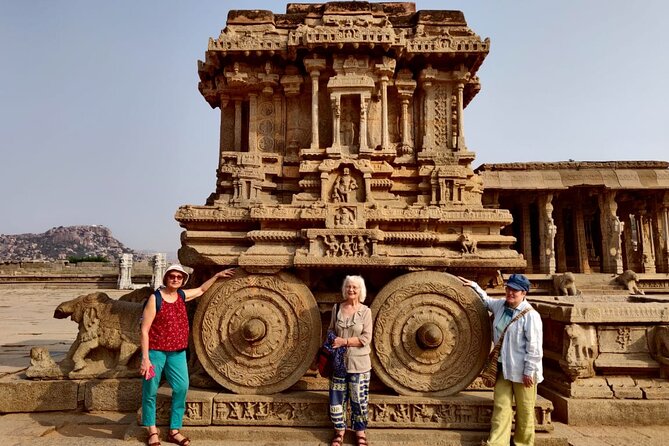
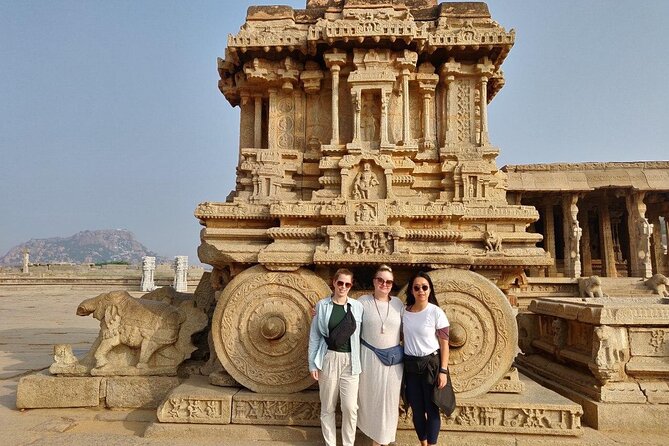
Your day kicks off at Vijaya Vittala Temple, often treated as the grand centerpiece of Hampi. The standout features are the temple’s dramatic stonework and its famous stone chariot in front. You also get context about how the temple is built on a polyhedron foundation, which helps you understand why the complex feels so carefully engineered rather than random ruins.
The stone chariot is the photo magnet, but what matters more is what the guide will point out while you are standing there. Details like the relationship between the main temple structure and surrounding carvings make the whole scene click. In 30 minutes, you can get the big sight seen and still have enough time to absorb what is actually in front of you instead of rushing through.
Possible drawback: if you are the type who likes long pauses for sketching, slow religious atmosphere, or serious close-up photos, 30 minutes may feel short. Think of this stop as your anchor, the one you want to be fully ready for.
King’s Balance, a small stop with a big legend
King’s Balance is less crowded than Vittala but still very memorable. It is a huge stone frame east of Purandara Mantapa, built around the simple idea of a beam set across two pillars of stone. Local legend ties the place to the generosity of the Vijayanagara kings, often described as a ritualized weighing story.
This is one of those stops where a good guide makes a difference. The physical structure is striking on its own, but understanding the story helps you notice the reason the structure exists. Even in 15 minutes, you can leave feeling like you learned something rather than just took a quick glance.
Possible drawback: if you are only interested in the most famous, the “balance” may feel more abstract. It is worth it if you like understanding the culture behind the stones.
Virupaksha Temple, why it feels like the oldest anchor
Next comes Virupaksha Temple, one of Hampi’s key sights. It is described as coming from the Hoysala period and being the oldest temple in Hampi. The temple’s tower is said to have eleven storeys and rise to about 165 ft, which helps you picture how central it would have been in the skyline when Hampi was active.
This stop is paced at about 30 minutes, enough time to understand the temple’s role without feeling whipped along. The tower height and the temple’s continued importance give the whole area a gravity that you can feel even if you are not fluent in the mythology.
Why this matters to you: it is easier to enjoy the rest of the ruins when you have one “anchor” temple that makes the city feel connected. Virupaksha is that anchor.
Sasivekalu Ganesha, quick visit, single-block power
The Sasivekalu Ganesha Temple is a statue carved from a single block of rock. You are looking at a giant Lord Ganesha figure, about 8 feet tall. At only 15 minutes, it is not a long stop, but it is an efficient one.
What makes it special is the sculptural clarity: a single-block carving means the monument’s shape and proportions matter. The guide can also help you appreciate why this kind of statue placement would work as a landmark in the city.
Possible drawback: if you want lots of time for close detail photos and slow reading of carvings, this stop may feel like a fast touch. But as a day-tour waypoint, it does its job well.
Ugra Narsimha statue, 22 feet of presence
Not far from the Badavi Linga area, you will see the Statue of Ugra Narsimha. The idol is described as about 22 feet high and carved during Krishnadevaraya’s time. There is also mention of a serpent with an open hood at the back, which adds drama to what could otherwise be just a big figure.
This is another 15-minute stop, but it tends to land because size changes how ruins hit you. From a distance it is impressive, up close it becomes even more vivid because you start noticing how the stone carries emotion and motion.
Why this helps: Ugra Narsimha gives a different flavor from the more architectural temple stops. It is a good balance for a one-day route.
Royal Enclosures and Queen’s Bath, where the power story is visible
Now you step into the Royal Enclosures, the seat of power of the Vijayanagara kingdom. This area includes durbar halls, platform spaces, tanks, underground chambers, and temples. You start around Queen’s Bath, described as part of the complex, and the schedule gives you about 1 hour here.
This is often the most rewarding stretch for people who want context. It is not just “look at temple, next.” It is a chance to understand how rulers used space, water, and public ritual. The mention of tanks and underground chambers is a clue that the city was engineered, not just decorated.
Queen’s Bath is the early highlight because it forces you to look for human-scale purpose inside the grandeur. Even if you only catch it briefly, it shifts your thinking from religious monuments to city planning and royal life.
Possible drawback: 1 hour goes quickly if you like to wander on your own. The benefit is that the guide can keep you from getting lost in a huge area and missing the key features.
Zanana Enclosure and Lotus Mahal, royal women and architecture in focus
From the Royal Enclosures you move to the Zanana Enclosure, described as the place for royal women. The standout structure here is the Lotus Mahal, a two-storeyed palace surrounded by a rectangular wall.
This part of the day is shorter, about 20 minutes. Still, it often feels like a relief because it changes the lens from religious monuments to palatial architecture. In a single day, switching viewpoints like this helps you avoid “ruins blur,” where everything starts to look similar.
I like that this segment gives a different side of royal life. It makes the city feel less like a set of temples and more like a full functioning society.
Hazara Rama Temple, a single temple in the royal complex
You then visit Hazara Rama Temple, described as the only temple in the Royal Enclosure, dedicated to Lord Ram. The time you get is about 20 minutes.
This stop works best if you enjoy seeing how devotion fits into a palace setting. A temple inside a political enclosure changes the feel of the whole zone. Instead of thinking only about ceremonies for the public, you start imagining how private worship and royal identity might have intertwined.
Possible drawback: because it is a single temple inside a larger complex, you could miss its significance if you rush. Let the guide help you compare it to what you saw at Queen’s Bath and the broader enclosure layout.
Underground Shiva Temple and the end stretch you should not skip
Before the tour finishes, you also visit an excavated water tank, the administrative enclosure, and an underground temple of Shiva. This part is about 20 minutes.
Underground spaces are a gift on a one-day route. They break up the visual sameness of above-ground ruins and remind you that Hampi was built with water systems and practical administrative spaces, not only temple structures.
This is also a good moment to ask the guide a question about the city’s overall design. By now you have seen enough monuments that you can connect the dots, and your questions will get better answers.
Comfort, lunch, and the small breaks that make a long day work
A long drive and a full day of walking in the open air can wear you down fast. One piece of feedback that stuck with me is that people have enjoyed a lunch stop at a place called Mango Tree before continuing. If it is on your route, it sounds like the kind of meal you want: something reliable so you can keep touring afterward.
Also remember that some Hampi highlights are spread out, so plan for steady movement, not long leisurely breaks every hour. The private car helps, because you get quick transitions from one area to the next.
One other highlight that comes up is a short boat ride to see ancient temples from the water. That kind of viewpoint can be a real reset for the brain, especially after you have been looking at stone carvings for hours.
Price and value, is $125 per person worth it?
At $125 per person for about 9 hours, the price only feels high if you compare it to a self-guided day. But self-guided has hidden costs: transport time, ticket chaos, and the risk of missing what is actually important.
Here, the value comes from packaging. You get a professional guide, a private car, pickup offered, and admission tickets included at the stops on the route. Plus, since it is private, you can go at your group’s pace within reason, instead of being stuck with a larger schedule.
Booking timing can also matter. This tour is often booked about 44 days in advance on average. If you have fixed travel dates, you will save stress by locking it in earlier.
Who this Hampi day tour is best for
This tour fits best if you:
- have limited time and want the major sights in one day
- care about understanding the site rather than just collecting photos
- prefer a private setup with a car and a guide
- want a structured route starting at 8:00 am
It may not be ideal if you:
- want to spend hours at a few locations and wander without guidance
- feel you need two full days to see Hampi at a slower rhythm
Even one-day tours come with the truth that Hampi is big. Some people will leave wishing for one more day, and that is not a failure of the tour. It is just how large this place really is.
Should you book this one-day Hampi private tour?
Book it if you want a tight, guided highlights plan and you know you will not have time for a longer stay. The guide-led flow, the inclusion of admission at each stop, and the comfort of a private car make it a low-stress way to enjoy Hampi’s biggest monuments.
Skip it, or choose a longer option, if you are the type who wants deep time at one temple or you plan to spend extra effort hiking, wandering, and discovering beyond the main circuit. In that case, one day can feel like a fast scan.
If you are on the fence, I would base your decision on your pace. If you love structure and context, this is the right match for a first visit to Hampi.
FAQ
What is the duration of the Hampi private tour?
The tour lasts about 9 hours.
What time does the tour start?
The start time is 8:00 am.
Is this a private tour?
Yes. It is private, and only your group participates.
What stops are included in the tour?
The tour includes Vijaya Vittala Temple, King’s Balance, Virupaksha Temple, Sasivekalu Ganesha Temple, Statue of Ugra Narsimha, Royal Enclosures (including Queen’s Bath), Zanana Enclosure (including Lotus Mahal), Hazara Rama Temple, and an Underground Shiva Temple area.
Are admission tickets included?
Admission tickets are included for the listed stops on the itinerary.
Is pickup available?
Yes, pickup is offered.
Do I need a printed ticket?
The tour uses a mobile ticket.
How much does the tour cost?
The price is $125.00 per person.
What is the cancellation policy?
Free cancellation is available up to 24 hours in advance for a full refund.
Historical Tours, compared.
 ★ 5.0Old Delhi Food, Heritage&Cultural Walk with Rickshaw ride to Masterji Kee HaveliFrom $52742 reviews
 ★ 5.0Blue City Heritage Private Walking Tour With Pickup and Drop-OffFrom $11441 reviews
 ★ 4.0Kolkata Heritage Tram TourFrom $60395 reviews
 ★ 5.0Private Heritage Walking Tour in Jaisalmer Fort and Old BazaarFrom $10306 reviews
 ★ 4.8Panaji: Heritage Walk through Goa’s Latin QuarterFrom $12291 reviews
 ★ 5.0Old Delhi Heritage Walking TourFrom $13247 reviews
 ★ 5.0Jodhpur Blue City Heritage Walking Guided TourFrom $13240 reviews
 ★ 5.03-hour Old Delhi Heritage Walking tour with Rickshaw RideFrom $7240 reviews
Browse the lists this tour appears in