
REVIEW · CHENNAI AND MAHABALIPURAM TOURS
British Architecture Walk, an immersive walking tour in Chennai
Chennai looks different once you notice the British lines. This walking tour strings together British-era architecture across key spots, with small groups (max 15) and a local guide who keeps the story clear. I also love that snacks and coffee or tea are included, so you do not lose time hunting food. One thing to plan for: a few major buildings have admission not included, so you may need to pay separately at those stops.
What makes it especially rewarding is the way the architecture mixes styles. You get Indo-Saracenic and Gothic Revival details tied to real names like Henry Irwin, George Harding, Robert Chisholm, N. Grayson, and Francis Napier, so the buildings feel less random and more meaningful. If your guide is Satish or Hareesh, you also tend to get extra human touches, like practical pointers on what to notice and even Indian coffee en route on at least some runs.
The route is designed for an evening or late afternoon walking pace, about 2 hours 30 minutes from Egmore to the University of Madras. Optional hotel transfers can reduce hassle, but if you are doing it without pickup, the walk starts near public transportation and finishes near the Marina Beach area.
In This Review
- Key highlights to plan your walk
- Price and what $55 gets you in Chennai
- Logistics that keep the walk from feeling like a marathon
- What British architecture looks like when you stop treating it like background
- Stop 1: Egmore Railway Station, Henry Irwin’s Indo-Saracenic calling card
- Stop 2: Chennai Central, Gothic Revival meets Robert Chisholm
- Stop 3: Victoria Public Hall, Queen Victoria’s Golden Jubilee in brick and stone
- Stop 4: Ripon Building area, civic authority and the name Lord Ripon
- Stop 5: Southern Railway Headquarters, Indo-Saracenic in a 1921 power suit
- Stop 6: Napier Bridge, Francis Napier and the Marina connection
- Stop 7: University of Madras Senate House, Robert Chisholm’s Indo-Saracenic finish
- Stop 8: Victory War Memorial, from Allied victory to local landmark
- The guides make the tour: names to watch for, and why it matters
- Who should book this walk, and who might want to skip it
- Should you book the British Architecture Walk in Chennai?
- FAQ
- How much does the British Architecture Walk in Chennai cost?
- How long is the tour?
- Is pickup included?
- How many people are in the group?
- What is included during the walk?
- Which stops include admission tickets?
- What is the cancellation policy?
Key highlights to plan your walk
- Max 15 people, so your local guide can answer questions and keep the pace sensible
- Snacks plus coffee or tea included, so you can focus on buildings instead of meal timing
- Mobile ticket for easier check-in, plus pickup is available if you select it
- Admission is included at Egmore, Chennai Central, Napier Bridge, and Victory War Memorial
- British architectural styles in one loop, from Indo-Saracenic rail buildings to Gothic Revival facades
- Route ends at University of Madras, with the Senate House area as a satisfying finish
More Chennai days and shore temple runs
Price and what $55 gets you in Chennai
At $55 per person for about 2 hours 30 minutes, this is not a budget-only activity. Still, I think it is good value when you look at what is wrapped in.
You get a local guide, small-group format, and snacks plus coffee or tea included. On top of that, admission tickets are already included at several stops, including Egmore railway station, Chennai Central railway station, Napier Bridge, and the Victory War Memorial. Those included admissions help make the price feel more fair than a tour where you pay separately at every single building.
You also get practical perks that matter in a city like Chennai. The tour uses a mobile ticket, and the company offers optional hotel transfers if you choose that add-on. Group discounts are listed too, which can help if you are traveling with friends or a small family.
Logistics that keep the walk from feeling like a marathon
This is a walk with a clear start and finish. You begin at Chennai Egmore, near Gandhi Irwin Road in Egmore, and you finish at University of Madras, near Navalar Nagar in Chepauk, Triplicane.
The tour is capped at 15 people, and that small size changes how the whole experience feels. With a big group, architectural details often get lost, because the guide is constantly trying to move people. Here, you have more room to stop, look closely, and ask questions without holding everyone up.
Most stops are near public transportation, which is useful if you need to rejoin or adjust your day plan. The tour also has mobile ticket convenience, which saves time at check-in.
What British architecture looks like when you stop treating it like background
The biggest payoff is learning how British-era rule shaped the built environment, not just the monuments. Chennai’s colonial period did not create one uniform style. Instead, you see a patchwork of British design ideas blended with local building traditions and materials.
A key theme is the Indo-Saracenic approach you keep seeing in civic and rail structures. You can spot it in how buildings mix arches, domes, and ornate surface patterns with the planning and authority feel that British institutions brought. When you know what to look for, the facades stop looking like random ornament and start looking like an architectural argument.
The Gothic Revival moments also help you compare. When you see Gothic features side by side with Indo-Saracenic ones, you start to understand why these buildings were meant to look powerful and official, not just pretty.
- Georgetown heritage walking tour in Chennai about the founding of Chennai★ 5.0 · 144 reviews
- Mahabalipuram Private tour from Chennai by car with guide and lunch by Wonder★ 5.0 · 137 reviews
- Mahabalipuram walking tour by tourism ministry approved company★ 5.0 · 102 reviews
- Chennai Walking Tour ( 2 hours guided tour)★ 3.8 · 85 reviews
- Sowcarpet Street Food Walking Tour in Chennai with guide★ 5.0 · 83 reviews
Stop 1: Egmore Railway Station, Henry Irwin’s Indo-Saracenic calling card
You start at Chennai Egmore railway station, an old landmark over 100 years old. This station is described as one of the earliest buildings in Indo-Saracenic style, designed by Henry Irwin.
One detail I would not skip, even if you only glance from the outside: the building is positioned as larger than London’s Charing Cross station. That comparison tells you the mindset behind the architecture, the intent to make a colonial-era station feel like a major hub, not a modest outpost.
You can also expect that ornate mix of forms typical of Indo-Saracenic design. Look for how the station’s styling balances British institutional clarity with Indian-influenced decorative language. Admission is included here, so you can focus on observing rather than figuring out ticket logistics.
Stop 2: Chennai Central, Gothic Revival meets Robert Chisholm
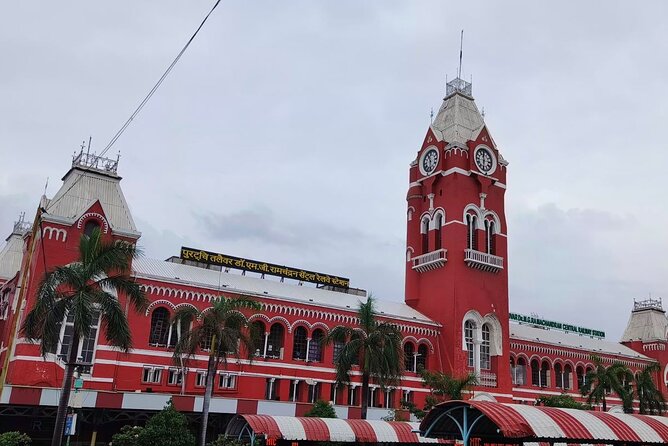
Next up is Chennai Central railway station, built in 1873 in Gothic Revival style by British architect George Harding. The story gets even better because the station was later modified by Robert Chisholm, who added a central clock tower and Travancore caps.
This is a great stop for learning through comparison. Harding’s Gothic Revival influence gives the station a strict, formal feel. Then Chisholm’s additions add a distinct rhythm to the skyline, especially with that central tower moment and the roofline caps.
If you like architecture that rewards looking up, this is your moment. Even without going deep into technical jargon, the guide can help you identify what is Gothic Revival and what is Chisholm’s layer. Admission ticket is included, which makes it easier to plan your time and energy for the rest of the walk.
Stop 3: Victoria Public Hall, Queen Victoria’s Golden Jubilee in brick and stone
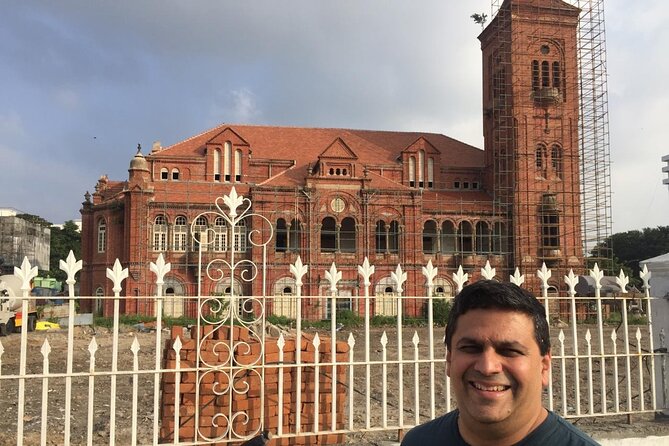
You then reach Victoria Public Hall, opened to the public in 1887 to commemorate Queen Victoria’s Golden Jubilee. The hall is named after the queen and was used for public events like meetings.
This stop is shorter, but it is a useful reminder that colonial influence was not only about railways and bridges. British rule also shaped civic life through venues for gatherings, speeches, and public decision-making.
One practical note: admission is not included here. That does not make it a bad stop, but it does mean you should be ready for the possibility of paying separately, depending on what access is available on the day.
Stop 4: Ripon Building area, civic authority and the name Lord Ripon
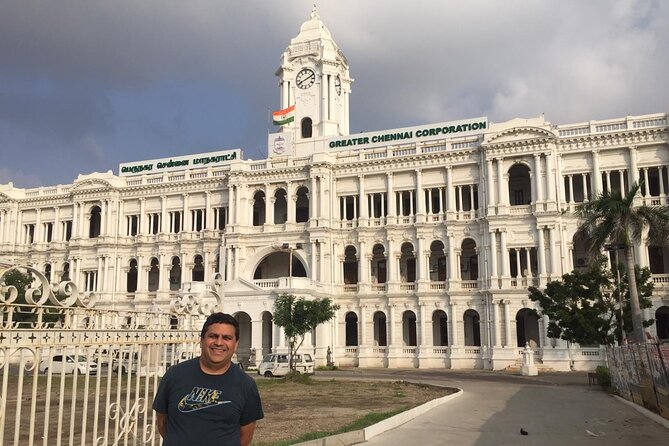
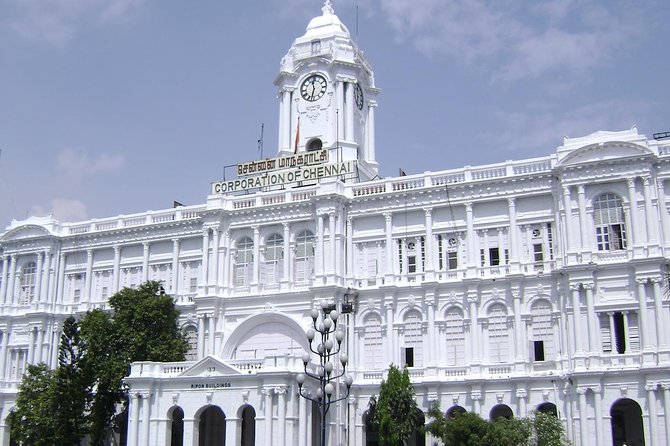
From there, you walk toward the Ripon Building, connected to the Greater Chennai Corporation office area. The Ripon Building was commissioned in 1913, designed by G.S.T. Harris, and built by Loganatha Mudaliar. It is named after Lord Ripon, a Governor-General.
This is one of those architecture stops where the context really matters. A lot of people think of colonial buildings as isolated landmarks, but civic buildings explain how power and administration were meant to be seen every day.
I also like that the stop ties together local builders and British political figures. It helps you see the architecture as a collaboration of sorts, not only a one-way import of styles.
Admission is not included for this stop, so you may want to keep a little cash or plan for paid entry if the guide suggests it on the day.
Stop 5: Southern Railway Headquarters, Indo-Saracenic in a 1921 power suit
Next is the Southern Railway Headquarters, completed in 1921. The building is described as Indo-Saracenic, designed by N. Grayson and built by Samynada Pillai.
If rail architecture is your thing, this stop is a treat because it shows how “transport infrastructure” was also a brand and a statement. Indo-Saracenic styling here is not decoration for decoration’s sake. It is used to give the headquarters an official presence, the kind of building that looks like it belongs at the center of something important.
Admission is not included at this stop, so treat it as a look-and-learn stop first. Still, even from outside, you can usually read the building’s attitude through its proportions and ornament choices.
Stop 6: Napier Bridge, Francis Napier and the Marina connection
You cross over to Napier Bridge, built in 1869 across the Coovum river. It is named after Francis Napier, a British governor connected to Fort St George, and the bridge connects the Marina to that fort area.
This is one of the most satisfying parts of the walk because it is architectural history plus a real sense of place. You are not just looking at a building. You are moving across a link that shaped how people traveled between the Marina and the fort zone.
The bridge is described as narrow and the walking experience helps you understand why bridges mattered so much in colonial planning. Admission is included here, so you can spend more time paying attention rather than sorting out tickets.
Stop 7: University of Madras Senate House, Robert Chisholm’s Indo-Saracenic finish
Then you end with academic authority at the University of Madras area, specifically the Senate House. It sits along the Marina Beach and is considered a fine example of Indo-Saracenic style, constructed by Robert Chisholm.
This stop works as a bookend to the rail and civic buildings you saw earlier. British-era design ideas show up in different public institutions, and the university setting adds another layer: education as a tool of administration and prestige.
Admission is not included here. Still, the overall route ending at the university area gives you a clean finish point that feels connected to the city’s coastline.
Stop 8: Victory War Memorial, from Allied victory to local landmark
You finish with the Victory War Memorial, originally called Cupid’s bow. It commemorates Allied Army victory during World War I (1914 to 1918), and later the name changed to Victory War Memorial.
This stop gives your brain a moment to reset. Up to now, the walk is about structures that project authority and institutional identity. Here, the theme shifts to memory and messaging, and it helps you understand colonial architecture as part of a wider system of public storytelling.
Admission is included at this stop, so you can take your time and read what you can without worrying about extra entry planning.
The guides make the tour: names to watch for, and why it matters
The reviews hint at one thing consistently: the guide is the difference between seeing buildings and actually understanding them. People have praised guides like Satish and Hareesh for staying enthusiastic and tying facts to what you are looking at, not just reciting dates.
You might also get small, friendly extras. One run included an Indian coffee purchased along the way, and it fits the tour’s overall rhythm of short stops, quick explanations, then time to look and ask questions. With snacks and coffee or tea included, the walk is designed so you do not feel drained just because you are learning.
If you like historical context that you can picture in your head, this format helps. The guide can help you connect Henry Irwin’s design intent at Egmore to Gothic Revival choices at Chennai Central, then follow the thread to Indo-Saracenic civic and rail buildings.
Who should book this walk, and who might want to skip it
This is a strong choice if you:
- Like architecture and want names, dates, and style comparisons without heavy reading
- Want a focused 2.5-hour walk that does not require you to build an itinerary from scratch
- Are interested in how colonial rule shaped real Chennai landmarks, not only the famous ones
You might want to think twice if you:
- Have zero interest in British-era influence and only want one or two buildings to photograph
- Hate the idea of possibly paying separately for admission at certain stops
- Need a fully sit-down experience, since most of the value here comes from walking and looking
Should you book the British Architecture Walk in Chennai?
I would book it if you want a guided, small-group way to spot British-era architecture in Chennai and learn what those styles actually mean in context. At $55, the math works better than it looks, because admission is included for several key buildings and you also get snacks plus coffee or tea.
If you are the type who notices details like clock towers, roofline caps, arches, and bridge connections, you will get a lot out of this. If you do not want to manage any extra admissions, plan for the fact that not every stop includes entry.
Do it soon if your dates are fixed. It is commonly booked about a month ahead on average, and with a max of 15 people per tour, that small-group cap can fill up.
FAQ
How much does the British Architecture Walk in Chennai cost?
The price is $55.00 per person.
How long is the tour?
It runs for about 2 hours 30 minutes.
Is pickup included?
Hotel pickup and drop-off are not included automatically, but pickup is offered if you select the transfer option.
How many people are in the group?
The tour has a maximum of 15 travelers.
What is included during the walk?
You get a local guide, coffee and/or tea, snacks at no extra cost, and all taxes, fees, and handling charges. You also receive a mobile ticket.
Which stops include admission tickets?
Admission tickets are included at Chennai Egmore, Chennai Central Railway Station, Napier Bridge, and Victory War Memorial. Admission tickets are not included at Victoria Public Hall, Greater Chennai Corporation Office, Southern Railway Headquarters, or University of Madras.
What is the cancellation policy?
Free cancellation is available up to 24 hours before the experience start time for a full refund.
Chennai and the Shore Temples




Recently reviewed across Chennai
- Colonial Charm & Cultural Treasures Chennai Sightseeing Tour
★ 4.0 · 10 reviews - Chennai & Mahabalipuram day trip with private car, Lunch & Guide
★ 5.0 · 10 reviews - Mahabalipuram walking tour by certified travel company
★ 5.0 · 10 reviews - Explore Chennai City Tour with Guide, Lunch, and Local Highlights
★ 5.0 · 10 reviews - British Architecture Walk in Chennai by Wonder tours
★ 5.0 · 10 reviews - St Thomas Trail in Chennai by Wonder tours
★ 4.5 · 11 reviews
Chennai and Mahabalipuram Tours, compared.
 ★ 5.0Mahabalipuram tour by Tourism Ministry approved companyFrom $115405 reviews
 ★ 5.0Gods of Mylapore walking tour- tourism ministry approved companyFrom $40267 reviews
 ★ 5.0Mahabalipuram & Kanchipuram by tourism ministry approved companyFrom $135264 reviews
 ★ 5.0Chennai tour in car with guide-winner of traveller’s choice awardFrom $80258 reviews
 ★ 5.0Georgetown heritage walking tour in Chennai about the founding of ChennaiFrom $50144 reviews
 ★ 5.0Mahabalipuram Private tour from Chennai by car with guide and lunch by WonderFrom $89137 reviews
 ★ 5.0Mahabalipuram walking tour by tourism ministry approved companyFrom $50102 reviews
 ★ 3.8Chennai Walking Tour ( 2 hours guided tour)From $1485 reviews
Browse the lists this tour appears in