
REVIEW · FULL-DAY
Delhi Full-Day Private Guided Tour
A day in Delhi that actually feels planned. This full-day private tour strings together Old Delhi heritage and New Delhi landmarks in about 8 to 9 hours, with a guide tailoring the order and pace to you. I like the comfort factor, front-door hotel pickup and drop-off in an air-conditioned, WiFi-equipped vehicle, and I also like the human touch, the guide can steer you toward what interests your group most. One thing to keep in mind: some big sights have entrance fees and extras like the cycle rickshaw are not included, so your final spending will depend on what you choose to pay on the day.
The route is built for maximum variety without turning into a sprint. You get signature religious sites, Mughal-era architecture, and major public monuments, plus time for market streets in Chandni Chowk rather than only stopping at photo points. Still, it is a full day, so if you hate walking in crowded lanes or want a very slow pace, you’ll want to manage expectations (and ask your guide to adjust the timing early).
In This Review
- Key Highlights You’ll Feel Immediately
- Price and Value: What $79 Buys in Real Terms
- Your Day at a Glance: How This Route Stays Efficient
- Old Delhi Start: Jama Masjid and the Scale of Mughal Power
- Chandni Chowk Heritage Walk, Then a Cycle Rickshaw Ride Back
- Agrasen Ki Baoli: A Quiet 8th-Century Stepwell Break
- Gurudwara Bangla Sahib: The Sikh Temple and Its Feeding Scale
- New Delhi Monuments: India Gate and Rashtrapati Bhavan in Short Bursts
- Humayun’s Tomb and Persia-Style Elegance, UNESCO Edition
- Lotus Temple: Quiet Meditation Between Major Sights
- Qutub Minar: Big Complex Energy and the Iron Pillar
- Gandhi Smriti Closeout: Museum Time, With a Monday Warning
- Who This Tour Suits Best (And Who Might Want to Adjust)
- A Note on Guide Quality: Why Names Matter Here
- Should You Book This Delhi Private Guided Tour?
- FAQ
- What is included in the tour?
- Are monument entrance tickets included?
- Is lunch included?
- Do I get hotel pickup and drop-off?
- Is Gandhi Smriti open every day?
- How does cancellation work?
Key Highlights You’ll Feel Immediately

- Private car with WiFi and AC, plus bottled water, so the day stays comfortable
- Tailor-made itinerary where your guide adjusts what you focus on
- Old Delhi heritage walk with a cycle rickshaw ride back through narrow lanes
- Bangla Sahib’s community kitchen scale, serving over 30,000 people daily
- Mughal and beyond with Humayun’s Tomb and Qutub Minar in one day
- High service track record, with guide flexibility and friendly hosting emphasized often
Shortlisting? Every New Delhi trip below went through the same review.


Price and Value: What $79 Buys in Real Terms

At about $79 for an 8 to 9 hour private tour, the value is strongest when you consider what is included beyond the guide itself. You get a private, chauffeured, air-conditioned vehicle with WiFi, bottled water, parking fees, GST, guide and driver fees, and pickup and drop-off from your hotel or the airport. That matters in Delhi, where time can vanish fast if you are stuck figuring out transport on your own.
Now the trade-off. Monument entrance fees are not included, and lunch is not included either. A few items are also listed as not included, like landing and facility fees and camera fees. So think of the price as covering the transportation, guide expertise, and logistics, while monuments and personal meals are the extra layer.
If you are traveling as a family or a small group, the private structure usually makes this easier on nerves, especially with a driver who knows how to handle the day. And you can nudge the itinerary toward your priorities, whether that is more time for photos, more time for markets, or a calmer rhythm.
Your Day at a Glance: How This Route Stays Efficient
This tour follows a classic Delhi “mix”: Old Delhi for sensory culture, New Delhi for big monuments and power landmarks, then major heritage sites that many first-timers want to tick off. The order helps you avoid bouncing randomly across the city, and it keeps the driving segments predictable.
Most stops are short by design. You will spend around 10 to 45 minutes at major locations like Agrasen Ki Baoli, India Gate, Humayun’s Tomb, and Qutub Minar. That style is great when you want breadth in one day, but it does mean you should show up ready to skim and learn fast, then slow down later on any place you fall in love with.
The tour is private, meaning it is only your group, so you are not negotiating pace with strangers. One practical bonus: mask and sanitizer are provided, which is a small thing but helpful on long days.
Old Delhi Start: Jama Masjid and the Scale of Mughal Power
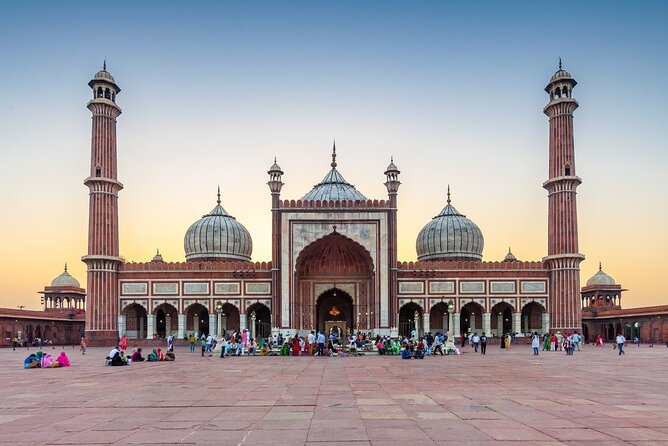
You begin at Jama Masjid, described as the largest mosque in India, built by Mughal emperor Shahjahan between 1650 and 1656. Even if you do not plan to go deep into architecture, the sheer scale of a site like this hits immediately, and it is a strong way to start the day with a landmark that anchors Old Delhi’s story.
Plan for a short stop, about 20 minutes. Entrance tickets are not included, so you may want to carry cash or be ready to pay on-site if you choose to enter. Also, mosques typically come with dress expectations, so keep that in mind and dress in a way that feels respectful and comfortable for a few minutes inside.
This is also a helpful mental warm-up. After the formal grandeur of Jama Masjid, you pivot quickly into the street-level intensity of Chandni Chowk, so your brain stays engaged instead of getting bored waiting around.
- Old & New Delhi City Tour – Half or Full Day Options Available★ 5.0 · 4,811 reviews
- Taj Mahal Tour from Delhi by Express Train (Viator Award Winner)★ 5.0 · 2,849 reviews
- Same Day Taj Mahal, Fort & Baby Taj Tour from Delhi by Car★ 4.9 · 2,534 reviews
- From Delhi: Taj Mahal and Agra Fort Private Sunrise Tour★ 4.9 · 2,270 reviews
- Sunrise Taj Mahal, Agra Fort & Baby Taj Tour from Delhi by Car★ 5.0 · 2,243 reviews
Chandni Chowk Heritage Walk, Then a Cycle Rickshaw Ride Back
Next up is Pasar Chandni Chowk, framed as a colorful street market full of shops. After Jama Masjid, your guide adds a heritage walk through narrow streets, and you get a spice-market style atmosphere in the mix.
This is one of the most “you feel it” segments, because you are not just looking at buildings. You are moving through the older commercial lanes, the kind of place where people actually live and shop daily. The stop window is about 2 hours, so you get enough time to wander without feeling rushed.
Then comes a fun twist. You head back to the car by cycle rickshaw, which is a classic Delhi experience, but the cycle rickshaw fees are not included. If you are tight on budget, you should ask your guide what to expect cost-wise before you get on.
Also, the rickshaw return is worth it for the perspective. Narrow lanes look totally different when you are not walking them at full pace, and you get small glimpses you’d miss if you were only using car windows.
Agrasen Ki Baoli: A Quiet 8th-Century Stepwell Break
You get a brief reset at Agrasen Ki Baoli, a stepwell built by King Agrasen in the 8th century. The tour description calls it stunning, and even in a short 10-minute stop, stepwells tend to be one of those places that makes you stop thinking in checklists.
Because this is not positioned as a long museum-style visit, you should use the time to look up and around. Stepwells often reward a few minutes of patient noticing, even if you only have a quick stop.
Entrance tickets are not included, so again it comes down to your preference. If you are curious to go in, plan for that extra cost. If you just want the exterior feel, you can treat it as a photo and atmosphere stop.
Gurudwara Bangla Sahib: The Sikh Temple and Its Feeding Scale
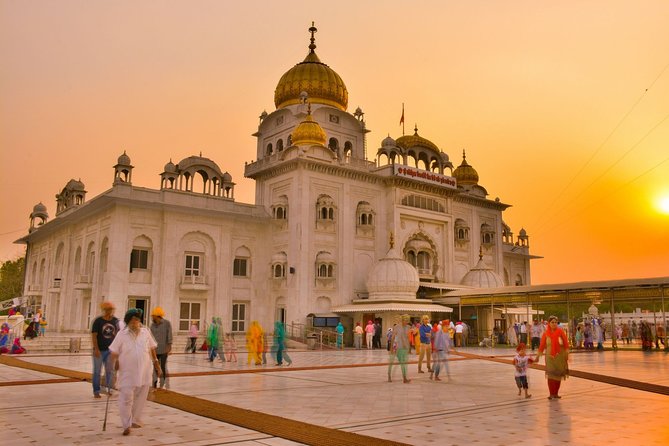
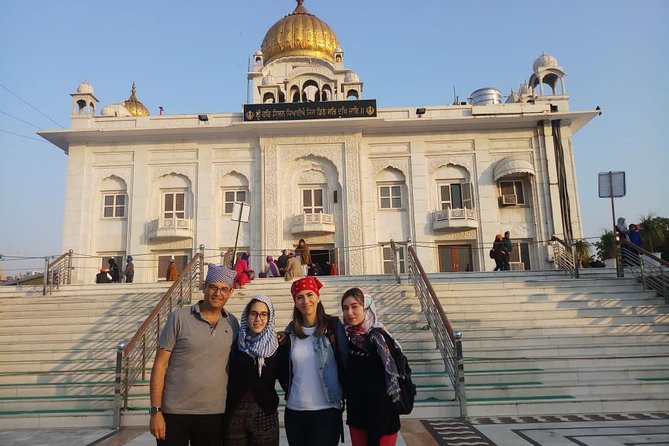
Then you move to Gurudwara Bangla Sahib, described as Delhi’s largest Sikh temple and home to a community kitchen serving over 30,000 people daily. That detail is not small. It changes how you experience the visit, because you are not just seeing a monument, you are seeing a system of daily care operating at huge scale.
You’ll have about 30 minutes here. Entrance tickets are not included, which makes this a relatively low-cost cultural stop. Still, you should expect a respectful environment and follow on-site guidance.
This is the part of the tour that often feels most human. You can see how faith turns into routine support for strangers, and it is the kind of contrast that makes Old Delhi and New Delhi feel less like separate worlds.
New Delhi Monuments: India Gate and Rashtrapati Bhavan in Short Bursts
After the older lanes, the day pivots to wide-open spaces and memorial architecture.
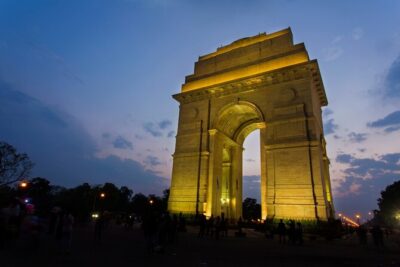
You stop at India Gate, a war memorial built by the British in 1931. You have around 15 minutes, and importantly, admission is free. This quick stop works because India Gate is easy to appreciate from a distance, with the monument and surrounding space doing most of the “wow” work.
Next is Rashtrapati Bhavan, the president’s house of India, with about 10 minutes and admission free. You also have another stop described as a British-built structure in the early 20th century, though the specific building name is not spelled out. Either way, the intent is clear: you see the official face of New Delhi, where colonial-era planning and modern governance share the same city frame.
Because these are short time windows, the value here is in context. Your guide can help you make sense of what you are seeing without turning it into a lecture.
Humayun’s Tomb and Persia-Style Elegance, UNESCO Edition
Humayun’s Tomb is one of the “keeper” stops: about 40 minutes, and it is a UNESCO World Heritage site. The tour description notes it as a fine example of Persia architecture, tied to the Mughal emperor Humayun from the mid-16th century.
Entrance tickets are not included. Since this is a big-name site, I suggest you confirm what you plan to pay before you get there. Some people are happy with quick exterior time, while others want the full experience inside the complex.
This stop tends to balance the day. After street markets and communal religion, you get a heritage moment that feels slower and more composed. Even if you are not an architecture nerd, the symmetry and mausoleum setting are hard to ignore.
If your group enjoys photography, this is a good place to ask your guide to slow down the rhythm slightly.
Lotus Temple: Quiet Meditation Between Major Sights
Next is the Lotus Temple, a Baha’i house of worship built in 1986. The tour description focuses on silent prayer and meditation, open to people of all religions. You get about 30 minutes.
Admission tickets are not included, so treat this as another potential add-on. But the experience is not just about entry. The Lotus Temple is famous for its design language, and even a short visit can change the pace of the day.
This stop also gives your feet a break from the crowds and the tight streets. It is a calmer zone, where the day’s energy shifts down a notch.
Qutub Minar: Big Complex Energy and the Iron Pillar
You finish with Qutub Minar, which the tour describes as Delhi’s most visited place, with a complex you can explore. You have about 45 minutes here, which is a good amount for a multi-part site.
The description lists several sights within the complex, including Alai Minar, the Tomb of Iltutmish, the Tomb of Ala ud din Khilji, the Madrasah, Quwat ul Islam mosque, Alai Darwaja, Qutub Minar itself, and the famous Iron pillar.
Entrance tickets are not included, so this is another moment where your costs may rise depending on what your group chooses to do. If you want to see the maximum number of listed elements, tell your guide early and ask how you will prioritize. If you want fewer stops and more time to appreciate, you can also ask for a streamlined route through just the key areas.
The Iron pillar is especially interesting because it gives you a concrete anchor point in a huge complex. If you like being able to name what you are looking at, this is one of the better sites on the day.
Gandhi Smriti Closeout: Museum Time, With a Monday Warning
The final stop is Gandhi Smriti, also known as Birla House. It is described as the place where India’s great leader was killed, and today it functions as a Gandhi Museum.
You have about 20 minutes. Entrance tickets are not included, and there is a critical detail for your planning: Gandhi Smriti is closed on Mondays. If your visit falls on a Monday, you should expect the guide to adjust the schedule so you still get a full day.
This stop gives your day a reflective ending. After temples, mausoleums, and memorials, it brings the story back to a modern turning point.
Who This Tour Suits Best (And Who Might Want to Adjust)
This is a great fit if you want a private guide who can respond to your interests while someone else handles transportation and timing. It also suits first-timers who want the big Delhi hits without the stress of arranging rides between scattered sites.
It is also ideal for families, because the stops are time-boxed and the vehicle removes a lot of fatigue. The tour has a strong service track record for adapting to group needs. One example from guide-hosting style: a guide was arranged for a Spanish language preference, and another highlight from hosting involved taking visitors to more than only monuments, including food-oriented Old Delhi time.
Here’s when you might want to tweak the day. If you hate “tick and move” schedules, the short stops might feel too fast. Also, since lunch and monument tickets are not included, budget-minded travelers may want to set aside extra money for entry fees and meals.
A Note on Guide Quality: Why Names Matter Here
The experience is provided by Vishnu Singh, a Delhi-Agra-Jaipur tour guide. From the way the service is described, Vishnu and the driver, Mr. Gee, are part of what makes the day feel smooth and personal.
That matters because in a city like Delhi, logistics are not boring. When the car shows up, the guide is ready with a plan, and the day flows, you spend your energy on the sights instead of the stress.
That said, there is one caution worth honoring. One negative report included a rate agreement mismatch and then a period of WhatsApp non-response. I do not assume it will happen to you, but it is a good reason to get pricing and meeting details confirmed in writing before the day starts.
Should You Book This Delhi Private Guided Tour?
Book it if you want a single day that covers both Old and New Delhi with a private car, a guide who can adjust the plan, and a route that includes major landmarks like Jama Masjid, Humayun’s Tomb, Lotus Temple, and Qutub Minar. The comfort package, the guide fees included, and the front-door pickup make it a clean choice for short visits.
Consider an alternative or modify the schedule if your budget is tight enough that entrance fees will stress you, or if your ideal pace is slow and contemplative. Also check what day you are going, since Gandhi Smriti is closed on Mondays.
If you book, do two smart things: ask your guide which stops you plan to enter versus view only, and confirm any optional extras you care about, especially the cycle rickshaw ride.
FAQ
What is included in the tour?
The tour includes an air-conditioned vehicle, bottled water, WiFi on board, private transportation, guide fees and allowance, driver fees and allowance, parking fees, GST, and pickup and drop-off from your hotel or the airport. Mask and sanitizer are also included.
Are monument entrance tickets included?
No. Monument entrances fees are not included, so places like Jama Masjid, Humayun’s Tomb, Lotus Temple, Qutub Minar, and others may require tickets or additional payment.
Is lunch included?
No. Lunch is not included, so you will need to plan for a meal on your own during the day.
Do I get hotel pickup and drop-off?
Yes. The tour includes pickup and drop-off from your hotel accommodation or the airport, using a private chauffeured, air-conditioned vehicle.
Is Gandhi Smriti open every day?
No. Gandhi Smriti is closed on Mondays, so if your tour date is Monday you will need an adjusted plan.
How does cancellation work?
You can cancel for a full refund up to 24 hours in advance of the experience start time. If you cancel less than 24 hours before, the amount you paid is not refunded.
Recently reviewed across New Delhi
- Golden Triangle – Delhi Agra and Jaipur
★ 5.0 · 10 reviews - Taj Mahal & Agra Tour by Indian Bullet Train All Inclusive
★ 4.5 · 10 reviews - Private Tour in Mehrauli Archaeological Park & Qutub Minar
★ 5.0 · 10 reviews - Old & New Delhi Tour
★ 5.0 · 10 reviews - From Delhi : Taj Mahal & Agra Fort Tour by Luxury Express Train
★ 5.0 · 10 reviews - Delhi Shopping Tour: Top Bazaars, Crafts & Souvenir Finds
★ 5.0 · 10 reviews
Full-Day, compared.
 ★ 5.0Old & New Delhi City Tour – Half or Full Day Options AvailableFrom $384,811 reviews
 ★ 5.0Old & New Delhi City Tour – Choose Half or Full Day ExperienceFrom $384,513 reviews
 ★ 5.0Full Day Taj Mahal, Agra Fort & Baby Taj Tour from Delhi by CarFrom $623,647 reviews
 ★ 5.0Old & New Delhi Private Tour – Half or Full Day (Rated Excellent)From $202,226 reviews
 ★ 4.9Private Full Day Sightseeing Tour By Car with GuideFrom $41,839 reviews
 ★ 4.9Full-Day Sightseeing Tour of MumbaiFrom $241,822 reviews
 ★ 5.0Full-Day Private Old and New Delhi Combo TourFrom $20625 reviews
 ★ 4.8Private Full-Day Sightseeing Tour by Tuk-TukFrom $2573 reviews