
REVIEW · OLD DELHI AND CHANDNI CHOWK TOURS
Old & New Delhi City Tour – Choose Half or Full Day Experience
Delhi can feel like information overload.
This tour is built to fix that fast, mixing Old Delhi landmarks with New Delhi government monuments in a tight schedule, and keeping you comfortable with a private air-conditioned vehicle. You can choose a half-day or full-day option, so you can match the plan to your time, not the other way around.
What I like most is how personal the day feels for a short visit. A real local guide leads the stops, and you get extra attention, from arranging the timing of entries to guiding you through what matters, whether your guide is Arham, Junaid, Zayn, or Kevin. I also love the “no wrestling” approach, you are picked up from your area and dropped back off, so your Delhi day has less logistics and more sightseeing.
One thing to consider is that the schedule moves, especially if you pick the full day. You will see a lot of highlights, and some sites involve walking and stepping around, so it helps to plan for a bit of pace, plus heat. If you are coming on a Monday, Lotus Temple is closed, and you will go to Qutub Minar instead.
In This Review
- Quick hits
- Private Delhi in half-day or full-day shape
- Starting with Bangla Sahib’s calm, then heading into the city’s pulse
- Jama Masjid and Old Delhi’s street reality, with a tuk-tuk ride
- Khari Baoli spice market: color, smells, and everyday use
- The Red Fort, India Gate, Parliament House, and Rashtrapati Bhavan from the road
- Agrasen ki Baoli, the stepwell with legends
- Humayun’s Tomb: UNESCO calm and Mughal garden design
- Lotus Temple on most days, Qutub Minar on Mondays
- Getting in and out smoothly: pickup, photo ID, and timing
- Price and value: is $38 per person a fair deal?
- Which guide style fits you best
- Should you book this Old and New Delhi City Tour?
- FAQ
- What types of tours can I choose?
- Where can pickup happen?
- What happens at the end of the tour?
- Is this a private tour?
- What transport is included?
- Are monument entry fees included?
- What if I visit on a Monday?
- What should I bring for monument entry?
- How does free cancellation work?
Quick hits
- Private, air-conditioned transport means less waiting, more comfort, especially in Delhi heat
- Old Delhi tuk-tuk ride is included on Old Delhi and Full Day options, built for short bursts of street life
- Temple to tomb to monument variety in one route keeps first-timer confusion to a minimum
- UNESCO Humayun’s Tomb plus the Lotus Temple option gives you both Mughal and modern Delhi icons
- Free entries at several stops keep your spending predictable
- Photo ID required for monument entry, so bring it before you leave your hotel
Shortlisting? Every Uttar Pradesh trip below went through the same review.


Private Delhi in half-day or full-day shape
The big value here is control. You choose how much Delhi you want to sample, then you get a private guide and private transport rather than squeezing into a large group. For first-time visitors, that matters because Delhi is big, neighborhoods feel different block to block, and the fastest way to waste time is getting stuck in the wrong area.
Your ride starts with a simple setup: pickup can be arranged from anywhere in Delhi, Noida, Gurugram, Ghaziabad, or Faridabad. At the end, you are dropped wherever you prefer within Delhi, Noida, Gurugram, or taken to the airport. That flexibility is a quality-of-life upgrade. It also makes layover days and early check-in days easier to plan.
Vehicle choice is also handled. If you are traveling as a smaller group, you get a four-seater sedan (for 1 to 2 people) or a six-seater wagon (for 3 to 5). For larger groups, there is a twelve-seater van (6 to 12 people), and for bigger parties, a bus is sized to the group. In practice, this means you are not crammed, and your guide can talk as you drive rather than shouting over crowded seats.
Starting with Bangla Sahib’s calm, then heading into the city’s pulse
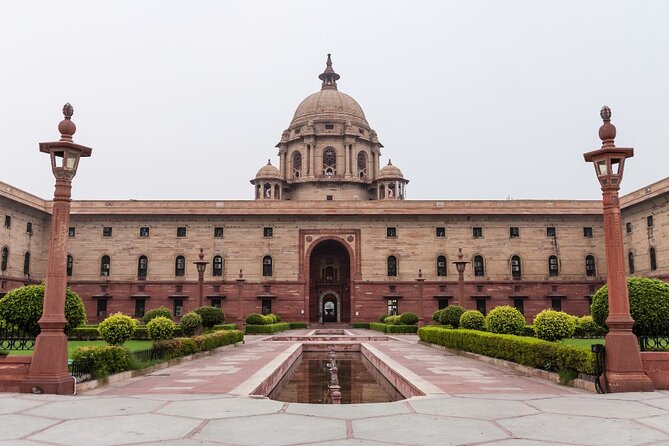
The tour begins at Gurudwara Bangla Sahib, a Sikh temple known for its peaceful atmosphere and its connection to the eighth Sikh Guru. You also get a look at the healing Sarovar. This is a smart opening stop because it breaks the usual Delhi pattern of jumping straight into traffic and crowds.
Expect about 30 minutes here, and the admission ticket is free. The experience is not about checking a box. It’s about getting your bearings in a spiritual space where the pace feels human. Even if you are not religious, it helps you understand how Delhi holds multiple identities side by side.
From there, you move into Old Delhi energy, where architecture, trade, and daily life collide. This transition is part of why the tour works. You are not just hitting sights, you are switching mental gears in a way that feels natural.
Jama Masjid and Old Delhi’s street reality, with a tuk-tuk ride
Next up is Jama Masjid, India’s largest mosque, built in 1656 by 5,000 workers. It sits across from the Red Fort area in the heart of Chandni Chowk. You get around 1 hour, and admission is included.
Jama Masjid is also a lesson in scale. You go from the calm of Bangla Sahib into a space that was designed for huge crowds. The red sandstone courtyard and the surrounding geometry make it easier to picture how this area functioned when travel and politics moved at the speed of empires.
Then the tour shifts into something more hands-on. Your guide meets you at Sunheri Masjid and you hop into a traditional tuk-tuk. This ride is included for the Old Delhi and Full Day options, and it is designed to show you the bazaars without burning your legs on constant walking.
Here is the real practical upside of the tuk-tuk: it lets you see streets and shopfronts while your guide explains how the area works. You get cultural context while still staying mobile. That is ideal if you are not comfortable navigating crowded lanes on your own.
- Agra: skip-the-line Sunrise Taj Mahal with Mausoleum Tour★ 4.9 · 16 reviews
- From Delhi:All Inclusive Taj Mahal Day Tour by Fastest Train★ 4.9 · 11 reviews
Khari Baoli spice market: color, smells, and everyday use
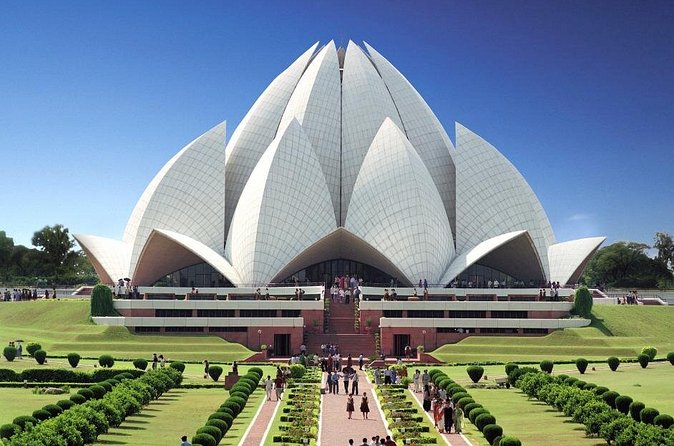
After the tuk-tuk ride, you head to Khari Baoli, an area famous for spice trading. It is described as Asia’s largest spice market in Chandni Chowk. Plan for about 30 minutes, and admission is free.
This stop works best when you treat it like a sensory map. You can learn how spices are used day to day, not just how they look in a photo. The market atmosphere also gives you a baseline understanding of why Old Delhi’s food culture is so big. You will likely notice that spices are part of daily routines, not only special occasions.
Potential drawback: spice markets can be intense for some people, especially with strong odors and crowds. If that’s you, you do not have to linger at stalls. Focus on what your guide points out, then keep moving.
The Red Fort, India Gate, Parliament House, and Rashtrapati Bhavan from the road
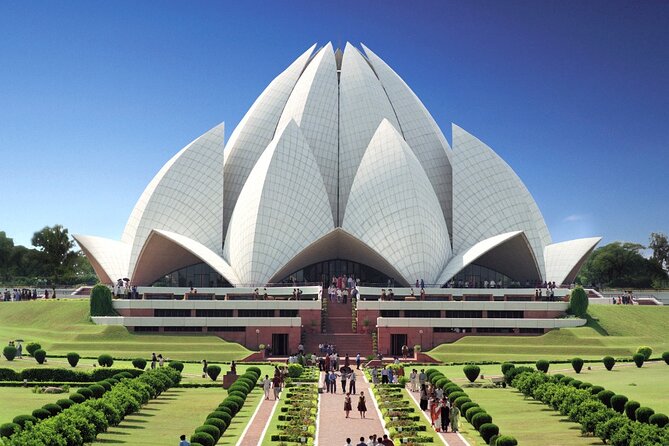
Between Old Delhi sites and New Delhi monuments, you get a set of major landmarks you typically see best from the drive. This part is where the tour earns its efficiency.
You pass the Red Fort, built by Emperor Shah Jahan between 1639 and 1648. It served as the main residence of the Mughal emperors and is known for its Indo-Islamic architecture. Even from outside, it gives you a visual anchor for what you saw in the earlier Mughal-adjacent areas.
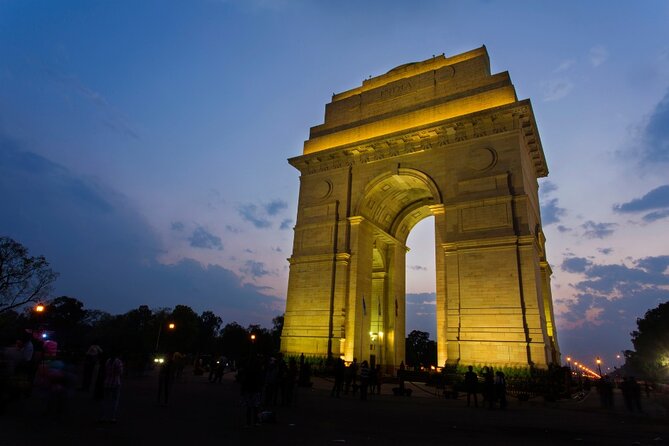
Then it’s India Gate, a war memorial called the Tomb of the Unknown Soldier. Names of 13,300 Indian soldiers who died during World War I are inscribed there. If you have never stood at a memorial like this, it changes the way you read the city. You stop thinking of monuments as decoration and start reading them as memory.
You also pass Parliament House, home to India’s bicameral legislature, including the Lok Sabha and Rajya Sabha. Rashtrapati Bhavan comes next, the former Viceroy’s House during British rule and now the official residence of the President of India.
This road segment is not “just driving.” It’s how you get a first-timer overview of power, governance, and national identity. You are building a mental map quickly.
Agrasen ki Baoli, the stepwell with legends
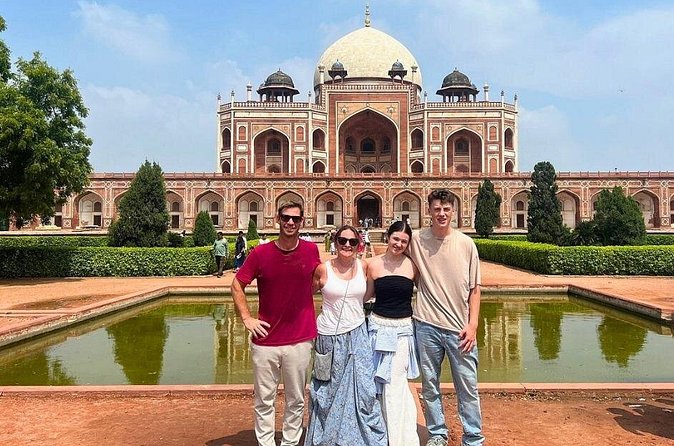
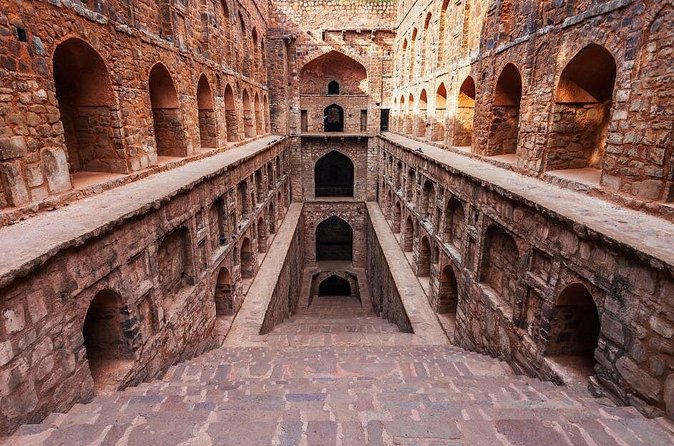
After the big-road landmarks, the tour takes a turn into a quieter kind of Delhi. You visit Agrasen ki Baoli, an ancient stepwell tucked away in central Delhi. You get about 30 minutes, and entry is free.
What makes this stop interesting is the vibe and the setting. Stepwells are not common sights in many countries, and this one is described as having unique architecture and an eerie charm, with stories and legends around paranormal activity. You do not have to buy into the stories to appreciate the atmosphere. It’s more about the feeling of discovery and the sense that Delhi holds surprises between the headline sites.
Practical note: stepwell environments can involve steps and uneven footing. If you have knee issues or you hate climbing down and up, take it slowly and let your guide know what pace you want.
Humayun’s Tomb: UNESCO calm and Mughal garden design
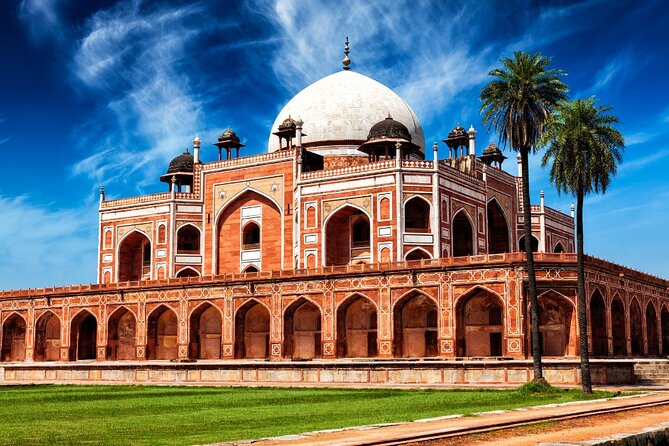
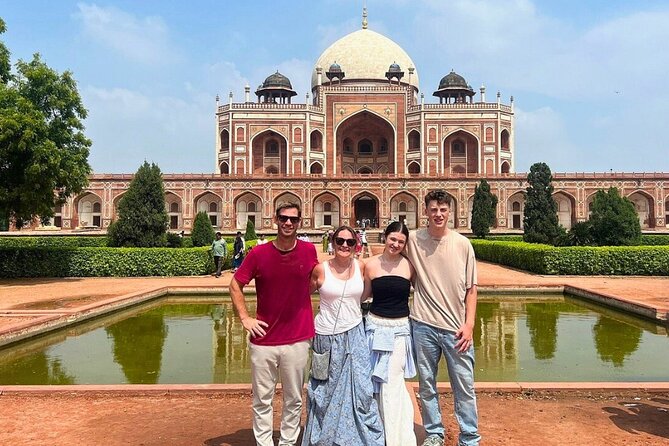
Next is Humayun’s Tomb, a UNESCO World Heritage Site and the first garden tomb in India. You get around 45 minutes, and admission is included.
This is one of the best stops for slowing down. The description here is not just “beautiful.” It’s about the Mughal architecture and the serene garden setting. It was commissioned by his wife after Humayun’s death, which adds emotional weight to the design. Even if you skim most historical details, the layout makes sense once you stand there.
If you care about photography, this is often where people relax their pace. If you care about history, this is where you see how Mughal architecture used space and symmetry to project permanence. Either way, it’s a solid anchor before the final stop.
Lotus Temple on most days, Qutub Minar on Mondays
Your final Delhi stop is the Lotus Temple, a Bahá’í House of Worship inaugurated in 1986. Expect about 45 minutes, and admission is free. The key idea is the lotus-shaped architecture and the symbolism of peace.
This is a good closer because it feels different from the Mughal tomb and the older mosque sites. It also works well if you are tired of too much stone, too much history talk, and you want a calmer end to the day.
There is one important schedule note. Lotus Temple is closed on Monday, and on that day you will be taken to Qutub Minar instead. If you are planning dates, it helps to know this swap so you do not feel like you got a downgrade. Your day still ends with a major Delhi landmark.
Getting in and out smoothly: pickup, photo ID, and timing
A big reason this tour is popular for short visits is how the day is organized around your time.
Pickup is available from your selected location in Delhi and nearby cities, and the driver handles return drop-off at your requested spot in Delhi, Noida, Gurugram, or to the airport. Bottled mineral water is included during the tour, which is genuinely useful when the day is hot.
You also need to plan for entry requirements. The tour asks you to carry a valid photo ID for monument entry. If you forget it, you can end up with delays at the gate. Bring your passport or the ID you used for booking if it is accepted.
What to expect in terms of movement: it is mostly guided walking mixed with driving. The itinerary includes steps at places like the stepwell and you will be on your feet in major sites. If you want the day to feel easy, wear comfortable shoes and keep a light layer, Delhi weather can swing even when it feels warm.
Meals are not included. That means you should have a plan for lunch or dinner based on whether you choose the half-day or full-day option. If your day includes multiple main stops, it often helps to eat early or late rather than trying to cram a full meal between sights.
Price and value: is $38 per person a fair deal?
The price listed is $38.00 per person, and the tour runs about 4 to 7 hours depending on whether you pick a half-day or full-day plan. That is a value proposition if you care about three things: convenience, access, and guide time.
First, you get private transport with air-conditioning. In Delhi, that alone can save you energy and reduce stress. Second, many entries are covered, including admission fees to monuments, and several stops are free on their own (like Bangla Sahib, Khari Baoli, Agrasen ki Baoli, and Lotus Temple). Third, you get a local guide plus bottled water.
If you try to stitch this kind of route together yourself, you would need to figure out pickup logistics, transport timing, and entry planning across several neighborhoods. For many people, that is the hidden cost. This tour reduces the friction, especially for a first visit.
One small caution: tips are not included. If you want to tip your guide or driver, plan for that extra cost in your budget.
Which guide style fits you best
The guides get consistently praised for clear explanations and friendly pacing. You will see names like Arham, Junaid, Zayn, Vimal, and Kevin popping up in the feedback, and the common thread is that the guide helps you see what matters without turning the day into a lecture.
From my perspective, this matters because Delhi sightseeing can go two ways: you either feel lost, or you feel coached through what to notice. A good guide does both. The guide can also adjust the day when you ask questions. Some feedback notes guides were accommodating with pace even in heat, and that is exactly what you want on a short itinerary.
If you like asking lots of questions, choose a half-day only if you can keep your stamina. If you love deeper conversations, the full-day option is better since you have more time to ask and wander at your own speed with guidance.
Should you book this Old and New Delhi City Tour?
Book this tour if you are a first-timer who wants a clear Delhi orientation in a short time. It is especially worth it if you want Old Delhi street culture plus New Delhi landmarks without dealing with navigation and transport stress on your own.
Skip or rethink it if you want a slow, quiet, spend-a-long-time-in-one-place day. This plan is designed for highlights and efficient flow. Also, if you are very sensitive to crowds, focus on pacing and let your guide know what feels too much.
If you do book it, go in with one mindset: treat it like a fast city primer. You will leave with the big visual anchors, and you will know which neighborhood you want to return to on your own.
FAQ
What types of tours can I choose?
You can choose between a half-day or a full-day experience.
Where can pickup happen?
Pickup is available from anywhere in Delhi, Noida, Gurugram, Ghaziabad, or Faridabad.
What happens at the end of the tour?
Your driver will drop you off at any preferred location in Delhi, Noida, or Gurugram, or at the airport.
Is this a private tour?
Yes. It is a private tour/activity, and only your group participates.
What transport is included?
You travel in a private air-conditioned vehicle. For Old Delhi and Full Day tours, you also get a tuk-tuk ride through the bazaars of Old Delhi.
Are monument entry fees included?
Yes. Entry fees to monuments are included, and your itinerary includes both paid and free-admission stops.
What if I visit on a Monday?
Lotus Temple is closed on Monday, so you will be taken to Qutub Minar instead.
What should I bring for monument entry?
Carry a valid photo ID for monument entry.
How does free cancellation work?
Free cancellation is available. You can cancel up to 24 hours in advance for a full refund. If you cancel less than 24 hours before the experience starts, the amount paid is not refunded.
Still in Old Delhi? Keep Going

Recently reviewed across Uttar Pradesh
- From Delhi:All Inclusive Taj Mahal Day Tour by Fastest Train
★ 4.9 · 11 reviews - Full Day Tour of Delhi Including a Heritage Walk in Old Delhi
★ 5.0 · 16 reviews - Agra: skip-the-line Sunrise Taj Mahal with Mausoleum Tour
★ 4.9 · 16 reviews - All Inclusive Private Car Tour To Taj Mahal From Delhi
★ 5.0 · 23 reviews - Agra City Tour By Car
★ 5.0 · 44 reviews - Taj Mahal, Fort, Baby Taj & Mehtab Bagh Private City Tour
★ 4.8 · 159 reviews
Old Delhi and Chandni Chowk Tours, compared.
 ★ 5.0Old & New Delhi City Tour – Half or Full Day Options AvailableFrom $384,811 reviews
 ★ 5.0Old & New Delhi Private Tour – Half or Full Day (Rated Excellent)From $202,226 reviews
 ★ 5.0Old & New Delhi Full or Half Day Sightseeing TourFrom $241,900 reviews
 ★ 5.0Old and New Delhi Guided Full or Half-Day TourFrom $20976 reviews
 ★ 5.0Old & New Delhi Private City Tour – Traveler’s Choice (Top Rated)From $13746 reviews
 ★ 5.0Old Delhi Food, Heritage&Cultural Walk with Rickshaw ride to Masterji Kee HaveliFrom $52742 reviews
 ★ 5.0Full-Day Private Old and New Delhi Combo TourFrom $20625 reviews
 ★ 5.0Old Delhi Bike TourFrom $30616 reviews
Browse the lists this tour appears in