
REVIEW · OLD DELHI AND CHANDNI CHOWK TOURS
Private Guided Tour of Old and New Delhi
Delhi feels huge, but this tour keeps it manageable. You get a private guide pacing the day across Old Delhi and New Delhi so you do not waste time guessing. I especially like how the route hits the big-name landmarks while still giving you moments of real street-level Delhi.
You also start with hotel pickup and drop-off and ride in a private, air-conditioned vehicle with an English-speaking driver. That means less hassle, fewer wrong turns, and a smoother day when the city traffic gets intense.
The main drawback is that it is a full day with lots of stops, and some monuments have admission tickets not included. You will also want to plan around Gandhi Smriti being closed on Mondays.
In This Review
- Key highlights to watch for
- Why the Old and New Delhi mix makes sense
- Price and value, plus the group size reality
- Hotel pickup and the air-conditioned advantage
- Jama Masjid: stepping into Mughal scale (and why it feels different)
- Red Fort and the Chandni Chowk rickshaw lanes
- Raj Ghat and Gandhi Smriti: seeing the modern story in quiet spaces
- Humayun’s Tomb: the garden-tomb concept and Persian design
- Lotus Temple: modern spiritual design with a simple message
- Qutub Minar, India Gate, and the New Delhi axis
- Swaminarayan Akshardham and Rashtrapati Bhavan: big Delhi statements
- How to pace yourself on a 7 to 8 hour Delhi day
- Should you book this private Old and New Delhi tour?
- FAQ
- What time does the tour start?
- How long does the tour take?
- How many people are in a group?
- Is hotel pickup and drop-off included?
- Will I travel in a comfortable vehicle?
- Is the tour guided?
- Are admission tickets included?
- Are meals included?
- Is Gandhi Smriti open every day?
- What is included in the price besides the guide?
- What if the weather is poor or I need to cancel?
Key highlights to watch for
- Private guide for just your group, which makes it easier to ask questions and move at your pace
- Rickshaw through Chandni Chowk’s narrow lanes, plus a spice market stop
- A balanced mix of Mughal, Gandhi, and modern Delhi, not just one era of sightseeing
- Garden-tomb and temple highlights like Humayun’s Tomb and the Lotus Temple
- A clear time structure for a 7 to 8 hour day, starting at 8:30 am
More of New Delhi, monument by monument
Why the Old and New Delhi mix makes sense

Delhi is two cities stitched together. Old Delhi delivers the Mughal-era power and the sensory overload of markets, mosques, and forts. New Delhi feels planned, formal, and government-centered, where the architecture has a different rhythm.
This tour works because it does not treat Delhi like a checklist. You start in Old Delhi with major Mughal sites, then shift to places that show India’s modern story and landmark New Delhi views. You also get a guide who can explain what you are looking at while you are standing there, not after you get back to the hotel.
The pacing is built for first-time visitors who want the top sights without spending hours figuring out routes, opening hours, and which neighborhoods are worth the extra effort.
Price and value, plus the group size reality
The price is listed at about $60.52 per group, up to 3 people, for a 7 to 8 hour guided day. That matters, because you are not paying a per-person guide rate. If you are traveling with 2 others, the cost spread can feel especially fair for a private setup.
You are also paying for time and logistics: hotel pickup and drop-off, private air-conditioned vehicle, parking and tolls, and an English-speaking driver. For a city as large as Delhi, that combination can be worth it just to reduce stress. It is not only about comfort. It is about keeping your sightseeing day intact when traffic and distances would normally eat your schedule.
Still, treat this as a value-priced private tour, not an all-inclusive museum pass. Several stops have admission tickets not included, and meals are not included, so you may need to budget a bit more on the spot.
Hotel pickup and the air-conditioned advantage

Starting at 8:30 am with pickup from your hotel sets the tone for a calmer day. Instead of coordinating taxis or relying on navigation apps in a crowded city, a driver meets you and handles the driving.
This is especially helpful on a day with many destinations spread across different parts of Delhi. You get an English-speaking driver, plus a tour guide included, so communication stays simple. The air-conditioned vehicle is not a luxury detail here. It is a practical way to avoid spending your energy on heat and fatigue.
One small thing to keep in mind: because you are fitting a lot into one day, you will want to keep your own add-ons minimal. If you try to pile on extra stops, the schedule can feel tight fast.
Deeper into Old Delhi and the Chowk
- Old & New Delhi Private City Tour – Traveler’s Choice (Top Rated)★ 5.0 · 746 reviews
- Old Delhi Food, Heritage&Cultural Walk with Rickshaw ride to Masterji Kee Haveli★ 5.0 · 742 reviews
- Full-Day Private Old and New Delhi Combo Tour★ 5.0 · 625 reviews
- Old Delhi Bike Tour★ 5.0 · 616 reviews
- Old Delhi Street Food Tour★ 5.0 · 497 reviews
Jama Masjid: stepping into Mughal scale (and why it feels different)
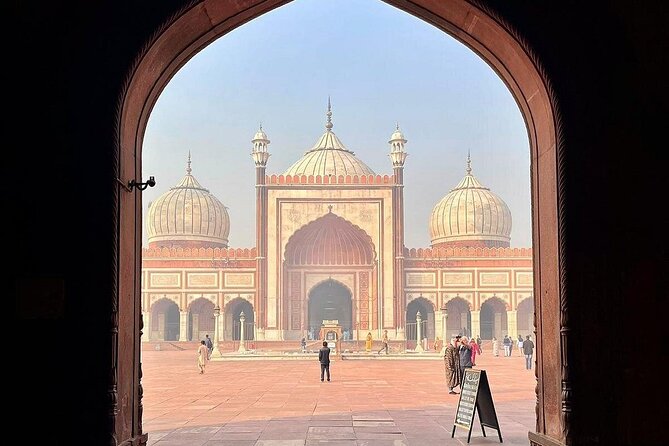
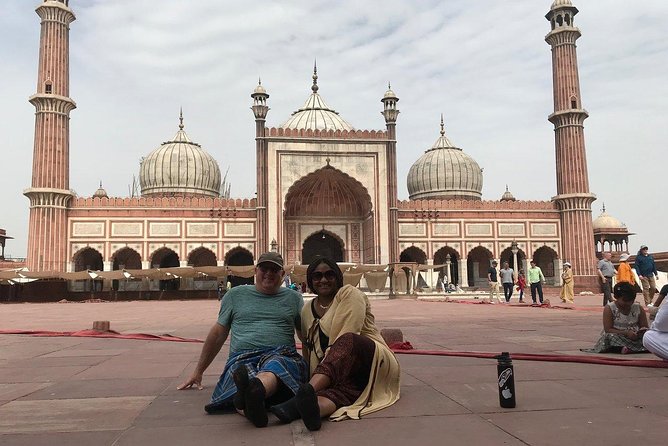
You begin at Jama Masjid, one of Delhi’s most impressive mosques. The description emphasizes the grand prayer hall and the three massive gates, and you feel that scale right away once you are inside the complex.
A mosque this size is not just a place to look. It is a place to observe how people move, where they gather, and how the architecture shapes the space. With a guide, you can connect what you see to the broader Mughal story of Delhi, without turning it into a lecture.
The itinerary lists admission ticket as free for this stop and gives you about 30 minutes. That timing works well here because you get enough time to walk around and orient yourself, then move on before the crowds and traffic patterns shift.
Red Fort and the Chandni Chowk rickshaw lanes
Red Fort is the Mughal anchor for this portion of the day. Built between 1639 and 1648, it served as the main residence of the emperors of the Mughal Dynasty. Even from the outside, the fort’s roughly 2 km wall makes it feel like a city inside a city.
The stop time is short, about 2 minutes in the provided schedule, and the admission ticket is not included. This setup tells you the emphasis is more on seeing and understanding than on a long, deep museum-style visit. If you want longer time inside the fort complex, plan to ask your guide about where you can realistically add time.
Then comes the Old Delhi energy of Chandni Chowk. The tour includes a rickshaw ride through the narrow streets of Chandni Chowk Bazaar, plus a spice market visit. This is the kind of stop that makes Delhi feel real. You are moving at street speed, surrounded by stalls and everyday commerce.
The itinerary lists admission ticket as free for this stop, and the time is about 30 minutes. In that window, you do not want to overthink it. Go with the flow, buy nothing until you have looked around, and use your guide to explain what you are seeing.
Tip: if you have sensory overload issues, plan to wear something light and keep water in mind. The rickshaw lanes are tightly packed by nature.
Raj Ghat and Gandhi Smriti: seeing the modern story in quiet spaces
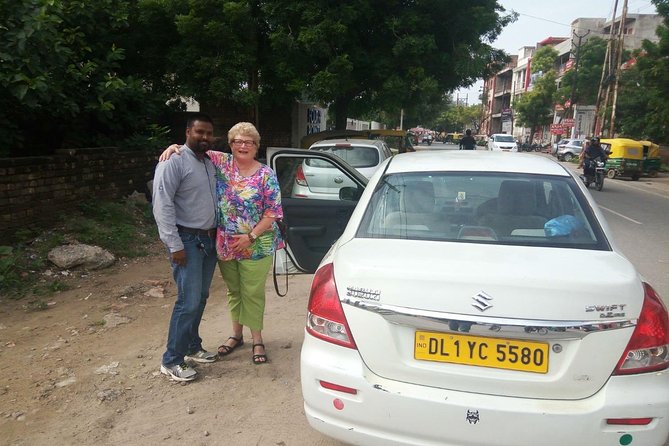
From the intensity of markets, you shift to memorial grounds. Raj Ghat is a memorial dedicated to Mahatma Gandhi, and you get about 30 minutes here.
The value of Raj Ghat is contrast. You are not looking at a fort wall or temple facade. You are looking at a place built for reflection and remembrance. A guide helps you understand why this stop matters to how India presents its identity, especially after you just spent time in older imperial Delhi.
Next is Gandhi Smriti, the place marking where Gandhi spent much of his life and where he was assassinated. The itinerary notes that Gandhi Smriti is closed on Mondays and lists the admission ticket as not included. Because of that, your day could feel different depending on the day of the week.
If Gandhi Smriti is closed for your dates, do not treat that as a loss. You still get the context of the Gandhi stops, and your guide can often help you make sense of the remaining stops so the overall story stays coherent.
Humayun’s Tomb: the garden-tomb concept and Persian design

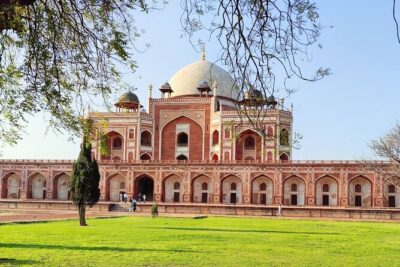
Humayun’s Tomb is scheduled next, with about 45 minutes allotted. The description points out two things that matter for understanding what you see: it was built in 1570 and it is the first garden-tomb in India. It also credits Persian architectural influence.
That combination is why Humayun’s Tomb hits differently than many stone monuments. It is not only about the main tomb structure. It is about the layout, the garden framing, and how the design guides your viewpoint.
The admission ticket is listed as not included, so you should expect an extra cost here. But the time allocation suggests the tour is giving you enough room to walk the garden areas and take in the symmetry, not just snap photos and rush out.
If you like architecture, this is one of the calmer, more rewarding pauses in the day. Use that time to slow down, because later stops in New Delhi can be more about scale and views than close-up details.
Lotus Temple: modern spiritual design with a simple message
The Lotus Temple is a Bahá’í House of Worship dedicated in December 1986, known for its flowerlike shape. The time is about 30 minutes, and the itinerary lists admission ticket as free.
What I like about including this stop is how it breaks up the Mughal-heavy portion of the itinerary. After forts, memorials, and tombs, you get a modern landmark that still feels spiritual rather than purely monumental.
A guide can help you interpret the design language. Even without getting technical, you can understand why the shape is so iconic once you are standing at the entrance and seeing how the petals create a distinct sense of form.
This is also the kind of stop where you can take a breath. If your day already feels crowded, Lotus Temple gives you space to reset.
Qutub Minar, India Gate, and the New Delhi axis
After Lotus Temple, you head to Qutub Minar. The tower is about 73 m high and includes five distinct stories. The description says it was built in 1193 by Qutab-ud-din Aibak after the defeat of Delhi’s last Hindu kingdom, and it is called a tower of victory.
The admission ticket is not included for Qutub Minar, and the visit is about 45 minutes. That is a good amount of time because you can focus on the vertical scale and the layered look of the tower, rather than only circling the base.
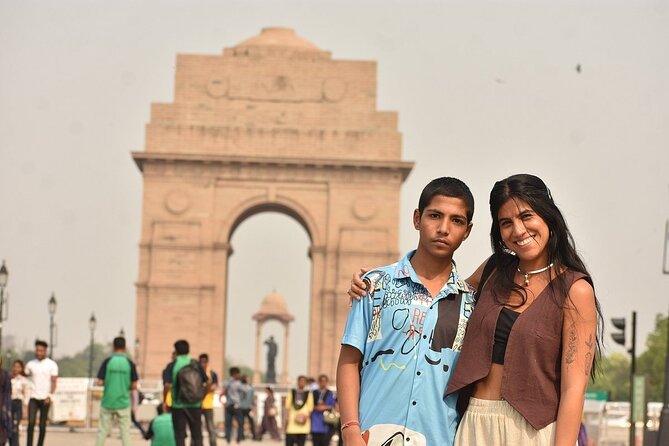
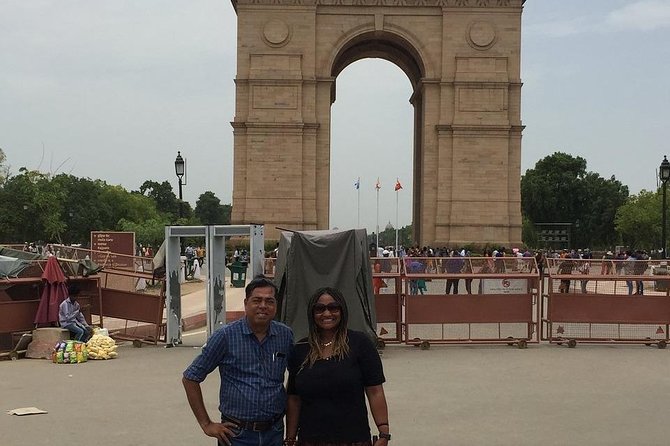
Then the itinerary includes India Gate, a 42 m war memorial in the center of New Delhi. It bears the names of 70,000 Indian soldiers who lost their lives while fighting for the British army during World War. You get a brief stop as part of the New Delhi flow.
India Gate is worth including because it is a reference point for understanding how New Delhi visually organizes itself around major public spaces. Even if you only have a few minutes, it adds a sense of place and timeline.
A practical note: New Delhi can feel wide and open around these landmarks, which makes timing useful. Your guide helps you see these stops in context rather than treating them like random waypoints.
Swaminarayan Akshardham and Rashtrapati Bhavan: big Delhi statements
You finish the cluster of major New Delhi landmarks with Swaminarayan Akshardham. The itinerary describes it as a Hindu temple and a spiritual-cultural campus. The admission ticket is listed as free and the time is about 30 minutes.
This stop can feel like a “whole complex in one visit,” so do not try to see everything. Instead, focus on the main architectural and devotional experience, then step back and appreciate how large the campus feels compared to older sites.
Finally, Rashtrapati Bhavan is included, with about 30 minutes. The description highlights its 330 acres scale and notes it was constructed in 1929 by Sir Edwin Lutyens and Herbert Baker, who were responsible for much of New Delhi’s design.
The admission ticket is not included, so you may get more of the external, viewing-style experience depending on the rules for your visit day. Even so, the stop gives you a strong sense of New Delhi’s planned government core.
How to pace yourself on a 7 to 8 hour Delhi day
This tour is built to cover a lot without turning your day into a sprint. Still, you should plan for the basics.
Wear practical shoes for mosque and tomb areas, and dress respectfully for religious spaces. Keep your attention on transitions. For example, when you leave a market like Chandni Chowk, your senses may stay “on.” Build in quick pauses by using your guide to point out what matters at each stop.
Also, expect that some monuments are ticketed separately, and camera fees at monuments are not included. The itinerary labels which admissions are free and which are not included, so read that list before you go. It helps you avoid surprises and plan your spending.
If you are hoping for long inside visits everywhere, this schedule may feel tight. It is designed more for guided orientation and key highlights than for slow, deep wandering.
Should you book this private Old and New Delhi tour?
Book it if you want a single-day framework for Delhi that covers the core landmarks from Old Delhi and New Delhi, with hotel pickup and a guide included. It is a strong choice for first-time visitors who would rather focus on seeing and learning than solving logistics.
Skip or adjust your expectations if you want long time inside every ticketed monument, since several major stops list admission tickets not included and the day runs about 7 to 8 hours. Also, if your visit is on a Monday, keep Gandhi Smriti’s closure in mind so you can plan mentally for that difference.
If your group is up to 3 people, the pricing can feel especially sensible for a private setup. With the right attitude, you get a lot of Delhi meaning in one day, without feeling like you are constantly fighting the city.
FAQ
What time does the tour start?
The tour start time is 8:30 am.
How long does the tour take?
The duration is approximately 7 to 8 hours.
How many people are in a group?
This is a private tour/activity, and the price is per group up to 3 people.
Is hotel pickup and drop-off included?
Yes. Pickup and drop-off from your hotel in Delhi are included.
Will I travel in a comfortable vehicle?
Yes. You get a private air-conditioned vehicle with an English-speaking driver.
Is the tour guided?
Yes. A tour guide is included.
Are admission tickets included?
Admission ticket inclusion varies by stop. Jama Masjid, Chandni Chowk (including the spice market), Raj Ghat, Lotus Temple, and Swaminarayan Akshardham list admission ticket as free. Red Fort, Gandhi Smriti, Humayun’s Tomb, Qutub Minar, and Rashtrapati Bhavan list admission ticket as not included.
Are meals included?
No. Meals, food, and breakfast, lunch, dinner are not included.
Is Gandhi Smriti open every day?
No. Gandhi Smriti is closed on Monday.
What is included in the price besides the guide?
Included items are the private air-conditioned vehicle, pickup and drop-off, fuel, parking charges, toll taxes and interstate taxes, and the tour guide. Camera fees at monuments are not included.
What if the weather is poor or I need to cancel?
The experience requires good weather. If it is canceled due to poor weather, you will be offered a different date or a full refund. Cancellation is free, and you can cancel up to 24 hours in advance for a full refund; if you cancel less than 24 hours before the start time, the amount paid will not be refunded.
Still in Old Delhi? Keep Going





New Delhi Landmarks Worth the Morning

Recently reviewed across New Delhi
- Golden Triangle – Delhi Agra and Jaipur
★ 5.0 · 10 reviews - Taj Mahal & Agra Tour by Indian Bullet Train All Inclusive
★ 4.5 · 10 reviews - Private Tour in Mehrauli Archaeological Park & Qutub Minar
★ 5.0 · 10 reviews - Old & New Delhi Tour
★ 5.0 · 10 reviews - From Delhi : Taj Mahal & Agra Fort Tour by Luxury Express Train
★ 5.0 · 10 reviews - Delhi Shopping Tour: Top Bazaars, Crafts & Souvenir Finds
★ 5.0 · 10 reviews
Old Delhi and Chandni Chowk Tours, compared.
 ★ 5.0Old & New Delhi City Tour – Half or Full Day Options AvailableFrom $384,811 reviews
 ★ 5.0Old & New Delhi City Tour – Choose Half or Full Day ExperienceFrom $384,513 reviews
 ★ 5.0Old & New Delhi Private Tour – Half or Full Day (Rated Excellent)From $202,226 reviews
 ★ 5.0Old & New Delhi Full or Half Day Sightseeing TourFrom $241,900 reviews
 ★ 5.0Old and New Delhi Guided Full or Half-Day TourFrom $20976 reviews
 ★ 5.0Old & New Delhi Private City Tour – Traveler’s Choice (Top Rated)From $13746 reviews
 ★ 5.0Old Delhi Food, Heritage&Cultural Walk with Rickshaw ride to Masterji Kee HaveliFrom $52742 reviews
 ★ 5.0Full-Day Private Old and New Delhi Combo TourFrom $20625 reviews
Browse the lists this tour appears in