
REVIEW · MUMBAI CITY TOURS
Shared Group Mumbai Tour For Cruise traveler
South Mumbai hits fast, and this tour is built for that. I love the small group size (up to 10) plus the air-conditioned vehicle, so you can see a lot without the usual scramble. I also like that the route mixes major landmarks with everyday Mumbai, like watching the laundry operation at Dhobi Ghat. One thing to consider: it’s weather-dependent, so you want a plan for heat, sun, or rain (and good footwear for short walks).
If you’re a cruise traveler or you just have one half-day to orient yourself, this makes sense. You get a clear, guided loop through the waterfront and south-central sights, ending where you started. The only museum stop is Mani Bhavan Gandhi Museum, so most of the time is outdoors and photo-friendly, with breaks built into the schedule.
In This Review
- Key highlights at a glance
- A half-day South Mumbai plan that fits cruise timing
- What you actually pay for: $59, AC comfort, and minimal ticket fuss
- Getting your bearings: the rhythm of the route
- Stop 1 and 2: Gateway of India and the Marine Drive viewpoint walk
- Gateway of India
- Marine Drive
- Stop 3: Mani Bhavan Gandhi Museum, where the tour turns personal
- Stop 4 and 5: Hanging Gardens and Kamala Nehru Park on Malabar Hill
- Hanging Gardens
- Kamala Nehru Park
- Stop 6: Dhobi Ghat, the stop that makes the whole tour feel real
- Stop 7 and 8: Chhatrapati Shivaji Terminus and Bombay High Court
- Chhatrapati Shivaji Terminus (CST)
- Bombay High Court
- Stop 9: University of Mumbai Library and the Colaba finish
- University of Mumbai Library
- Colaba Causeway
- Guide pace and what you should expect from the group
- Practical tips for a smooth half-day in Mumbai
- Who should book this South Mumbai tour
- Should you book it or skip it?
- FAQ
- FAQ
- How long is the South Mumbai tour?
- What is the group size?
- Is there an air-conditioned vehicle?
- Do I get to choose a departure time?
- Is the ticket mobile?
- Which stops include admission tickets?
- Where is the meeting point?
- How does cancellation work?
- What happens if weather is bad?
- Is this tour suitable for most travelers?
Key highlights at a glance
- Up to 10 people keeps the vibe relaxed and personal
- Air-conditioned transport means less time baking in the sun
- Dhobi Ghat gives you a memorable, real-world view of how Mumbai runs
- Mani Bhavan Gandhi Museum is the one ticketed stop, with focused time inside
- Malabar Hill gardens deliver sunset-style views (even if you are there earlier)
Mumbai, a few more routes through it
A half-day South Mumbai plan that fits cruise timing
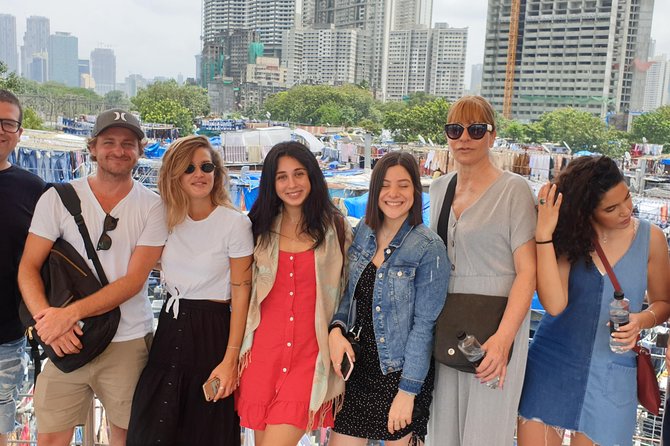
This tour is designed for exactly the kind of trip where your time is limited but your curiosity is not. In 4 to 5 hours, you cover a tight cluster of South Mumbai essentials: colonial-era monuments, major city institutions, classic sea views, and an experience that feels totally different from the marble-and-stone sights.
I like that it’s shared, but not crowded. With a maximum group size of 10, you’re not stuck waiting for a giant line to move, and it’s easier for the guide to keep track of what your group wants to see more closely. The route also has a built-in logic: you start near the water, work your way through iconic viewpoints and key buildings, then finish down in the Colaba area and return to the meeting point.
For cruise travelers, this matters. You want a tour that doesn’t drift into a long transit day. This one stays concentrated in South Mumbai and sticks to a simple, understandable loop.
What you actually pay for: $59, AC comfort, and minimal ticket fuss
At $59.00 per person, you’re paying for guided coordination plus a comfortable ride between stops. The big value is how the schedule is packed without being chaotic. A lot of city tours claim to be “efficient.” This one is efficient in the practical way: each stop gets a reasonable chunk of time, and the route doesn’t bounce across the whole megacity.
A second value point is the mobile ticket. It’s one less thing to manage when you’re juggling ship times, walking, and phone battery.
The admission setup is also pretty friendly. Most listed sights are free entry, and only Mani Bhavan Gandhi Museum is listed as ticket included. That means you can spend mental energy on the seeing part, not the ticket desk hunt.
One more detail that matters: it’s commonly booked about 16 days in advance. That’s a hint that popular cruise weeks and short-trip schedules grab these slots early, especially for the morning departure options.
Getting your bearings: the rhythm of the route
South Mumbai can feel like three different cities at once, depending on where you stand. This tour helps you stitch those parts together quickly.
You start at a dock-side meeting point in the Fort area, near Ballard Pier / Alexandra Dock / Green Gate. From there, you head to the waterfront monuments and viewpoints, then move inward for the Gandhi connection and the hilltop gardens. After that comes the most “real Mumbai” moment, Dhobi Ghat, followed by rail architecture at Chhatrapati Shivaji Terminus, civic buildings like the Bombay High Court, and then university grounds. The day ends near Colaba Causeway, and you finish back at the meeting point.
The pacing is light on long walking and heavy on seeing. That’s ideal if you want the big icons but you do not want to turn your whole half-day into a leg workout.
- Elephanta Caves & Island Guided Private Tour★ 5.0 · 1,327 reviews
- Private Guided Walking Tour in Fort & Colaba★ 5.0 · 895 reviews
- Mumbai: Street Food and Night Markets Tour★ 4.9 · 719 reviews
- Mumbai: Dharavi Slum, DhobiGhat, and Dabbawallas Tour★ 4.9 · 689 reviews
- Dharavi Slum Tour★ 5.0 · 625 reviews
Stop 1 and 2: Gateway of India and the Marine Drive viewpoint walk
Gateway of India
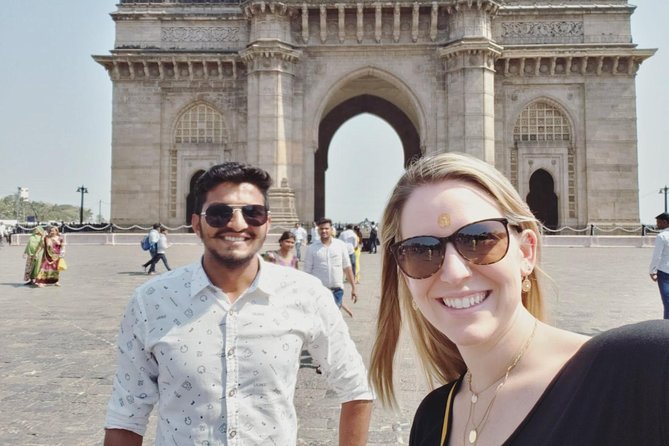
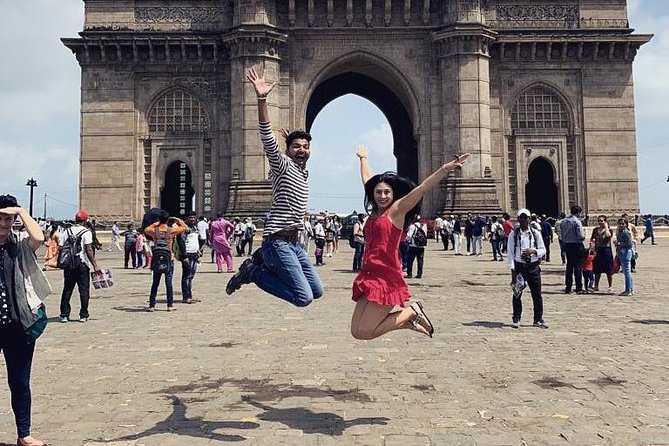
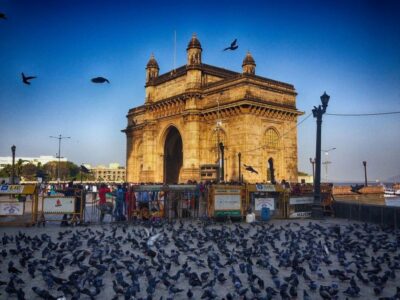
Your first major photo moment is the Gateway of India, an arch monument built in the early twentieth century. It was erected to commemorate the arrival tied to Britain’s first British monarch landing in India, with King-Emperor George V and Queen-Empress Mary arriving at Apollo Bunder.
What I like about starting here is that it gives you a visual anchor. When you later see other grand buildings and formal institutions in the area, you understand the area’s “official” side. Also, the setting on the water helps you grasp that Mumbai’s story is tied to the sea, not just streets.
A practical consideration: it’s usually a popular area, so expect crowds and keep your pace steady if you’re trying to get clean photos.
Marine Drive
Next is Marine Drive, a 3.6-kilometre boulevard in South Mumbai. Even if you only get a short window, this stretch does something useful. It helps you understand why locals and visitors keep coming back to this “line” of the city.
If you care about photo composition, try to position yourself so you catch the curve of the road and the open view beyond. The time here is short, but it’s long enough to orient your camera and your mental map.
Stop 3: Mani Bhavan Gandhi Museum, where the tour turns personal
Then the tour shifts from architecture to ideas at Mani Bhavan. This museum and historical building is dedicated to Gandhi, located in the Gamdevi precinct.
Here’s what makes this stop more than a quick checkbox: it was the focal point of Gandhi’s political activities in Mumbai between 1917 and 1934. That time period gives the visit a real sense of place. You’re not just seeing “a museum about Gandhi.” You’re stepping into a specific Mumbai hub tied to political work during those years.
The schedule includes about 30 minutes, and the museum entry is listed as ticket included. That’s just enough time to read a few key sections, look around calmly, and connect the dots between the city’s public institutions and the political energy that moved through it.
If you’re not a museum person, you can still enjoy the stop by focusing on the narrative and layout. If you do like museums, this is one of the few places on the route where you can slow down, sit, and think.
Stop 4 and 5: Hanging Gardens and Kamala Nehru Park on Malabar Hill
After the museum, you head to the hill gardens, which is a nice reset from streets and buildings. The tour includes two connected stops: Hanging Gardens (also known as Pherozeshah Mehta Gardens) and Kamala Nehru Park.
Hanging Gardens
These are terraced gardens perched at the top of Malabar Hill, on its western side. You’ll often find sunset-style views over the Arabian Sea, and the gardens feature hedges carved into shapes of animals.
I particularly like the origin story here. The park was laid out in 1881 by Ulhas Ghapokar over Bombay’s main reservoir. Some say the idea was to cover the water from potentially contaminating activity near nearby Towers of Silence. Whether you take that explanation literally or as local legend, it gives you a way to understand how Mumbai builds practical solutions into public spaces.
Kamala Nehru Park
Right after, Kamala Nehru Park is part of the same complex, covering about 16,000 square meters (about 4 acres). It’s a popular spot for young children and tourists.
If you’re traveling with anyone who needs a breather, this is where you benefit from having the tour organized for you. Gardens are one of the few places where you can move slower, step away from the group for a moment, and still feel like you’re doing the tour right.
One practical tip: expect sun exposure on the hill. Bring something for heat if you’re doing a daytime departure.
Stop 6: Dhobi Ghat, the stop that makes the whole tour feel real
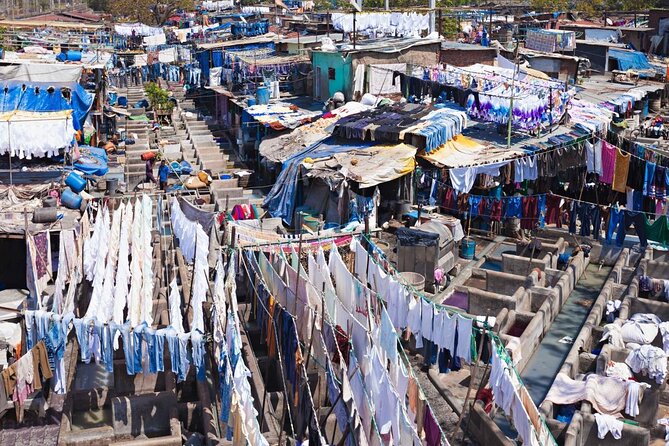
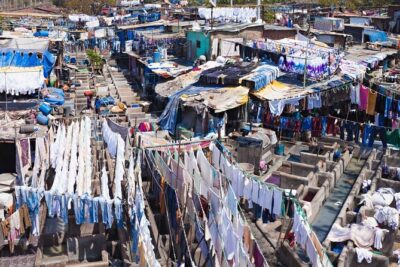
This is the moment that earns its own category. Dhobi Ghat (Mahalaxmi Dhobi Ghat) is an open-air laundromat in Mumbai, built in 1890. You’ll see washers known as dhobis working in the open to clean clothes and linens from Mumbai hotels and hospitals.
The description even calls it the world’s largest open-air laundry, and standing there helps you understand why people are drawn to it. It’s not “a sight you pass by.” It’s a living workspace. Clothes and routines become the spectacle.
And yes, this is where you’re likely to get those wide, stretching views that make the laundry feel endless. One guest highlighted exactly that feeling: the laundry seemed to stretch as far as the eye could see. That reaction is easy to understand once you’re there.
What to consider: this is an active working area. If you’re sensitive to strong smells or don’t like crowds, keep your distance and follow your guide’s lead. Also, the ground can be uneven near the working sections, so wear shoes you can walk comfortably in.
If you want an authentic Mumbai moment that has nothing to do with monuments, this is it.
Stop 7 and 8: Chhatrapati Shivaji Terminus and Bombay High Court
Chhatrapati Shivaji Terminus (CST)
Next up is the train station experience at Chhatrapati Shivaji Terminus. You’ll learn that the station name was changed to honor Shivaji, the 17th-century founder of the Maratha Empire, and that the station code is CST.
Even with a short stop, it’s worth paying attention to because railway stations in India are more than transportation. They are public gateways, constantly in motion, and they often carry architectural pride. Here, the key takeaway is the named honor and the station’s role as a major city symbol.
Bombay High Court
Then you see the Bombay High Court, which was one of the three High Courts in India established at the Presidency Towns by Letters Patent granted by Queen Victoria dated June 26, 1862. It was inaugurated on August 14, 1862, under the High Courts Act, 1861.
This is one of those stops where you can learn the “when” and “why” and then just watch how the building communicates authority. If you like civic architecture, this is a good contrast to the everyday intensity of Dhobi Ghat.
Because this is a quick viewing window, aim to look from multiple angles rather than trying to photograph everything from one spot.
Stop 9: University of Mumbai Library and the Colaba finish
University of Mumbai Library
Your route continues to the University of Mumbai, also known by its former name University of Bombay until 1997. The tour highlights that it is one of the earliest state universities in India and the oldest in Maharashtra, and that many courses use English as the language of instruction.
This stop gives a different kind of context to the day. After all the monuments, institutions, and waterfront energy, you get a sense of the city as a long-term learning center, not just a place of heritage and traffic.
Colaba Causeway
Finally, you reach Colaba, anchored by Colaba Causeway (also referred to as Shahid Bhagat Singh Road). This commercial street is described as a major causeway linking Colaba and the Old Woman’s Island.
This is a practical ending point. Commercial streets mean more street life, more snack options, and usually an easier time finding something simple if your group wants a last-minute bite. One of the reviews even mentioned finding the best chai as part of the overall experience, which makes sense for a finishing area like this.
The tour ends back at the meeting point, so you’re not left trying to figure out your next move in a part of town you barely met.
Guide pace and what you should expect from the group
The biggest quality factor here is how the tour feels with people around you. With only up to 10 in the group, the guide can keep it human. You don’t have to “race” to keep up, and you can ask for a quick extra moment at the places that grab you.
The schedule is built around short stop windows. That means you should decide in advance what matters most to you. If you care most about photography, prioritize the seafront viewpoints and the station area. If you want cultural context, the Gandhi museum is your deep focus moment. If you want something that looks like real life, Dhobi Ghat is the one.
Also, because the tour is shared, you’ll likely have a mix of travelers with different interests. The format supports that because each stop is distinct, so everyone finds at least one anchor moment.
Practical tips for a smooth half-day in Mumbai
This tour is short, but you’ll still feel Mumbai.
- Bring water. You’ll be outdoors at multiple stops.
- Wear shoes that can handle short walks and uneven pavement near busy areas like Dhobi Ghat.
- If you’re doing a sunny departure, plan for shade breaks during garden or museum time.
- For photos, aim for your “must shot” list: Gateway of India, Marine Drive, Hanging Gardens views, Dhobi Ghat, and CST from a workable angle.
Weather matters. The experience is noted as requiring good weather, and if it’s canceled due to poor conditions, you’ll be offered a different date or a full refund. So check the forecast close to departure day, especially during monsoon season or very hot stretches.
Who should book this South Mumbai tour
This is a smart match if:
- You have only 4 to 5 hours and want a curated overview of South Mumbai
- You prefer a small group and a guided route instead of navigating alone
- You want both major landmarks and an everyday work scene like Dhobi Ghat
- You’re traveling as a couple, solo, or with cruise-day constraints (meeting at Ballard Pier area helps some visitors)
You might think twice if:
- You hate crowds, even small ones, because the stops like Gateway of India and Dhobi Ghat can get busy
- You prefer long museum time. Here, Mani Bhavan is the only museum and the time is limited
- You’re very sensitive to smells or active working environments (Dhobi Ghat is an active laundry area)
Should you book it or skip it?
Book it if you want a fast, guided way to connect the dots in South Mumbai. The value is strongest in the mix: big-name sights like Gateway of India and Marine Drive, plus the Gandhi museum stop, plus the unforgettable working-laundry view at Dhobi Ghat.
Skip it only if you already have a very specific plan for South Mumbai that does not include this kind of focused loop. If you want a one-day “get oriented” tour that still gives you a couple of genuinely different experiences, this one earns its place.
FAQ
FAQ
How long is the South Mumbai tour?
It runs about 4 to 5 hours.
What is the group size?
The tour has a maximum of 10 travelers.
Is there an air-conditioned vehicle?
Yes, you travel in the comfort of an air-conditioned vehicle.
Do I get to choose a departure time?
Yes, you can choose from morning or afternoon departures.
Is the ticket mobile?
Yes, the tour uses a mobile ticket.
Which stops include admission tickets?
Mani Bhavan Gandhi Museum has admission included. The other listed stops are marked as free entry.
Where is the meeting point?
The meeting point is Ballard Pier Mumbai / Alexandra Dock / Green Gate (Fort area), with the location reference WRMR+9WV.
How does cancellation work?
You can cancel for a full refund up to 24 hours in advance of the experience’s start time.
What happens if weather is bad?
The tour requires good weather. If it is canceled due to poor weather, you will be offered a different date or a full refund.
Is this tour suitable for most travelers?
Most travelers can participate, with the main limitation being that it is outdoors and weather matters.
Mumbai, Keep Exploring



Recently reviewed across Mumbai
- Mumbai City Sightseeing Guided Tour on a Bicycle
★ 5.0 · 10 reviews - Mumbai Street Food & Beach Tour with 10+ Tastings
★ 5.0 · 10 reviews - Mumbai Market Tour & Maharashtrian Cooking Class with Chef Reshma
★ 4.5 · 10 reviews - Sailing Experience in Mumbai on Mid Size Yacht
★ 5.0 · 10 reviews - 3 Days Complete Mumbai Tour Inclusive of Bollywood Studio Experience
★ 5.0 · 10 reviews - Dharavi Slum Tour
★ 5.0 · 10 reviews
Mumbai City Tours, compared.
 ★ 4.9Full-Day Sightseeing Tour of MumbaiFrom $241,822 reviews
 ★ 5.0Group Guided Walking Tour in Fort and ColabaFrom $161,073 reviews
 ★ 4.8Elephanta Caves Half-Day Guided Tour with ExpertFrom $301,032 reviews
 ★ 5.0Highlights of Mumbai Sightseeing Tour: TRAVELLERS CHOICE AWARDEDFrom $33915 reviews
 ★ 5.0Private Guided Walking Tour in Fort & ColabaFrom $36895 reviews
 ★ 4.9Street Food and Night Markets TourFrom $13719 reviews
 ★ 4.9Dharavi Slum, DhobiGhat, and Dabbawallas TourFrom $14689 reviews
 ★ 5.0Highlights of South Mumbai Guided Private Tour in AC VehicleFrom $74620 reviews
Browse the lists this tour appears in