
REVIEW · PUSHKAR AND AJMER TOURS
Afternoon Walk Tour with Sunset & Fire Ritual -The Pushkar Route
Sunset in Pushkar turns serious fast. This afternoon walk threads together iconic shrines and the lake’s ghats, with hot drinks and snacks, live music, and a lakeside fire ceremony to give the city a moving, spiritual rhythm. I especially like how the route strings meaning to the scenery, from Varaha Temple to the Brahma Ghat ritual, instead of just ticking off landmarks. The only real drawback to plan for: you’ll be on your feet for a solid 3 hours, including steps and narrow lanes, so comfy shoes matter.
You’ll get a small group (max six) and a guide who keeps the pace human while answering questions as you go. I also like that several stops are free to enter, which helps this feel like real value, not a ticket bundle. One consideration: because the focus is religious and ceremonial, you should expect moments where standing and watching matters more than taking quick pictures.
In This Review
- Key highlights I’d circle before you go
- Why this 4:00 pm sunset walk fits Pushkar so well
- Price and value: $7 for temples, music, and a fire ritual
- Stop 1: Varaha Temple and the 12th-century start that sets the tone
- Stop 2: Gurudwara Sahib for Sikh history and why Pushkar crosses religions
- Stop 3: Pushkar Lake (Raj Ghat / Sunset Point) when the light turns kind
- Stop 4: Brahma Ghat fire ceremony, where the evening becomes a ritual
- Stop 5: Atamteshwar Mahadev Mandir, the underground cave temple stop
- Stop 6: Brahma Ghat walking along the ghats for offerings and ancestral prayers
- Stop 7: Brahma Temple, the one dedicated to Brahma in the whole universe
- Stop 8: The lanes, Halwai Gali for malpuas, and Gandhi Ghat vibes
- The guide effect: when the explanations turn sights into meaning
- Practical tips for a respectful, comfortable evening walk
- Who should book this Pushkar Route walk
- Should you book this sunset and fire ritual walk?
Key highlights I’d circle before you go
- Live music with the sunset mood, not just a silent stroll
- Lakeside fire ritual at Brahma Ghat, a memorable Pushkar evening moment
- Iconic temple chain (Varaha, Atamteshwar, Brahma Temple) plus a Vishnu shrine stop near Varaha Ghat
- Hot drinks and snacks included, so you start the evening steadier
- Max 6 travelers, which makes questions, pacing, and photo stops easier
- Mix of included and free sites, so you spend time instead of handling entrance hassles
Pushkar and Ajmer, more options
Why this 4:00 pm sunset walk fits Pushkar so well
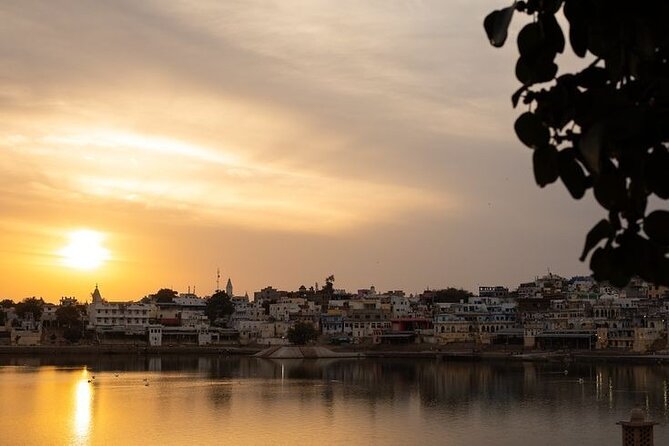
Pushkar works best late afternoon, when the light softens and the lake area starts to feel like the city’s true “center.” This tour starts at 4:00 pm and runs about 3 hours, which is long enough to cover real highlights without turning into a full-day grind.
The route is built for evening energy. You’ll have hot drinks and snacks along the way, which sounds simple, but it matters because Pushkar evenings can be cool and you might be walking before the fire ceremony. It also helps you stay focused on what you’re seeing, not just on getting through.
This is also a small group experience with a hard cap of six travelers. That size makes a difference around temples and ghats where space is tight. You’re more likely to hear explanations clearly, and you’re less likely to get separated in the lanes.
Price and value: $7 for temples, music, and a fire ritual
$7 per person is the kind of price that makes you ask, what’s the catch? In this case, the value comes from how many “experience elements” are stacked into a short walk.
You’re not paying extra just for a basic guided walk. You get:
- Multiple temple and ghat stops with admissions included for several of them
- A fire ceremony experience (the main evening highlight)
- Live music as part of the sunset atmosphere
- Hot drinks and snacks to keep you comfortable
- A guide-led flow through the places you’d typically struggle to connect on your own
Could you do a similar route on your own? Sure. But you would likely lose the context that makes the shrines and ghats feel coherent. At $7, you’re paying mostly for time saved, guidance, and ceremony access.
Stop 1: Varaha Temple and the 12th-century start that sets the tone
The walk begins at Varaha Temple, a dedication to Lord Vishnu and one of the eight Swayambhu Kshetra associated with Vishnu. That detail matters because Varaha here is not just a pretty stop. It’s part of Pushkar’s deeper religious map, and a good guide will help you read the place beyond the walls.
You’ll spend around 25 minutes here, and admission is included. The temple is described as dating back to the 12th century, built by King Anaji Chouh. Even if you’re not an architecture nerd, that century marker gives you instant perspective: this is not a recent tourist build.
What to watch for: take a moment to look at how worship happens in and around the temple space. Your guide’s explanations usually connect that everyday ritual behavior to why Pushkar is sacred in the first place.
- Walking Sightseeing Tour – The Shine Pushkar★ 5.0 · 64 reviews
- Evening Walking tour with Fire Ceremony – The Pushkar Route★ 5.0 · 35 reviews
- From Jaipur : Private Ajmer Pushkar Tour by Cab★ 4.5 · 29 reviews
- Dhiraj’s painting classes and art workshop★ 5.0 · 24 reviews
- Full Day Spiritual Tour of Ajmer & Pushkar-The Pushkar Route★ 5.0 · 12 reviews
Stop 2: Gurudwara Sahib for Sikh history and why Pushkar crosses religions
Next up is Gurudwara Sahib, where you learn about Sikh history and beliefs, including why Pushkar is sacred for Sikh tradition. This stop is only about 20 minutes, and entry is free, but it’s one of the best “balance” moments on the route.
Pushkar is often framed in Hindu terms, yet the town also matters to Sikh pilgrims. Getting that context early helps you understand why the city’s spiritual landscape feels shared, not one-note.
Practical note: because this is a place of worship, keep your movements calm and your attention on the guide’s explanations. If you ask a question, ask it in a respectful way and keep the pace steady.
Stop 3: Pushkar Lake (Raj Ghat / Sunset Point) when the light turns kind
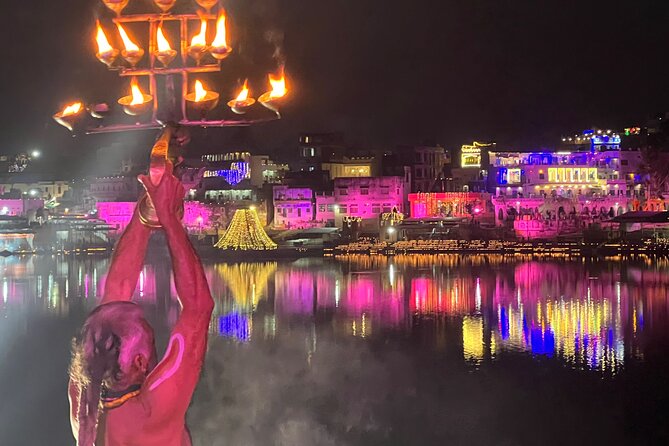
Then you reach Pushkar Lake, stopping at the ghat known as Sunset Point or Raj Ghat. You’ll have around 20 minutes here, with entry free.
This ghat is described as originally constructed by the King of Amer, Raja Mann Singh I, in the early 16th century, and later renovated by Jai Singh in the 18th century. That timeline helps you see the lake not just as scenery, but as a long-running place for pilgrimage and ceremonies.
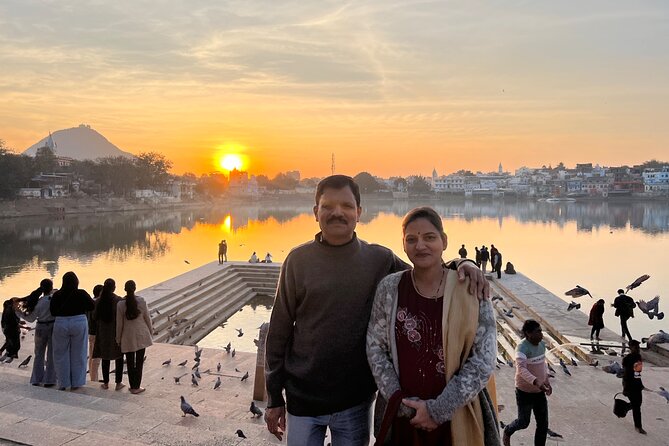
This is where the route earns its “sunset walk” label. As the day cools, the lake area becomes a stage for music, chanting, and the kind of evening atmosphere you can’t fully recreate alone.
If photography is your thing, this is a good moment for it, especially if you like shots that include people at the edge of the ghats. The key is to pause first, then shoot.
Stop 4: Brahma Ghat fire ceremony, where the evening becomes a ritual
Brahma Ghat is the moment many people remember most. You’ll spend about 30 minutes here, and admission is included for this segment.
The centerpiece is the fire ceremony, tied to evening aarti traditions. The description emphasizes that this is a special experience that you should not miss in Pushkar. This is also the stop where the tour feels more than sightseeing. You’re watching something active and time-bound, and your guide should help you understand what you’re seeing and why it matters.
Why the timing matters: a fire ritual is designed for the transition between day and evening. If you arrive late, you might miss key parts. That’s exactly why the tour starts in the late afternoon.
What you can do: stand where the guide indicates and follow the flow. If your group is small, you’ll have a better chance of finding a comfortable viewing position without constantly repositioning.
Stop 5: Atamteshwar Mahadev Mandir, the underground cave temple stop
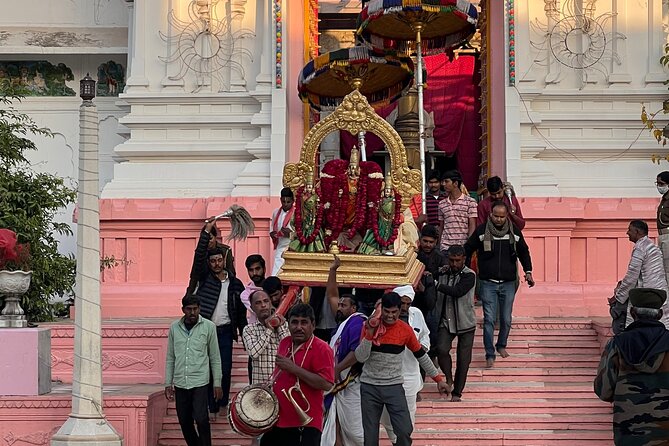
After Brahma Ghat, the tour moves to Ati Prachin Shri Atamteshwar Mahadev Mandir, dedicated to Lord Shiva. This stop is about 15 minutes, with admission included.
Here’s the fascinating detail: it’s described as an underground cave temple dating to the 12th century AD, known for its Hemadpanti architectural carvings. Even if you only catch a portion of the carvings, the underground-cave element changes the feel of the visit. It’s quieter, more enclosed, and it breaks the rhythm from bright lake views to something more inward.
If you like detail, ask your guide to point out what makes Hemadpanti style distinctive in this setting. If you don’t, just soak up the shift in atmosphere.
Stop 6: Brahma Ghat walking along the ghats for offerings and ancestral prayers
There’s a second Brahma Ghat segment on the route, about 20 minutes, with entry free.
This part is described as a spiritual walk along the ghats toward Brahma Ghat, where you can offer ceremonies for your family and special prayers for ancestors. In other words, you’re not only there to watch. Depending on what’s happening, you may have the chance to participate.
Some travelers get blessings here, and in practice it’s treated as optional, not a hard push. That’s important. If you want to participate, you can. If you’d rather watch quietly, you still get the meaning through the guide’s explanations.
How to approach this respectfully:
- Follow your guide’s instructions for where to stand
- Keep your pace slow near prayer areas
- Ask if participation is allowed in the moment you’re there, since ceremonies can vary
Stop 7: Brahma Temple, the one dedicated to Brahma in the whole universe
Next is the Brahma Temple, which is described as the only temple in the universe dedicated to Lord Brahma. It takes about 30 minutes, with admission included.
The structure is described as dating to the 14th century, partly renovated later, and built with black and white marble stones. That marble look can be stunning when the light shifts in the evening, so don’t rush this stop.
Brahma Temple is also a good place to ask your guide to clarify the role of Brahma in the broader Hindu pantheon. When a guide connects the theology to the physical layout, the temple becomes more than a photo backdrop.
Stop 8: The lanes, Halwai Gali for malpuas, and Gandhi Ghat vibes
After the Brahma Temple visit, you head through narrow lanes toward the Pushkar Main Market. This is about 20 minutes, with entry free.
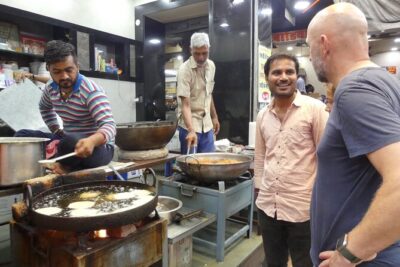
Along the way, you’ll see photography-friendly spots and reach Halwai Gali, famous for malpuas, plus Gandhi Ghat. You’re ending the walking loop with the kind of scene that tells you what Pushkar feels like outside the main ceremony areas.
One thing I like about this market segment: it helps your brain switch from sacred space to everyday life. Pushkar is a pilgrimage town, but it also runs on food stalls, conversations, and evening snacks.
If you have food goals, arrive hungry enough to grab a bite after the tour, or you might find the market part is too quick to satisfy real cravings.
The guide effect: when the explanations turn sights into meaning
The best part of this tour is how much explanation you get, not just where you go. Multiple guides are named in experiences tied to this route, including Manish and Vishwanath. Both come through as guides who make the walk feel exciting and understandable, with clear English.
What you should look for during your tour:
- Your guide explaining why each temple and ghat matters, not just what it is
- Answers that connect religion to everyday practices you’ll see around you
- A pace that lets you ask questions without slowing the whole group
There’s also a theme of practical preparation. Some guides offer useful advice before you start and are flexible if timing shifts. So if you’re trying to make this work around your arrival schedule in Pushkar, this format tends to be forgiving.
Also, if the idea of something like a Pushkar passport comes up, it’s treated as optional rather than a hard sell. That keeps the tour feeling more like a shared walk than a shopping pitch.
Practical tips for a respectful, comfortable evening walk
This is a walking tour with temple and ghat stops, so plan like you’re going to be on uneven ground at least some of the time. Wear comfortable shoes with grip. Keep your clothing respectful for temples.
Bring cash only if you expect to buy small things in the market, like snacks or sweets, since those are free-choice. Otherwise, the tour itself includes what you need to stay energized: hot drinks and snacks.
A small-group walk also means you’ll want to communicate with your guide if you have questions or if you need a moment. If you want a better photo, ask your guide when it’s okay to stop for a minute, rather than stepping out suddenly in ceremony zones.
Finally, arrive a few minutes early so the start at 4:00 pm is smooth. A late arrival can cut into the first temple timing.
Who should book this Pushkar Route walk
This tour is ideal if you:
- Want to see several major Pushkar sites in a single evening without planning each stop
- Like understanding the why behind temples, not just collecting landmarks
- Prefer a small group setting where the guide can answer questions
- Really want the emotional payoff of a fire ceremony plus live music by the lake
It might not be the best fit if you want a quiet, solo-paced experience with no ceremonies. This route leans into religious meaning and active evening ritual viewing, which some people love and others find too intense.
Should you book this sunset and fire ritual walk?
If you’re asking whether $7 is worth it, my take is yes, based on what this tour includes. You get a dense mix of temples, ghats, live music, hot drinks and snacks, and a fire ceremony in about 3 hours with a max group size of six. That’s strong value for Pushkar, where “good context” is usually what separates a memorable evening from a random walk.
I’d book it if you want a guided path through Pushkar’s spiritual center with enough structure to feel effortless. If you can handle walking on ghats and you’re open to ceremonial moments, this is the kind of evening that sticks with you.
Pushkar and Ajmer, More Routes



Recently reviewed across Pushkar
- Full Day Spiritual Tour of Ajmer & Pushkar-The Pushkar Route
★ 5.0 · 12 reviews - Fullday pushkar tour from jaipur with guid+camel/jeep safari
★ 4.4 · 12 reviews - Dhiraj’s painting classes and art workshop
★ 5.0 · 24 reviews - From Jaipur : Private Ajmer Pushkar Tour by Cab
★ 4.5 · 29 reviews - Evening Walking tour with Fire Ceremony – The Pushkar Route
★ 5.0 · 35 reviews - Walking Sightseeing Tour – The Shine Pushkar
★ 5.0 · 64 reviews
Pushkar and Ajmer Tours, compared.
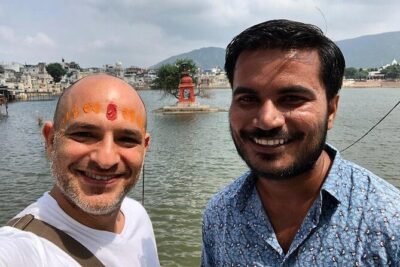 ★ 5.0Spiritual City Walking Tour-THE Pushkar RouteFrom $6907 reviews
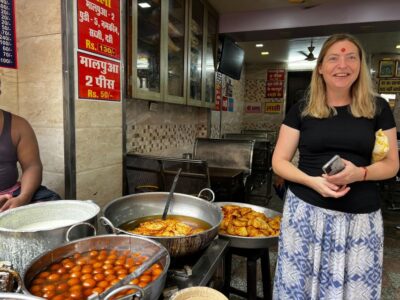 ★ 4.9Evening Walking Tour with Fire Rituals-The Pushkar RouteFrom $6108 reviews
 ★ 5.0Spiritual Walking tour with Puja Ceremony -The Pushkar RouteFrom $6101 reviews
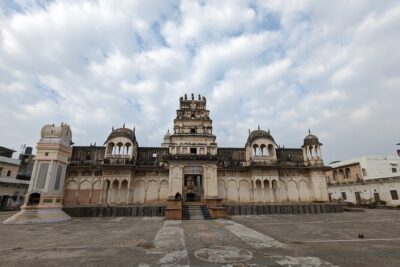 ★ 5.0Walking Sightseeing Tour – The Shine PushkarFrom $564 reviews
 ★ 4.5Pushkar Day Trip from Jaipur – Private Car, Safari, Guide & LunchFrom $5845 reviews
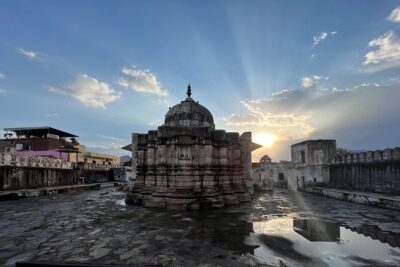 ★ 5.0Evening Walking tour with Fire Ceremony – The Pushkar RouteFrom $835 reviews
 ★ 4.5Private Ajmer Pushkar Tour by CabFrom $1229 reviews
 ★ 5.0Experience Private Food And Culture Walk-The Pushkar RouteFrom $1526 reviews
Browse the lists this tour appears in