
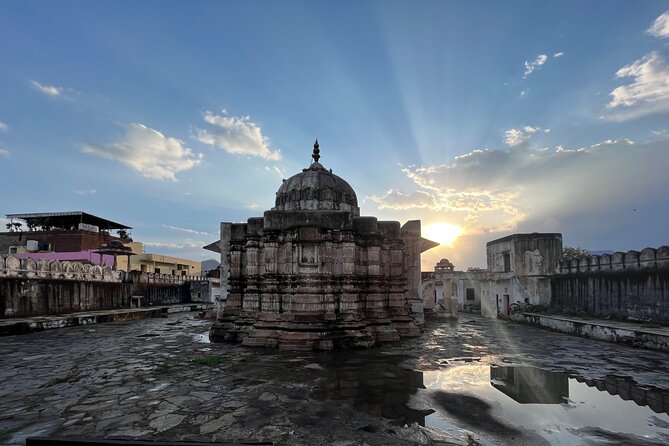
REVIEW · PUSHKAR AND AJMER TOURS
Evening Walking tour with Fire Ceremony – The Pushkar Route
One hour after sunset, Pushkar turns gentle and sacred. This evening walking tour mixes temple visits with the Maha Aarti by Pushkar Lake, and I love how the pace stays human in a small group. You’ll also get straightforward, on-the-ground context at several key sites, so the rituals and architecture make sense. A possible drawback, worth knowing up front, is that this is a walking-focused evening, so you should be ready for temple steps and uneven paths around the lake.
I like that the experience is shopping-free, so the stops feel like they are chosen for culture, not commissions. With a start time of 5:00 pm, you catch the town while the light is soft and the air cools off, then you end with the kind of fire ceremony people travel to see.
In This Review
- Key highlights that make this tour worth your time
- Pushkar after dark: why this walk feels calmer than daytime
- Price and value: $8 for a 3-hour, admission-included temple walk
- The 5:00 pm start and how the pacing works on foot
- Stop 1: Brahma Ghat, the opening act for Maha Aarti
- Stop 2: Brahma Temple, a rare focus on the creator god
- Stop 3: Brahma Ghat again, where the evening ritual peaks
- Stop 4: Varaha Temple, an older Vishnu connection
- Stop 5: Gurudwara Sahib, Pushkar’s religious mix in plain sight
- Stop 6: Pushkar Lake and the 52 ghats walking stretch
- Stop 7: Old Rangji Temple near Varaha Ghat to close the loop
- Shopping-free by design, and why that matters in Pushkar
- Guides make the difference: Manish and Kapil stood out in the details
- How to get the most out of the Maha Aarti moment
- Practical travel tips for an easier evening walk
- Who this tour suits best
- Should you book The Pushkar Route evening walk?
- FAQ
- What is the start time for the Pushkar evening walking tour?
- How long does the tour last?
- What does the tour cost per person?
- Is pickup offered?
- Is this tour a shopping tour?
- How big is the group?
- What is the ticket format?
- Are admission tickets included?
- What is the cancellation policy?
- Where does the tour begin?
Key highlights that make this tour worth your time
- Maha Aarti at the Brahma Ghat on the lakefront, timed for that evening atmosphere
- Temple route you cannot easily piece together on your own, with practical context at each stop
- Admission tickets included at every listed temple stop
- Small group size (max 6), which usually means more time for questions
- Shopping-free walking focused on spirituality, culture, and customs
- Pushkar Lake loop and lesser-seen corners, including older temples near the ghats
Pushkar and Ajmer, more options
Pushkar after dark: why this walk feels calmer than daytime
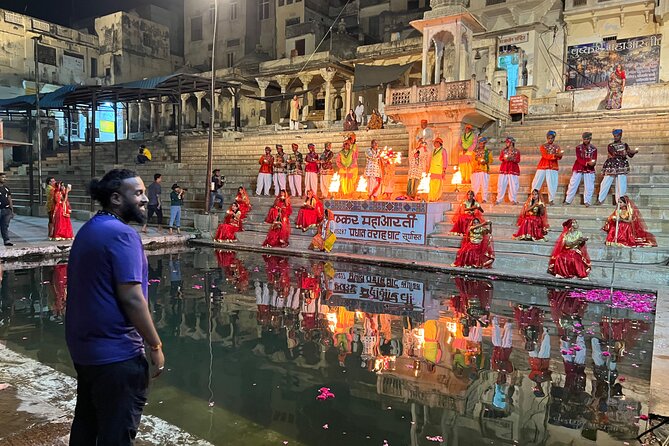
Pushkar is pretty in the day. At night, it gets quieter in the best way, especially when you are moving from temple to temple and letting the lake set the rhythm. Starting at 5:00 pm matters because you get that transition phase, from day bustle to evening ritual.
The tour leans into the town’s spiritual side without turning it into a lecture. You are walking, looking, and listening, and the guide ties it together in plain terms. That approach helps you avoid the common problem of temple hopping with no thread connecting it.
Price and value: $8 for a 3-hour, admission-included temple walk
At $8 per person for about 3 hours, this is priced more like an evening activity than a full-day tour. The big value is not just the cost. It is the mix of included admission tickets at each stop and a route designed so you do not waste time figuring out where to go next.
Also, the group limit of up to 6 travelers changes the feel. You can ask questions, and you are not stuck hearing one-way explanations through a crowd. In the reviews, people praised guides like Manish and Kapil for being friendly and able to answer curiosity on the spot, not just run a script.
One practical note: the tour includes pickup, but you are also told it is near public transportation. So even if you do not use pickup, you have a backup plan to meet easily.
The 5:00 pm start and how the pacing works on foot
This evening walk is built around foot traffic, not buses. You will move through the older parts of town toward Pushkar Lake, with short temple visits along the way. The listed time per stop is usually 15 to 30 minutes, then you walk to the next point.
That pacing is a plus. It keeps the evening from dragging, and it helps you stay alert during the fire ceremony portion. The main thing to plan for is comfort: wear shoes you trust on steps and stone edges, and keep water in mind for the warm months.
- Walking Sightseeing Tour – The Shine Pushkar★ 5.0 · 64 reviews
- Evening Walking tour with Fire Ceremony – The Pushkar Route★ 5.0 · 35 reviews
- From Jaipur : Private Ajmer Pushkar Tour by Cab★ 4.5 · 29 reviews
- Dhiraj’s painting classes and art workshop★ 5.0 · 24 reviews
- Full Day Spiritual Tour of Ajmer & Pushkar-The Pushkar Route★ 5.0 · 12 reviews
Stop 1: Brahma Ghat, the opening act for Maha Aarti
You begin at Brahma Ghat, one of Pushkar’s important ghats, known for evening ritual activity. The reason this first stop is smart is timing. Starting here sets your expectations for what the lakefront rituals look like, before you move deeper into the temple circuit.
The tour also mentions the Shankaracharya temple constructed on the ghat entrance by Shri Jayendra Saraswati. Even if you do not go in for long, it gives you a helpful anchor: this place is not random. It is tied to well-known figures and a long spiritual use of the ghats.
You are at this stop for about 30 minutes, which gives enough time to take in the setting and understand why the ghat matters before the main ceremony.
Stop 2: Brahma Temple, a rare focus on the creator god
Next comes the Brahma Temple, one of the few in India dedicated to Brahma, the Hindu creator-god. The temple structure dates to the 14th century, which means you are looking at an older layer of Pushkar’s religious life.
This stop works best when you treat it like a chance to understand symbols, not just take photos. The guide’s role here is key, because Brahma temples are not something most people see often, so your brain needs a few context points to connect what you see to the ideas behind it.
You have about 30 minutes here, including admission. That is enough for a calm look around without feeling rushed, as long as you give yourself a minute to watch how devotees move through the space.
Stop 3: Brahma Ghat again, where the evening ritual peaks
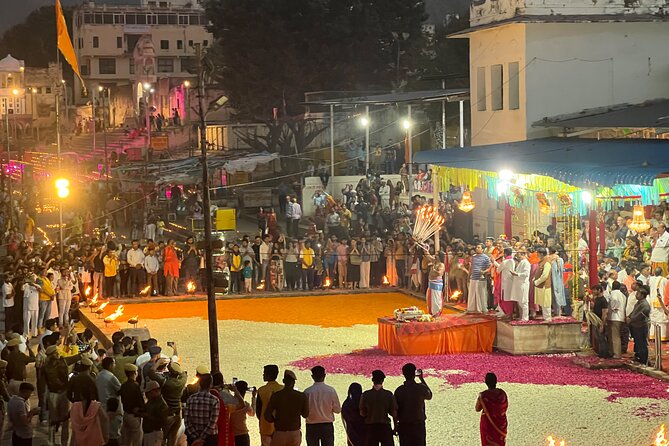
Then you return to Brahma Ghat for the evening Aarti, around 25 minutes. This repeat stop is not repetition for repetition’s sake. It is how the evening builds. You see the ghat earlier, then you see it when the ritual energy is in full swing.
The fire ceremony is the centerpiece of the route. The tour description emphasizes the sound of bells from the temples around the lake and the idea of purification through devotion. Even if you do not share the same religious viewpoint, you can still appreciate the atmosphere, the timing, and the care people put into a daily practice.
Practical tip: if you plan to take photos, decide early what you want. You can get great low-light shots, but keep your position respectful. In fire ceremonies, the best views often mean standing where you do not block other people.
Stop 4: Varaha Temple, an older Vishnu connection
From the main ghat ritual, the tour moves to the Varaha Temple, dedicated to Lord Vishnu. It is described as one of the eight Swayambhu Kshetra of Vishnu, and the tour notes a 12th-century construction associated with King Anaji Chouha.
This stop is valuable because it broadens the “who and why” of the route. Earlier you focused on Brahma. Here you shift to Vishnu, so your understanding of Pushkar’s temple network becomes less one-note and more connected.
You get about 25 minutes for this temple visit, including admission. The drawback to be aware of is simply time. The route is efficient, so if you want long readings on carvings, you might wish for more minutes than you get. The guide’s explanations help bridge that gap quickly.
Stop 5: Gurudwara Sahib, Pushkar’s religious mix in plain sight
After Varaha, you visit Gurudwara Sahib, also known as a Sikh temple. Pushkar is known for religious diversity, and this stop gives you a different kind of sacred space than you have seen so far.
The tour highlights the beauty and tranquility of the Gurudwara, and frames Pushkar as a place where multiple religions share space. Even if you are only passing through for about 30 minutes, it is a strong reminder that sacredness in Pushkar is not limited to one tradition.
This stop also helps balance the intensity of the fire ceremony. After flames and bell sounds, a quieter place of worship can feel like a deep breath.
Stop 6: Pushkar Lake and the 52 ghats walking stretch
Now the route opens up with a spiritual walk around Pushkar Lake, with mention of 52 ghats and photography opportunities. You also visit some smaller and older temples along the edge of the lake.
This is one of the most enjoyable parts of the entire evening, because it shifts you from single building focus to town-scale view. When you walk the lake path, you start to understand how Pushkar’s temples function like a network, with the ghats as the connective tissue.
You also get 25 minutes here, which is enough for a few viewpoints and a slow look, but not enough to wander off on your own. If you are hoping to linger at one specific temple, you will need to communicate with your guide or accept the group pace.
Stop 7: Old Rangji Temple near Varaha Ghat to close the loop
The final major stop is the Old Rangji Temple, located near Varaha Ghat. The route describes it as about 200 years old and dedicated to Lord Vishnu.
This is a nice way to end because it brings you back into a “neighborhood temple” feeling. The group gets a short visit, about 15 minutes, so it is not about deep sitting. It is about getting one last meaningful look before the evening winds down.
If you like finishing tours with a sense of place, this last stop helps. It gives you one more anchor to remember when you later think back on the route’s themes: Brahma, then Vishnu, then the lake, then community worship.
Shopping-free by design, and why that matters in Pushkar
One of the tour’s stated differentiators is that it is shopping free, meaning no forced stops at stores. In many places, that alone is worth something. It keeps the evening focused on temples, ghats, and customs rather than turning the experience into a sales run.
It also changes the flow. You spend your time where you came for it. You are more likely to look closely, ask questions, and enjoy the evening without feeling like you missed a “real” highlight because it got replaced with a shopping stop.
Guides make the difference: Manish and Kapil stood out in the details
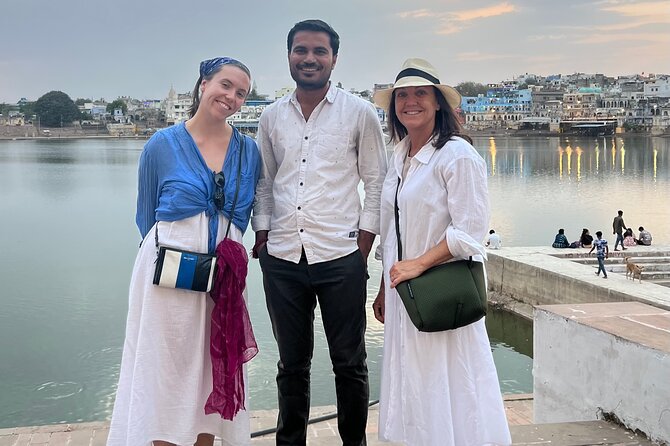
What really comes through in the experience is the guide quality. In the feedback I saw, both Manish and Kapil were praised for being friendly and highly informative, and for taking people to locations they would struggle to find alone.
That practical navigation matters in Pushkar. If you are walking without local help, you can easily hit the big names and miss the smaller sites that still shape the town’s identity. A good guide connects the dots fast, then slows down when the details matter, like why a particular ghat is important or how the evening Aarti timing changes what you see.
The best part is the Q and A style. Instead of only guiding with a set speech, the guides handle curiosity in real time. That is especially helpful if you are not already familiar with Hindu temple customs.
How to get the most out of the Maha Aarti moment
The Maha Aarti segment is what most people remember. The biggest way to get value is simple: prepare yourself to watch, not just capture.
Here are a few ways to make that fire-ceremony moment land:
- Arrive with respect and patience, since people and rituals move with purpose
- Choose a viewing spot that does not block others
- Keep your questions ready for your guide right after the ceremony so you can connect what you saw to the meaning
Also, be ready for sensory intensity. The tour mentions bells around the lake and a divine touch of religion. Even if you are new to the practice, that sound and motion are part of the experience, and they help explain why this ritual draws people from far away.
Practical travel tips for an easier evening walk
This is a walking tour with temple stops, so your comfort choices matter more than usual.
I’d plan for these basics:
- Start comfortable, since it begins at 5:00 pm and you will be on your feet for about 3 hours
- Wear shoes that handle stone steps and uneven edges around the lake
- If you want photos at Pushkar Lake, keep your camera settings ready before you reach the busiest parts
- Bring a light layer. Evenings can cool down, especially near open water
If you want a spiritual and cultural evening that does not feel like a checklist, this route fits. It is also a good option if you like learning as you walk, with historical and custom explanations given in a way that is meant to be understood.
Who this tour suits best
You’ll probably enjoy this most if you:
- Want an evening view of Pushkar that focuses on temples and lake rituals, not shopping
- Like small-group pacing and the chance to ask questions
- Are curious about how different sacred spaces connect in one town
It is also a strong pick if you feel overwhelmed by Pushkar logistics. The route gives you structure, direction, and context, so you do not end up wandering in circles near the ghats.
Should you book The Pushkar Route evening walk?
If your goal is the classic Pushkar evening experience, but with less stress, I think this is a smart booking. The price is low for a route that includes multiple temple visits and admission tickets, and the small group size supports a more personal guide experience.
The main reason to hesitate is the format: it is a walking tour with religious rituals. If you want a purely relaxed sightseeing evening, or if crowds and ceremony sounds make you uncomfortable, you may prefer a slower option.
If you can handle temple steps and you want the Maha Aarti moment done respectfully and with context, this is one of the most value-forward ways to see Pushkar after dark.
FAQ
What is the start time for the Pushkar evening walking tour?
The tour starts at 5:00 pm.
How long does the tour last?
The duration is approximately 3 hours.
What does the tour cost per person?
The price is $8.00 per person.
Is pickup offered?
Yes, pickup is offered.
Is this tour a shopping tour?
No. It is described as a shopping-free tour with no shopping stops.
How big is the group?
The tour has a maximum of 6 travelers.
What is the ticket format?
It uses a mobile ticket.
Are admission tickets included?
Yes. Admission tickets are included for the listed temple stops and points.
What is the cancellation policy?
Free cancellation is offered. You can cancel up to 24 hours in advance for a full refund.
Where does the tour begin?
The meeting points are described as near public transportation. Confirmation is received at booking.
Pushkar and Ajmer, More Routes




Recently reviewed across Pushkar
- Full Day Spiritual Tour of Ajmer & Pushkar-The Pushkar Route
★ 5.0 · 12 reviews - Fullday pushkar tour from jaipur with guid+camel/jeep safari
★ 4.4 · 12 reviews - Dhiraj’s painting classes and art workshop
★ 5.0 · 24 reviews - From Jaipur : Private Ajmer Pushkar Tour by Cab
★ 4.5 · 29 reviews - Evening Walking tour with Fire Ceremony – The Pushkar Route
★ 5.0 · 35 reviews - Walking Sightseeing Tour – The Shine Pushkar
★ 5.0 · 64 reviews
Pushkar and Ajmer Tours, compared.
 ★ 5.0Spiritual City Walking Tour-THE Pushkar RouteFrom $6907 reviews
 ★ 5.0Afternoon Walk Tour with Sunset & Fire Ritual -The Pushkar RouteFrom $7119 reviews
 ★ 4.9Evening Walking Tour with Fire Rituals-The Pushkar RouteFrom $6108 reviews
 ★ 5.0Spiritual Walking tour with Puja Ceremony -The Pushkar RouteFrom $6101 reviews
 ★ 5.0Walking Sightseeing Tour – The Shine PushkarFrom $564 reviews
 ★ 4.5Pushkar Day Trip from Jaipur – Private Car, Safari, Guide & LunchFrom $5845 reviews
 ★ 4.5Private Ajmer Pushkar Tour by CabFrom $1229 reviews
 ★ 5.0Experience Private Food And Culture Walk-The Pushkar RouteFrom $1526 reviews
Browse the lists this tour appears in